
NeuralTrust
What is NeuralTrust?
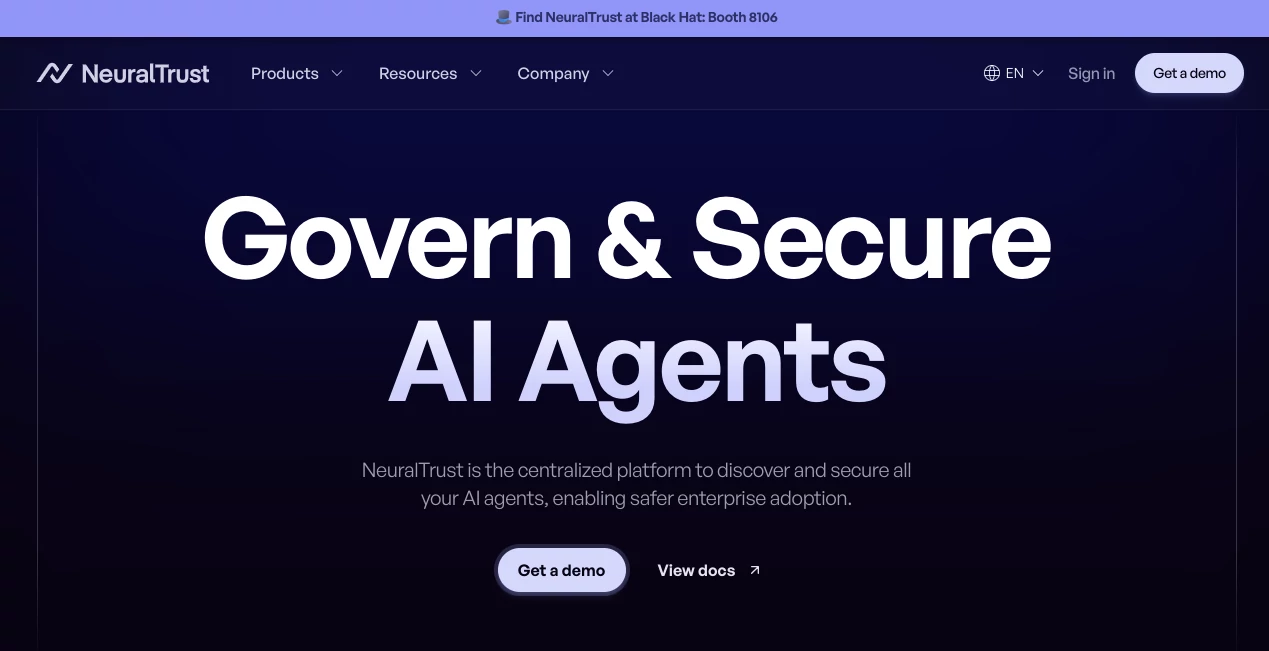
NeuralTrust is an enterprise platform built to help organizations govern, monitor, test, and secure AI agents throughout their lifecycle. As AI moves beyond simple chat interfaces and starts making decisions, calling tools, accessing data, and interacting with business systems, traditional security controls can leave important gaps. This platform addresses that problem by providing a centralized security layer for AI agents, models, applications, and workflows.
The approach is particularly useful for companies that are deploying multiple AI applications rather than experimenting with a single model. Instead of treating each chatbot, agent, API, or AI workflow as an isolated system, organizations can establish common policies and visibility across their AI environment. The platform supports discovery, evaluation, threat detection, runtime enforcement, and security monitoring, giving security and engineering teams a more practical way to manage growing AI adoption.
One of its strongest qualities is the focus on real-world enterprise environments. It supports cloud, hybrid, and on-premises deployment models, making it a better fit for organizations where data residency, regulatory requirements, or internal infrastructure are important considerations.
Key Features
- Centralized visibility across AI agents, models, applications, and connected tools
- Runtime protection for AI and agent interactions
- Prompt injection and jailbreak detection
- Protection against indirect, multimodal, and code injection attacks
- AI red teaming and adversarial testing
- Security policies that can be enforced across multiple AI surfaces
- Monitoring of agent behavior and AI interactions
- Data loss prevention and sensitive information protection
- Tool-use and access controls for autonomous agents
- Integration with enterprise SIEM environments
- Support for SaaS, hybrid, VPC, and on-premises deployments
- Enterprise identity and access management capabilities
User Interface
The platform is designed around centralized visibility rather than forcing teams to manage security controls independently inside every AI application. This makes the interface especially relevant for security teams, AI engineers, and administrators who need to understand what AI systems are deployed, what they can access, and how they behave.
Dashboards, inventories, security policies, monitoring data, and audit information can be managed from a unified environment. For organizations with many AI applications, this centralized approach can make investigations and policy management considerably easier than maintaining a collection of disconnected security solutions.
Accuracy & Performance
Performance is an important consideration for runtime AI security because excessive inspection can become a bottleneck. The platform states that its runtime enforcement can operate with less than 100 ms of latency and supports more than 20,000 requests per second per node. It also reports 99% multilingual detection, using behavioral, contextual, and multi-turn analysis rather than relying exclusively on simple prompt-level heuristics.
The platform also reports substantial real-world activity, including more than 3 million blocked attacks, over 1,000 monitored AI applications, more than 1.7 million scanned models, and over 22 million analyzed AI interactions. These figures provide useful context for the scale at which the technology is intended to operate.
Capabilities
The platform covers several stages of AI security. Organizations can discover AI assets, evaluate their security posture, test models with adversarial techniques, monitor interactions, and enforce policies during runtime.
Its security layer can inspect inputs and outputs while also considering the behavior of agents and the tools they use. This is important because modern AI attacks are not always contained within a single prompt. An attacker may attempt to manipulate an agent through external content, poisoned tool results, files, images, or a sequence of interactions.
The broader platform also includes AI red teaming capabilities for testing models before deployment. Security teams can use attack probes and multi-turn techniques to identify weaknesses before an application reaches production.
Security & Privacy
Security is at the center of the platform rather than being an optional add-on. The architecture separates the control plane from the data plane, allowing organizations to keep enforcement and sensitive AI traffic within their own controlled environment when required.
Deployment options include SaaS, hybrid environments, customer-managed VPCs, and on-premises infrastructure. The security documentation describes capabilities such as SSO, role-based access control, private connectivity, network access controls, encryption, audit logging, and customer-managed encryption keys.
The platform also states that customer content is not used to train its models. For organizations operating under strict regulatory or data-residency requirements, the ability to keep data within a controlled environment can be one of the most significant advantages.
Use Cases
- Enterprise AI Security: Security teams can establish centralized policies for AI applications and agents across an organization.
- AI Agent Protection: Autonomous agents can be monitored and protected against malicious inputs, unsafe actions, and suspicious behavior.
- LLM Application Security: Developers can add security controls around chatbots, RAG systems, APIs, and other AI-powered applications.
- AI Red Teaming: Security professionals can actively test models and applications with adversarial attacks before production deployment.
- Regulated Industries: Organizations with strict security and compliance requirements can use controlled deployment models and centralized auditing.
- Third-Party AI Governance: Companies can gain visibility into AI infrastructure and external AI tools used throughout their environment.
- Data Protection: Security policies can help prevent sensitive information from being exposed through AI interactions.
- Large-Scale AI Operations: Engineering and security teams can monitor large numbers of applications and interactions from a centralized security layer.
Pros and Cons
- Pros: Comprehensive AI and agent security coverage, runtime protection, red teaming capabilities, centralized governance, multilingual detection, enterprise integrations, and flexible deployment options.
- Pros: The architecture is well suited to organizations that need to keep AI security policies consistent across multiple applications and models.
- Pros: Support for cloud, hybrid, VPC, and on-premises environments gives security-conscious organizations more control over where their data and enforcement infrastructure operate.
- Cons: The platform is primarily designed for enterprise use, so smaller teams looking for a lightweight security utility may find its feature set more extensive than necessary.
- Cons: Pricing is quote-based, meaning prospective customers need to contact the provider rather than selecting a simple public self-service plan.
- Cons: Implementing a centralized AI security layer can require more planning than adding a basic guardrail directly inside a single application.
Pricing Plans
Pricing is offered on an enterprise basis rather than through a fixed public pricing table. The cost depends on factors such as the number of protected applications or agents, traffic volume, and the selected deployment model. Organizations can request a tailored quote following a discovery process or proof of value.
This pricing approach makes sense for larger organizations because AI environments can vary considerably in scale and architecture. A company protecting a handful of applications has very different requirements from an enterprise securing thousands of AI interactions across multiple environments.
How to Use It
Getting started is generally centered around connecting the organization's AI environment to the security platform. Teams can begin by identifying their deployed AI applications, agents, models, and connected tools. From there, security policies can be established around the types of interactions and activities that should be permitted, blocked, transformed, or flagged.
For an AI application in development, teams can use adversarial testing to uncover vulnerabilities before release. Once the application moves toward production, runtime controls can inspect interactions and enforce the organization's policies.
A practical rollout could begin with one high-value chatbot or AI agent, followed by additional applications once the policies and monitoring workflow have been validated. This approach allows engineering and security teams to learn how the controls affect real workloads without attempting a large-scale deployment on day one.
Comparison with Similar Tools
Many AI security products concentrate on one specific area, such as prompt filtering, model testing, or application-level guardrails. This platform takes a broader approach by combining discovery, security testing, runtime protection, governance, and monitoring.
That distinction matters for companies operating a growing AI estate. A developer building one application may only need a focused guardrail, while a large organization may need to understand every AI system being used across departments and apply consistent security rules to them.
The platform is therefore best viewed as an infrastructure-level security and governance solution rather than simply another prompt filter. Its ability to work across gateways, APIs, browsers, endpoints, agent platforms, and existing AI infrastructure gives it a wider operational scope than many single-purpose tools.
Conclusion
AI security becomes considerably more complicated when applications can reason, access external information, call tools, and take actions on behalf of users. A simple content filter is rarely enough for that environment. Organizations need visibility into what their AI systems can do, the ability to test them before deployment, and controls that remain active while those systems are running.
NeuralTrust brings these responsibilities into a centralized platform, combining AI discovery, security testing, runtime protection, monitoring, and governance. Its enterprise deployment options and emphasis on data control make it particularly attractive to organizations with demanding security or compliance requirements.
For companies moving from isolated AI experiments toward a larger agent-based environment, it offers a structured way to make security part of the AI lifecycle rather than something added after deployment.
Frequently Asked Questions (FAQ)
What does NeuralTrust do?
It provides security, governance, monitoring, and testing capabilities for AI applications, models, and autonomous agents. The platform is designed to help organizations discover AI assets, identify threats, test systems, and enforce security policies.
Can it protect AI agents at runtime?
Yes. Runtime security capabilities inspect AI and agent interactions and can enforce policies against threats such as prompt injection, malicious inputs, unsafe actions, and sensitive-data exposure.
Does it support on-premises deployment?
Yes. Deployment options include on-premises environments, customer-managed VPCs, hybrid architectures, and SaaS deployments. This provides additional flexibility for organizations with strict data-residency requirements.
Can it be used for AI red teaming?
Yes. The platform includes adversarial testing capabilities designed to evaluate the security, safety, and robustness of AI models and applications before they reach production.
How much does it cost?
Pricing is enterprise-focused and depends on factors such as protected applications or agents, traffic volume, and deployment architecture. Customers can request a tailored quotation through the provider.
Who is it best suited for?
It is particularly well suited to enterprises, security teams, AI engineering teams, and organizations deploying multiple AI applications or autonomous agents that require centralized security and governance.
AI Testing & QA , AI API Design , AI Developer Tools .
These classifications represent its core capabilities and areas of application. For related tools, explore the linked categories above.

NeuralTrust Alternatives Product

Latency Atlas

langextract.…

Firefox
RepoClip

freellm
You.bot

GLM 5
JSON to TOON…

MyToolster W…