


















Norse Computer
What is Norse Computer?
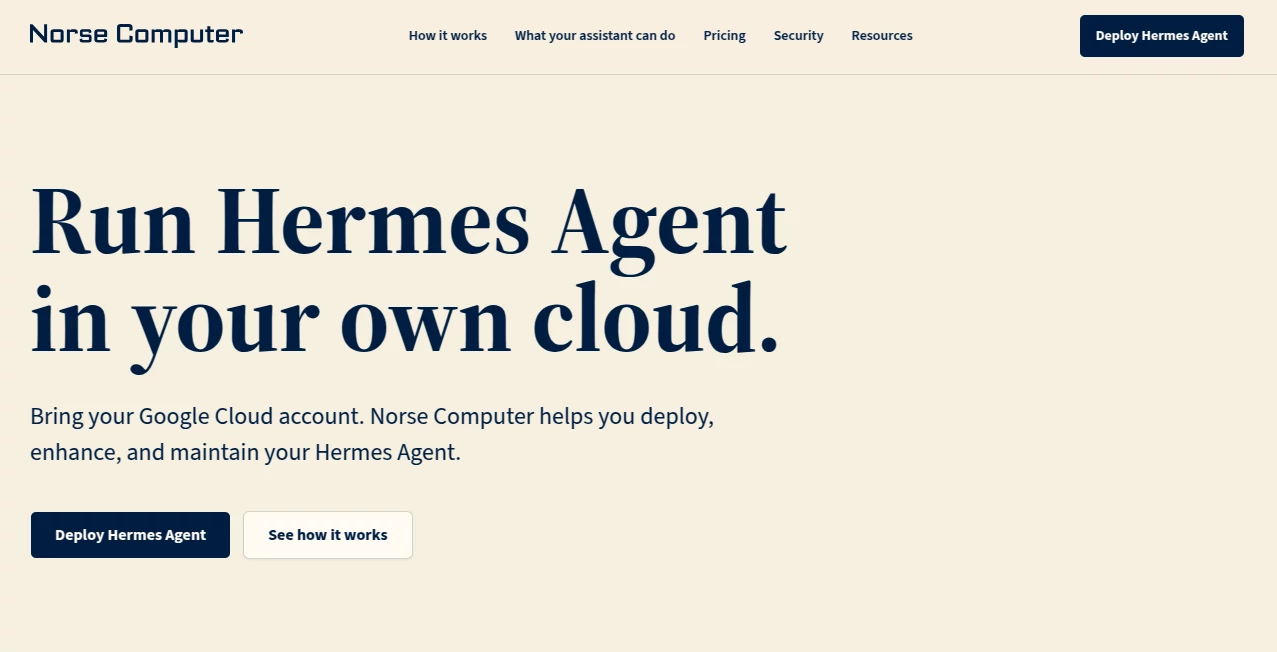
Norse Computer is a managed deployment service for Hermes Agent, designed for people and businesses that want a private AI assistant without taking on the technical work of configuring and maintaining cloud infrastructure. Instead of placing the assistant in a shared environment, it is deployed inside the customer's own Google Cloud account, giving the business control over its environment, connected systems, credentials, and data.
The idea is particularly useful for teams that have plenty of recurring work but do not want another complicated software project to manage. Email research, recurring reports, document lookup, follow-up tracking, operational checklists, and information scattered across different business systems are all areas where a properly configured AI assistant can take some pressure off the team.
What makes the service appealing is the managed approach. The technical setup, permissions, configuration, updates, security patching, backups, and monitoring are handled as part of the service, while the customer retains control of the cloud account and decides which systems the assistant can access.
Key Features
The platform focuses less on being another general-purpose chatbot and more on putting an AI agent to work inside an existing business environment. It builds around Hermes Agent and turns its capabilities into a managed deployment that can be used for practical operational work.
- Private deployment inside the customer's own Google Cloud account
- Hermes Agent installation and configuration
- Email research and reply drafting
- Recurring business report preparation
- Private search across connected business systems
- Document lookup and summarization
- CRM and data cleanup assistance
- Follow-up tracking and reminders
- Operational checklists and task handoffs
- Proactive workflow suggestions
- Automated backups and monitoring
- Ongoing updates and security patching
User Interface
The experience is built around a deployment portal rather than a complicated infrastructure console. After connecting a Google Cloud account, the deployment process guides the user through the setup and handles the configuration required to get the assistant running.
This is a strong choice for business owners who understand what they want an AI assistant to accomplish but would rather not spend an afternoon configuring virtual machines, permissions, services, and updates. The company states that most deployments take less than 30 minutes, making the initial setup considerably less intimidating for non-technical users.
Accuracy & Performance
Performance depends heavily on the underlying Hermes Agent configuration, connected systems, selected models, and the quality of the information available to the assistant. The real advantage here is not simply generating text quickly. It is having the assistant work with relevant business context before producing an answer or draft.
For example, an email requiring a careful response can be reviewed, related information can be found, and a draft can be prepared for human review. Likewise, a recurring report can follow a defined process instead of requiring someone to manually gather the same information every week.
This approach makes the service especially interesting for repetitive work where consistency matters more than flashy demonstrations.
Capabilities
The assistant can be configured for a range of operational workflows. It can research emails, find relevant information across connected systems, prepare reports, locate and summarize documents, track follow-ups, assist with CRM cleanup, and support recurring operational processes.
Hermes Agent itself is an open-source, MIT-licensed AI agent with capabilities that include persistent memory, scheduled automations, messaging integrations, web control, MCP support, subagents, and several execution environments. The managed service adds deployment and maintenance around that foundation, which can remove much of the infrastructure burden for a business user.
A useful example would be a founder who repeatedly receives customer emails that require checking documents or CRM records before responding. Instead of manually searching several systems each time, the assistant can gather the relevant context and prepare a response for review.
Security & Privacy
Privacy is one of the most important parts of the product's positioning. The assistant is deployed in the customer's own Google Cloud account rather than being hosted in a shared environment controlled entirely by the service provider. The customer also decides which tools and data sources the assistant can access.
The service includes secure access configuration, backups, monitoring, security patching, and infrastructure maintenance. The company also emphasizes that cloud hosting and model providers are billed directly to the customer, keeping those accounts in the customer's name rather than adding a markup.
Businesses should still review permissions carefully and only connect the systems and data sources genuinely required for their workflows. A private deployment improves control, but sensible access policies remain important when an AI agent can interact with business information.
Use Cases
The strongest use cases are recurring tasks that consume time without necessarily requiring constant human judgment.
- Email management: Research incoming messages, locate relevant context, and prepare replies for review.
- Business reporting: Gather recurring information and turn it into regular updates.
- Internal search: Find answers across connected documents, business records, databases, and other approved systems.
- Document work: Locate important documents and summarize their contents.
- CRM maintenance: Help identify and clean up outdated or inconsistent information.
- Follow-ups: Keep track of tasks and reminders that might otherwise slip through the cracks.
- Operational workflows: Support repeatable checklists, handoffs, and administrative processes.
For a small team, even removing a few hours of repetitive work every week can make the investment worthwhile. The best results are likely to come from starting with one clearly defined workflow and expanding only after the assistant has proven reliable in that area.
Pros and Cons
Pros
- Runs the assistant in the customer's own Google Cloud account
- Managed setup reduces the need for cloud and infrastructure expertise
- Deployment is designed to take less than 30 minutes in typical cases
- Includes ongoing updates and security patching
- Backups and monitoring are part of the deployment approach
- Useful for recurring operational and administrative work
- Customers retain control over connected data and systems
- Simple subscription structure with no setup fee
Cons
- Google Cloud is required for the deployment environment
- Cloud hosting and model costs are billed separately
- Advanced workflows may still require careful configuration
- The value depends on having useful systems and data for the assistant to work with
- Businesses with no recurring operational workload may have less reason to adopt a managed AI agent
Pricing Plans
The service currently offers one straightforward subscription at $30 per month. The plan includes deployment and unlimited access to the company's AI agents for deploying and maintaining Hermes Agent.
The subscription also covers ongoing Hermes updates, security patches, infrastructure-level improvements, configuration upkeep, backups, and monitoring. There is no setup fee or sales call required according to the company's current pricing information.
One important detail is that the customer's Google Cloud account and model providers are billed directly. Those costs therefore sit outside the $30 monthly subscription.
How to Use
Getting started is designed to be considerably simpler than building a private AI agent environment from scratch.
- 1. Create an account: Sign in and subscribe to the $30 monthly plan.
- 2. Connect Google Cloud: Provide access to the Google Cloud account where the assistant will be deployed.
- 3. Start the deployment: The deployment agent installs and configures Hermes Agent using the recommended architecture.
- 4. Define the workflow: Decide which tasks, systems, tools, and information sources the assistant should work with.
- 5. Launch the assistant: Once configured, the assistant can begin handling delegated operational work.
- 6. Keep it maintained: Updates, security patches, and infrastructure-level improvements are applied as the service continues.
Comparison with Similar Tools
There is an important distinction between a managed private AI deployment and general AI assistants such as ChatGPT or Claude. General assistants are excellent for direct conversations, writing, research, and many everyday tasks, but they are not primarily designed around deploying a persistent business agent inside the customer's own cloud environment.
Open-source automation platforms such as n8n provide considerable flexibility for connecting applications and constructing workflows, but they generally require users to design and maintain more of the workflow infrastructure themselves. Self-hosted agent projects can provide even more control, but they also put more responsibility on the user for deployment, updates, permissions, monitoring, and troubleshooting.
The appeal here is therefore the middle ground: the customer gets a private Hermes Agent deployment while much of the technical maintenance is handled as a managed service. For a technical team that wants to build everything independently, that may be unnecessary. For a founder who simply wants a working private AI assistant, it can be a much more practical route.
Conclusion
Running an AI agent for real business work is very different from opening a chatbot and asking a question. Once an assistant needs access to email, documents, CRM records, cloud resources, scheduled tasks, and other systems, deployment and maintenance become important parts of the equation.
Norse Computer addresses that problem with a focused proposition: deploy Hermes Agent in your own Google Cloud account while taking care of much of the technical work around it. The combination of private deployment, managed maintenance, backups, monitoring, and a simple $30 monthly subscription makes it an interesting option for founders and teams that want agentic automation without becoming cloud infrastructure specialists.
Its strongest appeal is likely to be businesses with repetitive operational work and several places where useful information already exists. If the goal is to turn that scattered information into an assistant that can research, organize, draft, report, and help with follow-through, this approach deserves a closer look.
Frequently Asked Questions (FAQ)
What is this service used for?
It is designed to deploy and maintain a private Hermes Agent AI assistant inside a customer's own Google Cloud account. The assistant can help with recurring business tasks such as email research, reports, document lookup, follow-ups, and operational workflows.
Does it require Google Cloud?
Yes. The current deployment model uses the customer's own Google Cloud account as the environment where Hermes Agent is installed and configured.
How much does the service cost?
The current subscription is $30 per month with deployment included and no setup fee. Google Cloud hosting and model provider costs are billed separately to the customer's accounts.
Do I need cloud or API expertise?
No. The service is specifically designed to handle the technical deployment and configuration, so users do not need to manage the underlying cloud infrastructure themselves.
How long does deployment take?
The company states that most deployments take less than 30 minutes from sign-up to a running assistant, although the exact time can depend on the environment and configuration.
Is the AI assistant private?
The assistant is deployed inside the customer's own Google Cloud account, and the customer controls which connected systems and data sources it can access. This provides a private deployment boundary while still requiring sensible permission management.
What happens after deployment?
The service continues to handle Hermes updates, security patching, infrastructure-level improvements, configuration upkeep, backups, and monitoring while the subscription remains active.
AI Workflow Management , AI Productivity Tools , AI Business Ideas Generator , AI Developer Tools .
These classifications represent its core capabilities and areas of application. For related tools, explore the linked categories above.

Norse Computer Alternatives Product
KoloQR

FLINT AI
JSON to TOON…

Oasis

ChatFlowchart

ForthWrite

Somnio

Chatzy AI

SalaryHow
