


















OneDollarClarity
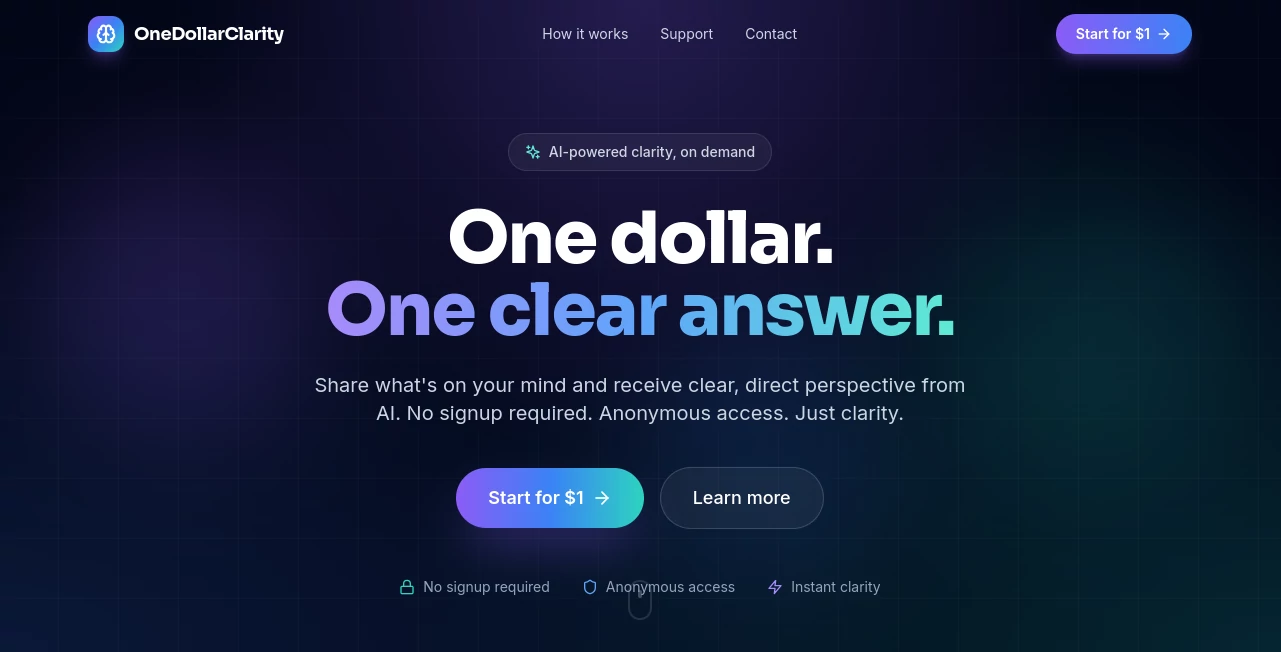
What is OneDollarClarity?
Clear thinking is often more valuable than having more information. When a decision feels complicated, the hardest part is frequently identifying the question that actually needs an answer. OneDollarClarity takes a refreshingly simple approach to this problem: make focused thinking accessible at a very low cost and put clarity at the center of the experience.
The idea behind the service is straightforward. Instead of turning every problem into a long and complicated process, it encourages users to focus on one mind, one question, and one clear answer. That simplicity makes it interesting for entrepreneurs, professionals, students, creators, and anyone who wants help thinking through a particular situation without unnecessary complexity.
Its positioning is especially appealing to people who value practical answers over endless information. If you have a decision to make, a problem to understand, or an idea that needs sharper thinking, a focused AI experience can provide a useful starting point.
Key Features
- Focused approach to problem solving and decision making
- Simple concept built around obtaining a clear answer
- Low-cost access designed to reduce the barrier to trying the service
- Useful for questions that benefit from structured thinking
- A straightforward alternative to unnecessarily complicated AI workflows
- Suitable for personal, professional, and entrepreneurial questions
User Interface
The service presents a deliberately simple concept rather than overwhelming users with a large collection of complicated features. This is one of its strongest qualities. When the goal is clarity, a clean and focused experience can be more useful than an interface filled with controls that most people rarely touch.
For someone arriving with a specific question, the appeal is easy to understand: spend less time figuring out how the tool works and more time thinking about the problem itself.
Accuracy & Performance
For any AI-based answer service, the quality of the result depends heavily on the quality and clarity of the question. Specific questions with relevant context generally give an AI system more useful information to work with than vague prompts.
This makes the focused nature of the service particularly practical. Users can approach it with a defined problem rather than attempting to solve an entire project at once. The resulting answer should still be treated as decision support rather than an unquestionable source of truth, especially when the subject involves financial, legal, medical, or other high-stakes decisions.
Capabilities
The concept is well suited to situations where a person wants another perspective before taking action. Entrepreneurs can use a focused question to examine a business decision. A freelancer might use it to think through a difficult client situation. A student could use it to organize a confusing question before researching further.
It can also be useful as a second opinion. Sometimes the biggest benefit of asking an AI system a question is not receiving a perfect answer, but seeing the problem from an angle that was previously overlooked.
Security & Privacy
Users should always review the service's current privacy information before entering confidential, personal, financial, business-sensitive, or otherwise private material into an AI service. Avoid submitting passwords, private credentials, confidential customer information, or sensitive documents unless the provider clearly explains how that information is handled.
For ordinary brainstorming and general questions, users can also minimize unnecessary exposure by providing only the context required to receive a useful answer.
Use Cases
- Business decisions: Explore a business question and identify important factors before making a decision.
- Entrepreneurship: Pressure-test an idea, strategy, or next step from a different perspective.
- Personal decisions: Organize competing considerations when a situation feels difficult to evaluate.
- Problem solving: Break a broad problem into a more manageable question.
- Planning: Think through possible approaches before committing time or resources.
- Research preparation: Turn an unclear question into a sharper starting point for deeper research.
- Creative thinking: Get another perspective when developing an idea or overcoming a creative block.
Pros and Cons
Pros
- Very simple value proposition
- Focuses attention on clarity rather than feature overload
- Low price makes experimentation accessible
- Can be useful across personal and professional scenarios
- Works well as a quick second perspective
Cons
- A short answer cannot replace detailed research when a problem is complex
- AI responses still need human judgment and verification
- Users looking for advanced workflow automation may need a more specialized platform
- The usefulness of the result depends heavily on how clearly the question is presented
Pricing Plans
The service is positioned around a one-dollar price point, which is central to its value proposition. The low entry cost makes it possible for users to experiment with the concept without committing to a conventional high-priced AI subscription.
Because pricing and access options can change, users should check the current offering before purchasing. The most attractive aspect of the pricing strategy is its simplicity: it lowers the barrier for someone who wants to test whether a focused AI answer can help with a particular question.
How to Use OneDollarClarity
Start with one problem rather than an entire list of unrelated problems. Write the question as clearly as possible and include the context that genuinely matters. For example, instead of asking for general business advice, describe the decision you are facing, the available options, the main constraint, and what outcome you want.
Once you receive an answer, do not stop at the first response if the decision matters. Look for assumptions, missing information, alternative explanations, and evidence that could change the conclusion. The strongest use of an AI answer is often as a thinking partner rather than as the final decision-maker.
Comparison with Similar Tools
General-purpose AI assistants are designed to handle a huge range of tasks, from writing and coding to research and analysis. Specialized decision-support products take a different approach by narrowing the experience around a particular type of problem.
The main distinction here is simplicity. Instead of asking users to learn a broad AI platform and construct elaborate workflows, the service is built around a much smaller proposition: ask a question and seek clarity. That makes it potentially attractive to people who do not need a large AI toolkit and simply want an inexpensive way to think through one specific issue.
Of course, users who require advanced research, document analysis, integrations, coding, automation, or long-running workflows may be better served by larger AI platforms. The right choice ultimately depends on the complexity of the task.
Conclusion
There is something compelling about reducing an AI product to a simple promise: help someone get clearer about a question. Not every problem requires a complicated dashboard, dozens of settings, or a large collection of features. Sometimes the most useful tool is the one that encourages you to define the problem and focus on the answer.
With its inexpensive approach and clarity-first positioning, this service is worth considering for users who want a quick AI-assisted perspective without taking on another substantial software commitment. It is best viewed as a practical thinking aid—something that can help sharpen a question, explore possibilities, and provide another perspective before the user makes the final call.
Frequently Asked Questions (FAQ)
What is OneDollarClarity?
It is an AI-focused service built around the idea of helping users obtain a clear answer to a specific question at a low cost.
How much does it cost?
The service is positioned around a one-dollar price point. Users should check the current offering for the latest pricing and access details.
Who can benefit from this service?
Entrepreneurs, professionals, students, creators, and everyday users can potentially benefit when they need another perspective on a specific question or decision.
Can it make decisions for me?
It should be treated as a decision-support resource rather than a replacement for human judgment. Important decisions should be checked against reliable evidence and, when appropriate, qualified professional advice.
What is the best way to get a useful answer?
Ask one focused question and provide enough context to explain the situation, constraints, available options, and desired outcome. A precise question usually creates a much stronger foundation for useful AI assistance.
AI Life Assistant , AI Productivity Tools , AI Business Ideas Generator .
These classifications represent its core capabilities and areas of application. For related tools, explore the linked categories above.
OneDollarClarity details
Website unavailable — View Alternatives
Pricing
- Free
Apps
- Web App
Categories

OneDollarClarity Alternatives Product

Sendmux

Naxely

MEANINGS

Parking Prac…

Ask Bishop

Distro

AlphaTax

Syncity AI

Notion
