


















Orchestra
What is Orchestra?
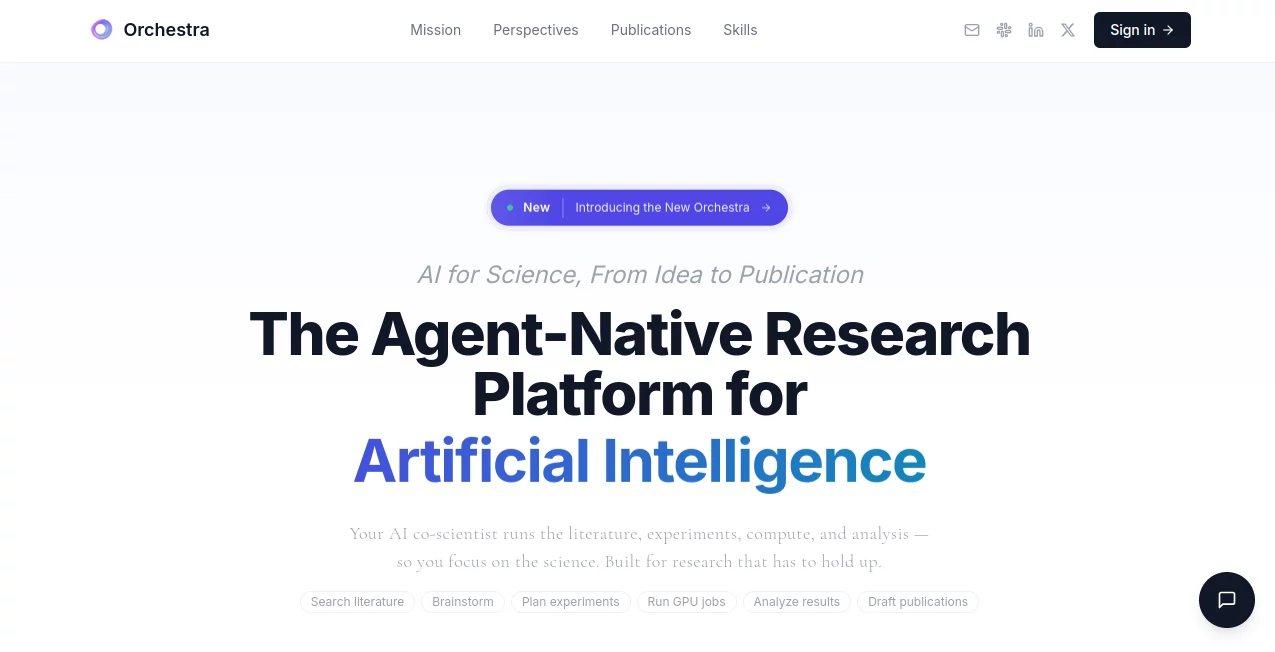
Orchestra is an AI-native research platform built for people who want to spend less time dealing with the repetitive parts of research and more time thinking about the science itself. It brings literature discovery, idea development, experiment planning, code execution, analysis, and scientific writing into a connected workflow.
Instead of jumping between a paper database, coding environment, cloud GPU service, notes app, and document editor, researchers can keep much of the research process in one place. The platform is designed around the way real research develops: a question leads to reading, reading leads to an idea, an idea becomes an experiment, and the results often lead to another question.
This makes it particularly interesting for machine learning, artificial intelligence, data science, natural language processing, computer vision, bioinformatics, and other research-heavy fields where experiments can involve large amounts of literature, code, compute, and analysis.
Key Features
- AI-assisted literature search and synthesis for exploring existing research.
- Research brainstorming and hypothesis development.
- Experiment planning using natural-language instructions.
- AI agents that can work with code, execution, and research tasks.
- GPU-based computing for research experiments.
- Experiment tracking covering code, data, and results.
- Analysis and interpretation of experimental outputs.
- Support for drafting research papers and publication-ready material.
- Cross-domain research workflows for connecting ideas from different fields.
- An open-source collection of AI research engineering skills designed to extend research agents.
User Interface
The interface is built around the research process rather than a collection of disconnected utilities. Researchers can describe what they want to investigate and move through stages such as literature review, brainstorming, experimentation, reflection, and writing.
That approach can feel refreshing for researchers who are tired of setting up a new environment every time an experiment changes direction. The platform aims to keep the important context together, making it easier to return to an earlier idea, inspect an experiment, or continue working from previous findings.
For someone starting a machine learning project, for example, the experience can be closer to explaining the research question to a technical collaborator than configuring several unrelated services from scratch.
Accuracy & Performance
Research software needs more than a convincing answer on the screen. Results need to be traceable, experiments need to be repeatable, and assumptions need to be checked. The platform addresses this by keeping experiment information, code, data, and results connected within the research workflow.
Its ability to work with GPU resources is also important for modern AI research, where even a simple experimental idea can quickly become computationally expensive. The available infrastructure includes different GPU levels depending on the subscription, giving researchers a way to scale their experiments as their requirements grow.
As with any AI-assisted research system, generated analysis, code, and scientific conclusions should still be reviewed by the researcher. The platform itself states that AI outputs can contain errors and should be independently validated.
Capabilities
The strongest part of the platform is the breadth of the workflow it tries to cover. A research project can begin with a literature question, move into brainstorming and experiment design, continue through code execution and analysis, and eventually produce material suitable for a paper.
Its AI Research Skills library adds another layer to this approach. The collection provides production-ready knowledge packages covering areas of the AI research lifecycle, including literature surveys, ideation, model training, evaluation, interpretability, and paper writing. These skills are designed to give AI agents more specialized knowledge instead of relying only on general-purpose coding ability.
The platform also showcases research projects covering topics such as reinforcement learning fine-tuning, LLM interpretability, AI cognition, and computational biology. This gives prospective users a useful picture of the type of work the system is intended to support.
Security & Privacy
Research data can be highly sensitive, particularly when it involves unpublished experiments, proprietary datasets, or papers that are still being prepared. The service states that users retain ownership of the content they create, upload, or generate.
Its terms explain that uploaded research material may be processed as necessary to operate the service, including by AI model providers when required to generate responses. The company also states that research content is not used to train AI models or for marketing purposes without explicit consent.
Users should still review the current privacy policy and terms before uploading confidential or commercially sensitive research material, especially when working with external collaborators or unpublished datasets.
Use Cases
Academic research: Researchers can use the platform to explore literature, develop hypotheses, design experiments, analyze findings, and prepare research papers.
Machine learning experiments: ML researchers can use AI agents, coding workflows, experiment tracking, and GPU infrastructure to move from an idea to a working experiment without spending as much time on infrastructure setup.
Literature reviews: When a topic has hundreds or thousands of relevant papers, AI-assisted synthesis can help researchers understand the landscape and identify areas worth investigating further.
AI model research: Researchers working on LLMs, reinforcement learning, computer vision, or model interpretability can use specialized research workflows to investigate technical questions and compare experimental results.
Cross-disciplinary research: The platform is also suited to projects where useful ideas may come from neighboring disciplines. Connecting research from areas such as AI, biology, data science, and computer vision can open directions that are easy to miss when information remains siloed.
Students and independent researchers: The combination of guided research workflows and reusable skills can be useful for people who have strong research questions but do not have access to a large research engineering team.
Pros and Cons
- Pros: Covers a broad research workflow from literature discovery to publication.
- Pros: AI agents can assist with coding, experimentation, analysis, and research tasks.
- Pros: Built-in access to research-oriented compute and GPU resources.
- Pros: Experiment tracking helps preserve the history behind research work.
- Pros: The open-source AI Research Skills library adds specialized research knowledge.
- Pros: Suitable for technical fields such as machine learning, NLP, computer vision, and data science.
- Cons: AI-generated research outputs still require human verification.
- Cons: Heavy experimentation can consume credits quickly, particularly for compute-intensive projects.
- Cons: Researchers who prefer complete manual control over their development environment may need time to adapt to an agent-driven workflow.
Pricing Plans
The platform offers a free plan as well as paid subscriptions, making it possible to test the workflow before committing to a larger research budget.
- Free: $0 per month with 2,000 credits, up to 5 research projects, up to 5 AI agents, basic GPU access, core experiment tracking, and community support.
- Pro: $29 per month with 6,000 credits, unlimited research projects and AI agents, advanced GPU access including A100 and H100 resources, full experiment tracking and analytics, and priority email support.
- Max: $79 per month with 24,000 credits, Pro features, priority access during high-traffic periods, dedicated support, and early access to beta features.
- Ultra: $299 per month with 120,000 credits, Max features, priority GPU queue access including H100 and B200 resources, dedicated Slack or Discord support, and early access to experimental features.
There are also one-time credit packs for researchers who do not want another recurring subscription. The available packs include Boost at $8 for 1,500 credits, Research at $22 for 4,200 credits, and Sprint at $49 for 9,500 credits. The site states that purchased credits do not expire.
How to Use the Platform
Getting started is straightforward. Create an account and begin with a research question or topic that you want to investigate. From there, the AI-assisted workflow can help explore relevant literature and organize the early stages of the project.
Once you have a direction, describe the experiment you want to run. The research agents can assist with the engineering side, including code execution, environment setup, and computational work. You can then inspect the results, compare findings, refine the hypothesis, and continue the research loop.
The platform is particularly useful when the project changes direction during the process. Instead of treating failed experiments as disposable work, the workflow is designed to keep research history and dead ends visible so that previous attempts can inform the next decision.
Comparison with Similar Tools
Traditional academic search tools are excellent for finding papers, while notebook environments and cloud computing platforms provide powerful places to run code. However, they generally focus on individual stages of research.
This platform takes a broader approach by connecting literature discovery, research ideation, experimentation, computing, analysis, and writing. That makes it less of a single-purpose paper search engine or coding assistant and more of a research workspace built around AI agents.
The distinction becomes especially noticeable in complex machine learning projects. A researcher can move from reading prior work to planning an experiment and then to running and interpreting that experiment without rebuilding the workflow in several different applications.
Conclusion
For researchers who spend their days moving between papers, code, experiments, GPUs, datasets, and drafts, an AI-native research environment can remove a surprising amount of friction. The real appeal here is not simply that AI can write code or summarize papers. It is the attempt to connect those abilities into one continuous research process.
The combination of AI agents, experiment tracking, computational resources, literature workflows, research skills, and publication support makes the platform a compelling option for modern AI and scientific research. It does not remove the need for human judgment, and it should not. The researcher remains responsible for deciding which questions matter, whether an experiment is sound, and whether a conclusion is actually supported by the evidence.
For anyone exploring AI research, building experiments, or looking for a more integrated way to move from an initial idea toward a publishable result, this is a platform worth exploring.
Frequently Asked Questions (FAQ)
What is this platform designed for?
It is designed to support AI and scientific research workflows, including literature review, brainstorming, experiment planning, code execution, analysis, and scientific writing.
Can it run AI experiments?
Yes. The platform provides access to cloud compute and GPUs, with available hardware depending on the selected plan.
Does it support research papers?
Yes. The workflow includes research writing and document generation, allowing researchers to move from experimental findings toward publication-oriented material.
Is there a free plan?
Yes. The free plan costs $0 per month and includes 2,000 credits, up to five research projects, up to five AI agents, basic GPU access, and core experiment tracking.
What are AI Research Skills?
They are reusable knowledge packages designed to give AI research agents specialized capabilities across different stages of the research lifecycle. The collection covers areas such as literature research, ideation, training, evaluation, interpretability, and paper writing.
Can researchers keep ownership of their work?
According to the service terms, users retain ownership of the research projects, experiments, data, papers, and other content they create, upload, or generate through the service.
Should AI-generated research results be trusted without checking?
No. Scientific results, generated code, analysis, and conclusions should be reviewed and independently validated. AI can make mistakes, and research decisions should remain under human supervision.
Who can benefit most from using it?
Machine learning researchers, AI engineers, academic researchers, students, independent researchers, and teams working on computational science can all benefit from a workflow that brings research discovery, experimentation, computing, and analysis closer together.
AI Knowledge Management , AI Research Tool , Large Language Models (LLMs) , AI Developer Tools .
These classifications represent its core capabilities and areas of application. For related tools, explore the linked categories above.

Orchestra Alternatives Product

Mythx AI
Vurge

AI Workflow …

SciSpace

Mage

GPTZero

Omphalis

DevUtilX
ZoraInsights
