
Pallix
What is Pallix?
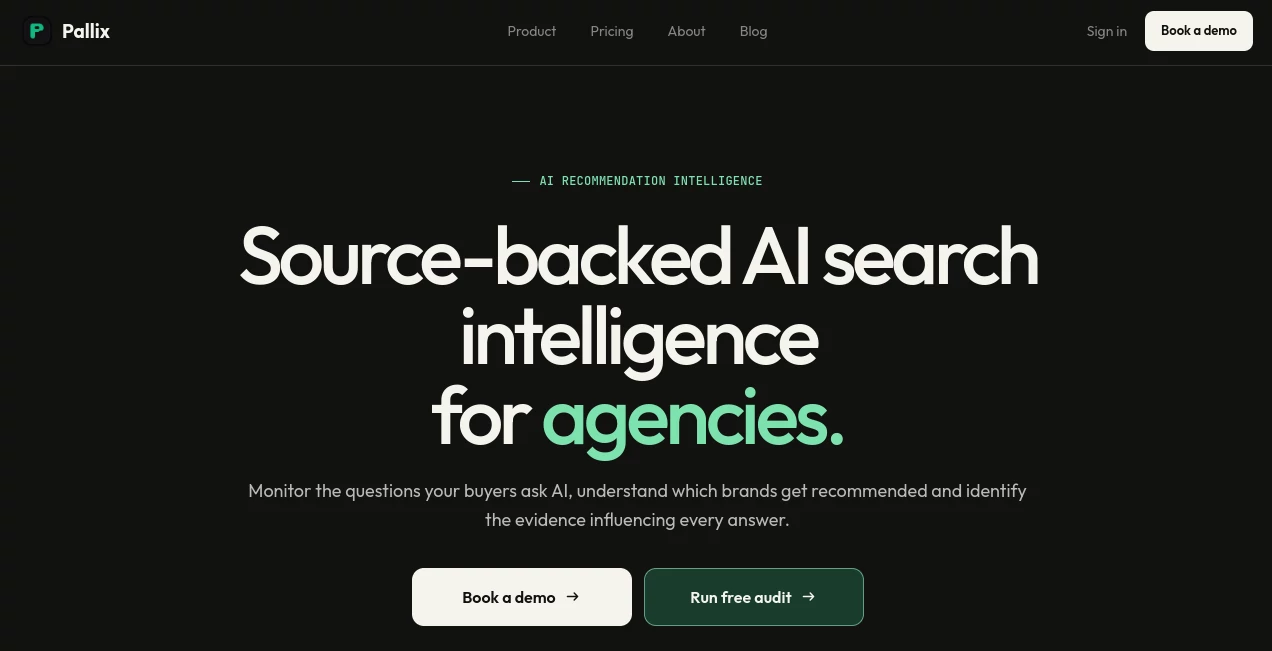
Pallix is an AI visibility and citation intelligence platform built for brands, marketing teams, agencies, founders, and freelancers who want to understand what happens when potential customers ask AI about their category. Instead of looking only at traditional search rankings, it focuses on a newer question: does AI mention your brand, recommend it, and use your content or other sources when forming an answer?
The platform monitors buyer-focused prompts across leading AI answer engines and turns those responses into practical marketing intelligence. It can show which brands are being recommended, where a brand appears in an answer, which competitors are gaining visibility, and which websites or communities are influencing the recommendation.
This approach is particularly useful as customers increasingly use conversational tools to compare products, discover companies, and narrow down their choices. A business may have a strong website and a solid SEO strategy yet still be missing from the conversations that happen inside AI search.
One of the more useful aspects is the focus on evidence. Rather than presenting a single visibility score and leaving the user to guess what caused it, the platform connects recommendations with the sources behind them. That makes the information much easier to turn into an actual content, PR, technical SEO, or reputation-building task.
Key Features
- AI visibility monitoring across major AI answer engines
- Buyer-intent prompt tracking
- Brand mention and recommendation monitoring
- AI citation intelligence
- Identification of third-party sources influencing AI answers
- Competitor visibility benchmarking
- Market and category intelligence
- Source gap identification
- Sentiment analysis
- AI traffic and crawler activity monitoring
- Historical visibility snapshots and trend tracking
- Prioritized recommendations for improving AI visibility
- Reddit opportunity and evidence tracking on eligible plans
- Editorial coverage and publisher opportunity analysis on eligible plans
- CSV and PDF reporting
User Interface
The workspace is designed around the information a marketing team needs to act on rather than simply collect. The dashboard brings together visibility, sentiment, competitors, market intelligence, citation performance, AI sourcing, source gaps, and recommended fixes.
A practical example is the suggested-fixes area, where problems can be ranked according to their potential impact. Instead of spending an afternoon searching through dozens of AI responses manually, a team can start with issues such as a missing source, an inaccurate product fact, or a technical problem affecting AI crawlers.
The interface also makes historical changes easier to understand. Visibility can be viewed over different periods, helping users see whether a content update, technical fix, or external mention actually changed the way AI answers represent the brand.
Accuracy & Performance
The strength of the platform is its connection between an AI answer and the evidence behind that answer. It does not stop at asking whether a company was mentioned. It can map the domains, URLs, communities, marketplaces, and other sources that influence recommendations.
This distinction matters because an AI answer can be influenced by information far beyond a company's own website. A review page, Reddit discussion, YouTube video, marketplace listing, or editorial article may contribute to how a product is described.
The platform also takes geography, language, category, and buyer intent into account. This is important because an AI answer seen by a customer in one country may not be identical to an answer generated for another market.
Rather than treating the displayed score as an absolute measure of business performance, it is more useful to view it as an ongoing visibility indicator. The real value comes from watching how the score, mentions, competitors, and source patterns change over time.
Capabilities
The core workflow follows a straightforward path: track AI visibility, understand AI sourcing, examine the surrounding market, identify problems, and measure what changes after those problems are addressed.
Users can monitor the prompts their customers are likely to ask, compare their recommendation position against competitors, and examine the sources appearing behind AI-generated recommendations. The system can then turn these observations into prioritized actions related to content, authority, technical accessibility, and external coverage.
For teams working in specific regions, market-aware monitoring is another useful capability. Country selection, local language, market-native sources, and category-specific prompts can provide a more realistic picture of what customers in a particular market are likely to encounter.
The platform also goes beyond traditional website analysis. Its market intelligence can incorporate signals from social platforms, marketplaces, editorial sources, and online communities, helping marketers understand the broader reputation ecosystem surrounding a brand.
Security & Privacy
For businesses evaluating an analytics platform, privacy and data handling should always be reviewed before connecting operational information. The public product pages focus primarily on AI visibility monitoring, source intelligence, reporting, and market analysis, while detailed security and data-retention specifications are not prominently presented in the available product information.
Teams considering a paid deployment should therefore review the provider's privacy and terms documentation and ask the sales team about data retention, account security, access controls, and handling of any sensitive business information before using the platform for confidential workflows.
Use Cases
AI visibility monitoring: Marketing teams can track whether their company appears when potential customers ask AI for recommendations within a particular category.
Competitor research: Businesses can see which competitors are gaining recommendation share and identify the prompts where competing brands consistently appear first.
Content strategy: Source and citation data can reveal topics, publishers, pages, and discussions that deserve attention when a brand is underrepresented.
Technical SEO: Teams can identify technical issues that may prevent AI crawlers from accessing important pages and prioritize fixes based on their potential impact.
PR and digital authority: Growth teams can discover publications and external sources that are already influencing AI answers and use that information to guide future outreach.
Reputation management: Sentiment, citations, community discussions, and marketplace signals can help businesses understand how they are being described beyond their own website.
Agency reporting: Agencies managing multiple brands can use broader monitoring and reporting capabilities to organize AI visibility work across different clients and markets.
Pros and Cons
Pros
- Focuses specifically on the growing AI search and recommendation landscape
- Connects AI recommendations with the sources influencing them
- Provides competitor and visibility monitoring rather than one-time analysis alone
- Supports market-specific tracking by country, language, and category
- Turns visibility problems into prioritized actions
- Useful combination of SEO, PR, reputation, and AI-search intelligence
- Offers a 14-day trial without requiring a payment card
- Unlimited seats are included in paid plans
Cons
- The platform is more valuable for teams actively working on AI visibility than for casual users
- Some of the deeper market, editorial, and Reddit intelligence is limited to higher plans
- Pricing is positioned toward professional and business users rather than hobby projects
- Users looking only for traditional keyword rank tracking may find the broader workflow unnecessary
- Detailed security and data-handling information should be confirmed directly before enterprise deployment
Pricing Plans
A 14-day free trial is available with no credit card required. The trial includes 20 active prompts, daily refreshes, and access across five AI surfaces. There is also a free one-time audit for users who want an initial visibility diagnosis without creating a full workspace.
Starter: ₹2,249 per month when billed annually, or ₹2,499 per month with monthly billing. This tier includes 30 tracked prompts, bi-weekly refreshes, three competitors per AI surface, citation intelligence, AI sourcing, historical snapshots, sentiment analysis, source-gap capabilities, exports, and unlimited seats.
Growth: ₹5,399 per month when billed annually, or ₹5,999 per month with monthly billing. It increases tracking to 50 prompts with daily refreshes and five competitors per surface. It also adds market intelligence, editorial intelligence, Reddit opportunity tracking, alerts, citation analysis, and hallucination flags.
Agency / Enterprise: Custom pricing is available for teams operating across multiple brands. The plan supports 200+ prompts, daily monitoring with additional weekly sweeps, 10+ competitors or multi-brand tracking, white-label exports, shared client reports, custom onboarding, dedicated support, and expanded market intelligence.
Pricing and included AI surfaces can change as the service develops, so businesses should confirm the current commercial terms before purchasing.
How to Use the Platform
Getting started is relatively straightforward. First, enter your website so the system can identify the brand and prepare the workspace. Next, confirm the market, geography, and category you want to monitor.
After setup, choose buyer-focused prompts that reflect the questions your customers actually ask. These might include requests for the best product in a category, comparisons between competing brands, or questions about a specific product type.
The platform then monitors the selected AI surfaces and records how brands are represented. Review your visibility score, mentions, recommendation positions, competitor presence, and the sources being cited.
From there, focus on the gaps with the strongest potential impact. A missing editorial mention, an inaccessible page, inaccurate information appearing elsewhere, or a competitor dominating a frequently asked question can each lead to a different action.
Finally, continue monitoring after making changes. AI visibility is not static, so the important question is not simply whether a brand improved once, but whether that improvement remains visible as AI answers and external sources change.
Comparison with Similar Tools
Traditional SEO platforms are primarily built around search rankings, keywords, backlinks, technical audits, and website traffic. AI visibility platforms address a different layer of discovery: what happens when a customer asks an AI system to recommend or compare brands.
The distinction becomes especially important for conversational searches. A traditional rank tracker might tell a marketer that a page ranks well for a keyword. An AI visibility workflow can instead show whether the brand is actually recommended in an AI response, which competitors appear alongside it, and which external sources are helping shape the answer.
There is also a strong source-intelligence component. Rather than treating the AI response as a black box, the platform attempts to expose the evidence behind recommendations. For companies investing in content marketing, PR, reputation, and technical SEO at the same time, this creates a more connected picture than a conventional ranking report.
It is not necessarily a replacement for a full SEO platform. In many marketing stacks, it makes more sense as a complementary layer that focuses specifically on AI-driven discovery and recommendation behavior.
Conclusion
AI is becoming another place where customers discover products, compare companies, and decide which brands deserve attention. That creates a new visibility problem for businesses: being present on the web is not always enough if AI systems are learning the category from competitors, communities, marketplaces, and publishers instead.
This platform takes a practical approach to that problem by connecting AI answers with the sources behind them. The combination of prompt monitoring, competitor intelligence, citation analysis, market signals, and prioritized recommendations gives marketing teams something more useful than a simple visibility number.
For businesses serious about understanding how they appear inside AI search and recommendation experiences, it offers a focused way to measure the problem, find the evidence behind it, and decide what to improve next.
Frequently Asked Questions (FAQ)
What is AI visibility?
AI visibility refers to how often and how favorably a brand appears when customers ask AI systems for recommendations, comparisons, or information within a particular category.
Which AI platforms can be monitored?
The available plans support major AI answer engines including ChatGPT, Gemini, Google AI Overviews, Perplexity, and Copilot. The exact number of supported surfaces depends on the selected plan.
Is there a free trial?
Yes. A 14-day trial is available without a credit card. It includes 20 tracked prompts with daily refreshes across five AI surfaces. A separate free audit is also available for a one-time visibility diagnosis.
Can it track competitors?
Yes. Competitor monitoring is included in the paid plans, with the number of competitors depending on the selected tier.
Can it monitor different countries?
Yes. The system is designed for market-specific monitoring and can use the selected country's language, buyer phrasing, source ecosystem, and category context.
Who can benefit from this platform?
It is particularly useful for brands, marketing teams, SEO professionals, agencies, founders, and enterprise teams that want to understand and improve their visibility in AI-generated recommendations.
Does it only analyze a company's website?
No. The platform also examines external sources such as publishers, communities, marketplaces, Reddit, YouTube, and other sources that can influence AI recommendations.
Can the reports be exported?
Yes. CSV and PDF exports are included in the paid plans, making the data easier to share internally or use in client reporting.
Does it replace traditional SEO tools?
Not necessarily. Traditional SEO tools remain useful for keywords, rankings, backlinks, and technical website analysis. This platform is better viewed as an additional layer focused on AI-driven discovery and recommendation behavior.
AI SEO Assistant , AI Analytics Assistant .
These classifications represent its core capabilities and areas of application. For related tools, explore the linked categories above.

Pallix Alternatives Product

OGimage

Reachara

Surmado

UPDF AI

Roipad

SupaTraffic

Jasper

Diploria AI

BlogBuster