


















Payzum
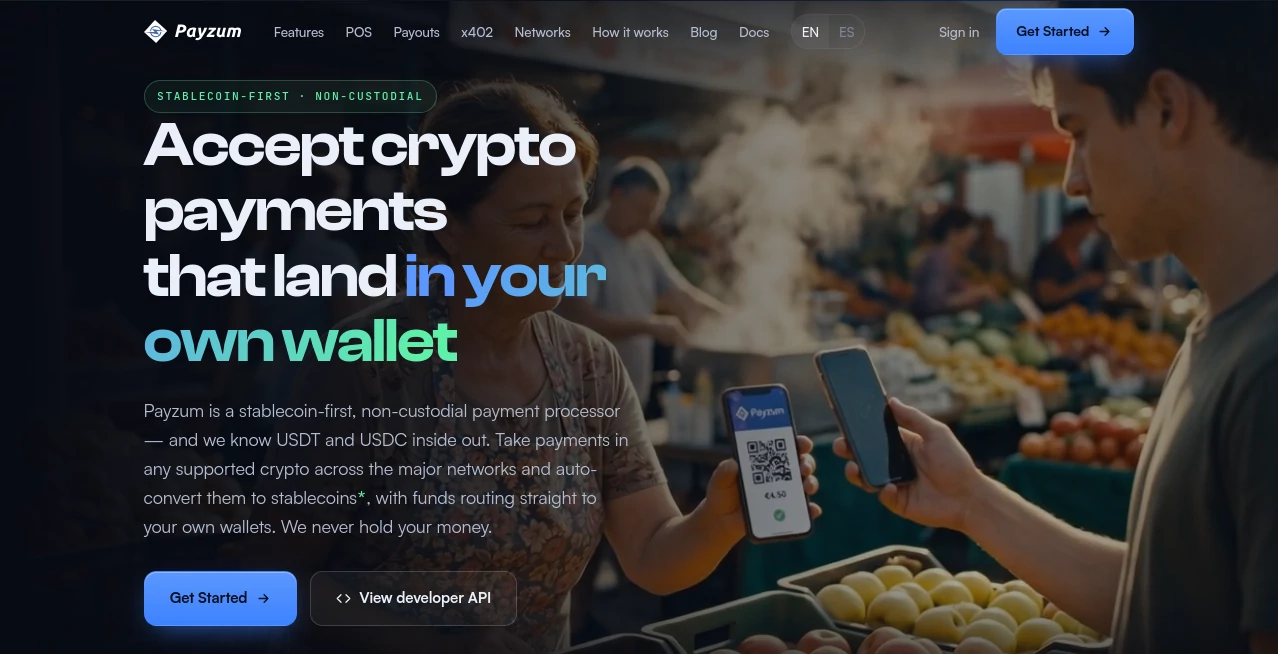
What is Payzum?
For businesses that want to accept cryptocurrency without handing control of their funds to a third party, Payzum offers a practical payment infrastructure built around direct wallet settlement. It is designed for merchants, developers, online businesses, creators, and teams building services that need reliable on-chain payments without adding unnecessary complexity to the checkout process.
The platform takes a non-custodial approach, meaning incoming funds are routed directly to wallet addresses controlled by the merchant. Instead of keeping customer payments in a platform balance, the service connects payment collection with the wallet infrastructure a business already uses.
It supports payments across Bitcoin, Ethereum, Solana, and several major EVM networks, along with a wide selection of tokens. Businesses can create payment links, embed checkout buttons, issue invoices, accept donations, collect recurring payments, or connect payments to their own applications through APIs and webhooks.
One particularly interesting feature is its support for machine-to-machine payments. Developers can use the x402 protocol to let AI agents pay for API calls with USDC, creating a straightforward way to monetize APIs, data services, and other digital resources on a per-request basis.
Key Features
- Non-custodial cryptocurrency payment processing
- Direct settlement to merchant-owned wallet addresses
- Multi-chain payment support
- Payment links and embeddable payment buttons
- Hosted checkout with redirect, modal, and inline options
- Invoices with payment expiry and live payment progress
- Overpayment detection
- Recurring crypto payment links for subscriptions
- Donation and tip-jar payment options
- Point-of-sale functionality for physical businesses
- Cashier and terminal management
- Mass cryptocurrency payouts
- CSV-based payout management
- Stablecoin payouts across multiple EVM networks
- Optional automatic conversion to USDC or USDT
- REST API and signed webhooks
- Integration playground for testing payment workflows
- x402 support for AI agent payments
- Multi-merchant management from one account
User Interface
The interface is built around the practical needs of merchants rather than trying to turn cryptocurrency payments into a complicated technical exercise. Payment links and checkout options can be created without extensive development work, while developers have access to API tools, webhooks, and integration resources when they need more control.
The POS section is particularly useful for businesses operating multiple locations or terminals. Owners can manage terminals, assign cashiers with individual PINs, and review sales based on cashier, terminal, and payment type. For a small shop or market stall, having these details available from one dashboard can make crypto payments much easier to manage.
The checkout experience also supports fresh QR codes for individual transactions, which is a sensible approach for physical payments. It keeps the process simple for the person behind the counter and the customer standing in front of them.
Accuracy & Performance
Payment processing depends heavily on the blockchain being used, so performance naturally varies from one network to another. The platform provides support for several networks, allowing merchants to select payment rails that fit their customers and transaction requirements.
Stablecoin payments are especially useful for businesses that want to reduce exposure to cryptocurrency price movements. Incoming payments can optionally be converted to USDC or USDT on a selected network, while remaining entirely within the crypto ecosystem.
For online businesses, the combination of payment status tracking, exact payment amounts, expiration handling, and overpayment detection provides useful safeguards around everyday transactions. Developers can also use signed webhook events to connect payment activity with their own applications.
Capabilities
The platform covers considerably more than a basic cryptocurrency checkout. A business can start with a simple payment link and later move toward hosted checkout, recurring payments, point-of-sale transactions, automated payouts, or a custom API integration.
For marketplaces and platforms, the mass payout functionality can be valuable. Affiliate commissions, creator revenue, contractor payments, seller payouts, rewards, and other distributions can be handled in batches instead of being processed individually.
Developers building AI-powered products have another option. Through x402, an API can require payment before returning a response, allowing an AI agent to pay for a specific request using USDC on Base. This opens up an interesting model for monetizing APIs, data, tools, and other machine-accessible services without forcing every automated customer through a traditional account and subscription flow.
There is also support for multiple merchants and storefronts from a single account, making the system more suitable for operators managing several businesses or payment environments.
Security & Privacy
The non-custodial architecture is one of the most important aspects of the service. Funds are sent directly to merchant-owned addresses rather than being pooled in a custodial balance controlled by the payment processor. This gives merchants direct control over their cryptocurrency and private keys.
Security features include two-factor authentication, encrypted secrets, signed webhook payloads, and an audit log. These features are particularly relevant for developers connecting payment events to production applications, where an incorrectly trusted webhook could otherwise create serious accounting or fulfillment problems.
As with any cryptocurrency payment system, users should still take responsibility for wallet security, access credentials, transaction verification, and the operational security of their own infrastructure. Non-custodial payments provide greater control, but that control also means the merchant remains responsible for its wallets.
Use Cases
Online Stores: Ecommerce businesses can add crypto payment links, buttons, or hosted checkout options without rebuilding their entire payment flow.
SaaS Businesses: Companies selling software subscriptions can use recurring crypto payment links for memberships and ongoing services.
AI Platforms: AI services can explore pay-per-request models where automated agents purchase API calls or other digital resources using stablecoins.
API Developers: Developers can monetize APIs by requiring payment before providing access to individual requests, creating a usage-based alternative to conventional monthly plans.
Creators and Influencers: Donation buttons and recurring payment options can provide another way for audiences to support creators directly.
Marketplaces: Platforms can distribute commissions and seller earnings through batch payouts rather than handling each transfer manually.
Freelancers and Contractors: Businesses can use cryptocurrency payouts to compensate remote workers and contractors without relying exclusively on traditional banking rails.
Physical Shops: Markets, taxis, delivery businesses, small retailers, and other local merchants can use the POS functionality to accept stablecoin payments with QR-based checkout.
Pros and Cons
Pros
- Non-custodial architecture gives merchants direct control of funds.
- Supports multiple blockchain networks and tokens.
- Payment links can be created without extensive coding.
- Includes hosted checkout, invoices, subscriptions, and donations.
- Useful POS features for physical businesses.
- Supports automated and mass cryptocurrency payouts.
- Optional stablecoin conversion can help reduce volatility exposure.
- REST API and signed webhooks provide flexibility for developers.
- x402 support creates a useful payment option for AI agents and API businesses.
- Multiple merchants and storefronts can be managed from one account.
Cons
- The service is focused exclusively on cryptocurrency payments rather than traditional card or fiat processing.
- Businesses accepting crypto remain responsible for their own wallet security.
- Blockchain confirmation times and network fees can vary depending on the selected network.
- Customers who do not already use cryptocurrency may face more friction than they would with conventional card payments.
- Businesses need to understand the operational and accounting requirements associated with cryptocurrency transactions.
Pricing Plans
The website presents the service as a free-to-start platform, allowing merchants to create an account and begin setting up their payment infrastructure. The actual cost of processing a transaction can depend on the payment method, blockchain network, and specific functionality being used.
Because cryptocurrency network fees and processing conditions can change, businesses should review the current pricing information and applicable transaction costs before choosing a payment setup for production use. This is particularly important for high-volume businesses where small differences in processing costs can become significant over time.
How to Get Started
Getting started follows a straightforward process. First, create an account using an email address and complete any verification required for the workspace. Next, connect the wallet addresses where you want to receive payments.
Once the wallet setup is complete, choose the payment method that fits your business. A simple payment link or button is enough for a small website, while a hosted checkout or API integration may make more sense for an ecommerce store or software product.
Developers can also experiment with the integration environment before deploying payment workflows to production. This makes it easier to test payment events, payouts, and webhook handling without having to discover integration issues after launch.
For an AI or API business, the workflow can be taken a step further by configuring a paid endpoint through the x402 infrastructure. An AI agent can then make a stablecoin payment for an individual request before receiving the requested response.
Comparison with Similar Tools
Traditional payment processors are generally designed around cards, bank transfers, customer accounts, and fiat settlement. That model works well for mainstream ecommerce, but it is not always ideal for businesses that want cryptocurrency to remain the payment and settlement layer.
Crypto-focused processors can remove some of that friction, but the architecture matters. A custodial service may keep merchant funds inside an account until they are withdrawn, while a non-custodial approach routes funds directly to addresses controlled by the business.
The platform also goes beyond simple crypto checkout by combining merchant payments, POS functionality, recurring payments, payouts, APIs, webhooks, and machine-to-machine payment capabilities. For developers experimenting with AI agents or usage-based API pricing, the x402 functionality is one of the more distinctive parts of the offering.
The best choice therefore depends on the business model. A company that needs conventional credit-card processing may prefer a traditional payment provider, while a crypto-native business, marketplace, API provider, or AI service may find a crypto-first infrastructure more appropriate.
Conclusion
For businesses that want cryptocurrency payments without placing their funds into a third-party custodial balance, this platform presents a compelling approach. Its combination of direct wallet settlement, multi-chain support, payment links, hosted checkout, subscriptions, POS tools, payouts, and developer APIs gives it a broad range of practical applications.
The support for AI agent payments is especially interesting. As software increasingly interacts with other software, paying for an individual API request can make more sense than creating an account, entering card details, and subscribing to a conventional plan. Stablecoin-based x402 payments provide a foundation for that kind of machine-driven commerce.
It is not intended to replace every traditional payment method, and businesses should consider their customers, compliance requirements, wallet security practices, and preferred payment networks before adopting it. For crypto-native merchants and developers, however, the combination of non-custodial payments and modern API infrastructure makes it worth exploring.
Frequently Asked Questions (FAQ)
Is it a custodial crypto payment processor?
No. The service uses a non-custodial model in which merchant funds are routed directly to wallet addresses controlled by the merchant rather than being held by the payment processor.
Which cryptocurrencies and networks are supported?
Supported networks include Bitcoin, Ethereum, Solana, Polygon, Base, Arbitrum, Optimism, BNB Chain, and Avalanche, with support for multiple tokens including USDC and USDT. Litecoin and Dogecoin are also supported for certain payout workflows.
Can businesses accept recurring crypto payments?
Yes. Recurring crypto payment links can be used for memberships, SaaS products, subscriptions, and other services that require ongoing payments.
Can AI agents pay for API requests?
Yes. The x402 functionality allows compatible AI agents to pay for API requests using USDC on Base. The payment can be made per request, with settlement routed to the service provider's wallet.
Can it be used by physical stores?
Yes. The POS functionality is designed for physical businesses and supports terminals, multiple locations, cashier PINs, sales tracking, and fresh QR codes for individual transactions.
Can businesses send payments to many recipients?
Yes. Mass payout features allow businesses to distribute cryptocurrency to multiple recipients. Supported use cases include affiliate commissions, contractor payments, creator revenue sharing, marketplace payouts, rewards, and other bulk distributions.
AI E-commerce Assistant , AI Blockchain , AI Developer Tools , Web3 .
These classifications represent its core capabilities and areas of application. For related tools, explore the linked categories above.

Payzum Alternatives Product

Sendmux

volume shade…

Kimi K2.5

GPTLocalhost

Nano Banana …

Layven

wigoo

AI Agent Ski…

Tate-A-Tate
