
Plurai
What is Plurai?
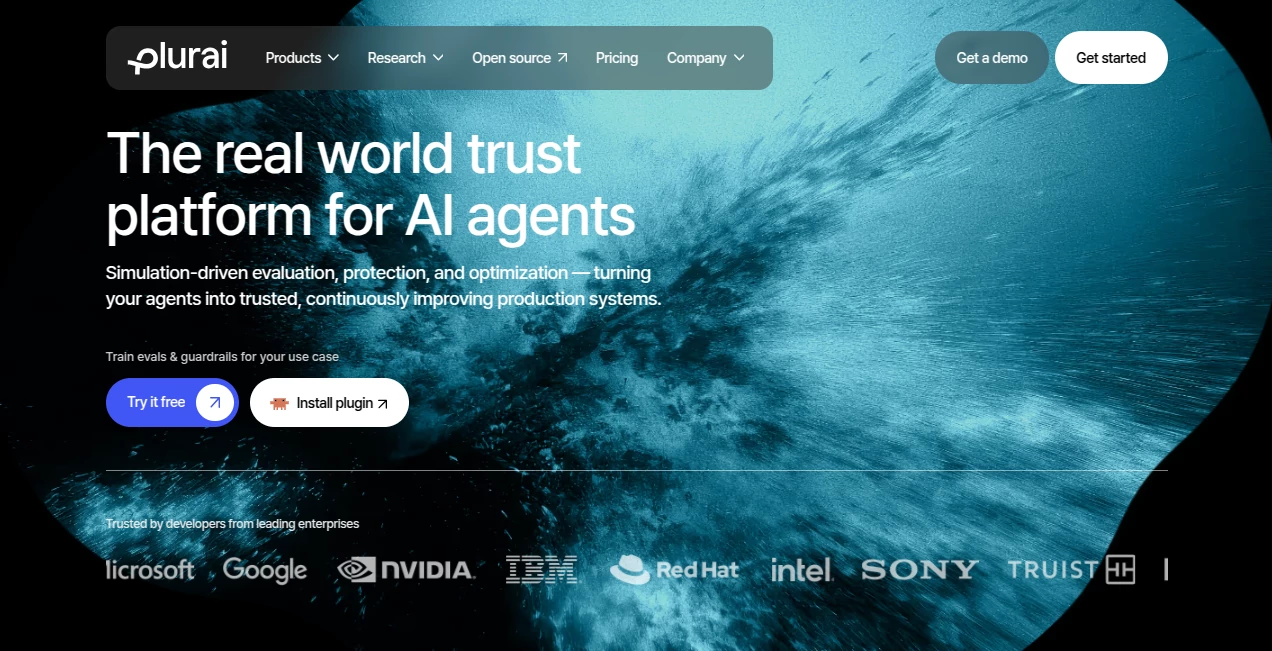
Plurai is built for teams that need more than an AI agent that simply works in a demo. Its focus is on making AI agents reliable, testable, protected, and ready for real-world production. The platform combines simulation, evaluation, and real-time guardrails to help development teams discover failures before users do and continuously monitor the quality of their agents.
Instead of depending entirely on expensive general-purpose LLM judges, the platform uses purpose-built small language models (SLMs) and tailored evaluation workflows. Developers can describe an evaluation or guardrail task in natural language, provide sample data when available, review generated test scenarios, and create a dedicated endpoint for the resulting evaluator.
This approach is particularly useful for companies building customer-facing agents, internal copilots, automated workflows, and other AI systems where an incorrect or unsafe response can create a real business problem.
Key Features
- AI agent evaluation for production environments
- Real-time AI guardrails for policy and safety enforcement
- Simulation and generation of realistic edge-case scenarios
- Purpose-built small language models for specific evaluation tasks
- Automatically generated synthetic evaluation datasets
- Dedicated evaluation and guardrail endpoints
- Support for semantic similarity, grounding validation, policy compliance, and conversation evaluation
- CI/CD integration for continuous validation
- Multimodal scenario support covering areas such as voice and documents
- On-premises and VPC deployment options for enterprise environments
User Interface
The workflow is designed around a straightforward prompt-to-model experience. Rather than requiring a team to build a complex evaluation pipeline from scratch, developers can describe what they want to measure in free language and optionally add examples from their agent.
The generated test set can then be reviewed and refined through an iterative workflow. Once the evaluation or guardrail has been optimized, a dedicated endpoint is made available for integration. This makes the experience approachable for developers who want to experiment quickly without spending days preparing a testing framework.
The Claude integration is another practical touch for development teams already working inside an AI-assisted coding environment. It allows production-oriented evaluation workflows to fit more naturally into an existing development process.
Accuracy & Performance
Performance is one of the strongest parts of the platform. The company reports more than 43% fewer failures compared with GPT-5-mini for its evaluation workloads, along with more than 8x lower cost and inference latency below 100 milliseconds for its SLM-based guardrails.
The underlying idea is sensible: instead of sending every production classification or policy check to a large model, a smaller model can be trained specifically for the task. For high-volume systems, that difference can become significant. A customer-service agent handling thousands or millions of interactions does not necessarily need a large general-purpose model to perform every safety or quality check.
The platform also provides a calculator showing how task-specific SLM inference can reduce the cost of classification workloads compared with larger models. Actual savings will naturally depend on the workload, token volume, model configuration, and evaluation requirements.
Capabilities
The platform covers several stages of the AI agent lifecycle. Simulation helps teams create realistic scenarios and difficult edge cases before an agent reaches production. Evals provide a structured way to measure behavior, while guardrails can intervene in real time when a response violates a defined policy.
Use cases include conversation evaluation, semantic similarity, grounding validation, and policy compliance. Teams can also create customized evaluators around their own product requirements instead of relying exclusively on generic benchmarks.
One particularly useful capability is synthetic test-set generation. When a company does not have a large collection of labeled historical examples, the platform can generate tailored synthetic data for the evaluation task. That can shorten the path from an idea such as “check whether this response follows our policy” to an actual repeatable test.
For larger engineering organizations, CI/CD integration makes the workflow even more practical. Evaluation can become part of the development cycle rather than something performed manually before a release.
Security & Privacy
Security becomes especially important when AI agents handle customer conversations, documents, personal information, or internal business data. The platform offers VPC and on-premises deployment options, giving organizations greater control over where their evaluation infrastructure runs.
Enterprise plans also include features such as enterprise SSO, customized service-level agreements, dedicated support, custom models, and unlimited active endpoints. These options make the platform more suitable for organizations that need their AI evaluation infrastructure to fit existing security and deployment requirements.
Use Cases
- Customer service agents: Evaluate conversations for quality, policy compliance, and inappropriate responses before problems reach customers.
- Enterprise copilots: Check whether generated answers are grounded in approved information and follow internal policies.
- AI safety: Detect policy violations, jailbreak attempts, sensitive information exposure, and other undesirable behavior.
- Production monitoring: Continuously evaluate agent interactions instead of relying only on pre-launch testing.
- AI development teams: Add automated evaluation to CI/CD pipelines and catch regressions during development.
- Multimodal agents: Create realistic scenarios involving voice, documents, and other interaction formats.
- High-volume applications: Use lower-latency SLM evaluators where running a large LLM judge for every request would be unnecessarily expensive.
Pros and Cons
Pros
- Strong focus on production-grade AI agent reliability
- Combines simulation, evaluations, and guardrails in one platform
- Purpose-built SLMs can be significantly cheaper than large-model evaluation approaches
- Reported inference latency below 100ms for SLM guardrails
- Natural-language workflow makes creating evaluators easier
- Synthetic test data can help teams without extensive labeled datasets
- Supports VPC and on-premises deployment
- Useful integrations and CI/CD-oriented workflows for development teams
Cons
- The platform is primarily aimed at developers and organizations building AI agents rather than casual AI users.
- Teams may need some understanding of evaluation concepts to get the most from the platform.
- Enterprise deployment and advanced requirements may require a sales conversation.
- Evaluation quality still depends on defining a clear and meaningful task or policy.
Pricing Plans
The platform offers a free option with no credit card required. The free tier includes 1 million tokens, one dedicated personal endpoint, and a synthetic evaluation test set that can be downloaded.
The pay-as-you-go SLM option is listed at $0.15 per 1 million tokens and includes response latency below 100ms, up to 20 personal endpoints, downloadable synthetic test sets, and unlimited seats. The company also offers an optimized LLM evaluation option at $0.30 per 1 million tokens for teams that want a large-model evaluator for instant testing and offline workflows.
Enterprise plans are designed for organizations that need on-premises deployment, enterprise SSO, customized inference pricing, customized SLAs, broader SLM use cases, white-glove support, custom models, and unlimited active endpoints.
How to Use the Platform
- Describe the evaluation or guardrail task in natural language.
- Add representative examples from your AI agent when available.
- Review the automatically generated synthetic test set.
- Refine the task and test scenarios until they accurately reflect your requirements.
- Let the platform optimize the evaluator for the selected use case.
- Deploy the dedicated evaluation or guardrail endpoint.
- Connect the endpoint to your application, agent, or development workflow.
- Use continuous evaluation and CI/CD integration to detect regressions as the agent evolves.
Comparison with Similar Tools
Traditional AI evaluation often relies on manual test cases, fixed benchmarks, or an LLM acting as a judge. Those approaches can be useful, but they become harder to operate economically when an agent needs continuous testing across large volumes of production interactions.
This platform takes a more specialized route. Its evaluators are tailored to individual tasks and can be implemented as smaller models designed for speed and cost efficiency. The result is closer to an engineering layer for AI reliability than a conventional chatbot testing utility.
Another distinction is the combination of simulation and real-time protection. Teams can generate difficult scenarios before deployment, evaluate agent behavior, and then use guardrails to intervene during live interactions. For organizations building serious AI products, having these capabilities connected can be more practical than assembling several unrelated tools.
Conclusion
For teams building AI agents that need to survive contact with real users, evaluation cannot be an afterthought. Unexpected prompts, policy violations, hallucinations, and subtle quality problems can appear even when an agent performs well during initial testing.
This platform takes a practical approach by combining realistic simulation, specialized evaluations, and fast guardrails. Its SLM-based architecture is particularly interesting for production workloads where latency and inference costs matter as much as raw model capability.
The free tier also makes it relatively easy to experiment before committing to a larger deployment. For developers and organizations working seriously on AI agents, it is worth considering as part of the testing and reliability stack rather than simply another AI development utility.
Frequently Asked Questions (FAQ)
What is this platform used for?
It is used to simulate, evaluate, protect, and continuously improve AI agents. Common applications include conversation evaluation, policy compliance, grounding checks, semantic evaluation, and real-time guardrails.
Does it support AI agent guardrails?
Yes. Its guardrail system is designed to evaluate agent behavior in real time and intervene when defined policies or requirements are not met.
Can I create an evaluator without a labeled dataset?
Yes. The platform can generate synthetic evaluation data tailored to a specific task, so an existing labeled dataset is not required to get started.
How fast are the SLM guardrails?
The company reports inference latency below 100 milliseconds for its SLM-based guardrails.
Does it support enterprise deployment?
Yes. Enterprise customers can use VPC or on-premises deployment options, along with enterprise SSO, customized SLAs, custom models, and dedicated support.
Is there a free plan?
Yes. The free option includes 1 million tokens, one dedicated personal endpoint, and one downloadable synthetic evaluation test set, with no credit card required.
Can it be integrated into CI/CD workflows?
Yes. Continuous validation through CI/CD workflows is supported, making it possible to include agent evaluation in an ongoing development and release process.
AI Testing & QA , AI Developer Tools .
These classifications represent its core capabilities and areas of application. For related tools, explore the linked categories above.

Plurai Alternatives Product

Discord Time…

cznull

Website Clon…

ChatFlowchart

AIQualityHQ

Verne

UpMocker

MyToolster W…

freellm