
Outfit Finder
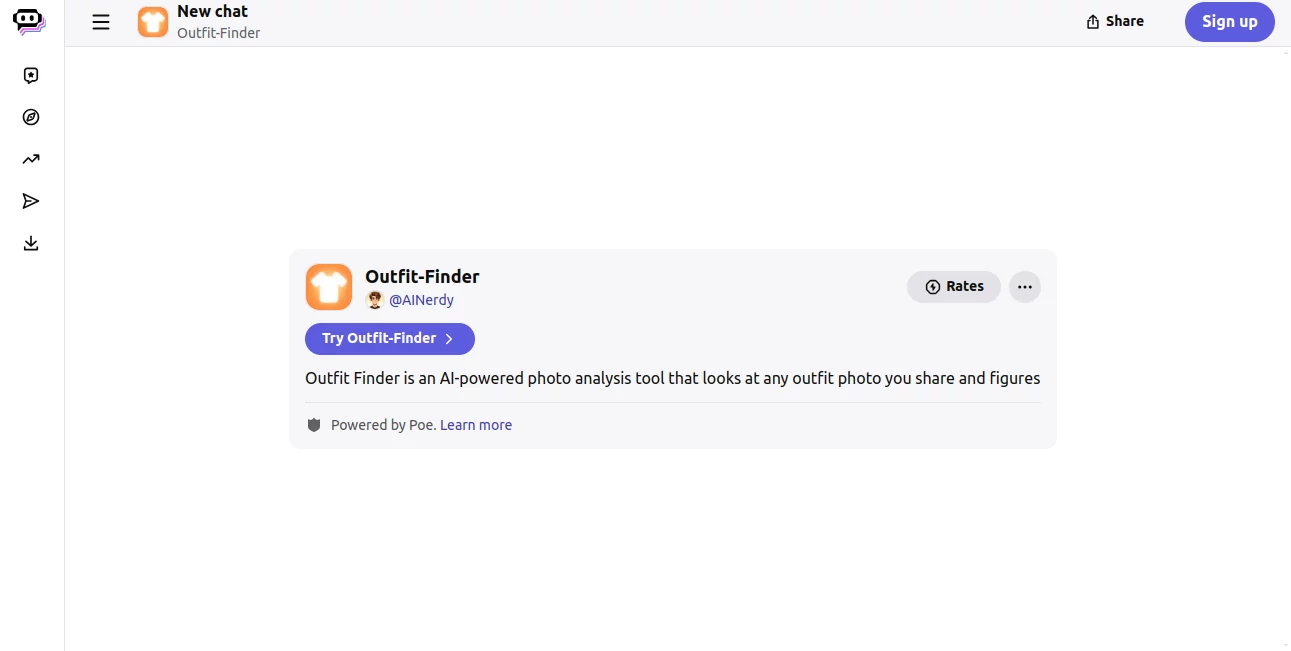
What is Outfit Finder?
Ever seen an outfit online and wondered where every piece came from? Outfit-Finder makes that process much easier by turning a fashion photo into a practical shopping starting point. Instead of manually searching through dozens of stores or trying to describe a jacket, pair of shoes, or bag with the right words, you can upload a clear outfit image and let the AI examine what is actually visible.
The tool is designed to break a complete look into individual clothing items and accessories. It can recognize tops, bottoms, outerwear, footwear, bags, and accessories, while also looking for useful clues such as colors, materials, patterns, visible logos, labels, and text. The result is more than a general description: each detected item comes with search terms that can help you look for the original product or a similar alternative.
For fashion shoppers, this is a particularly convenient approach. A photo from Instagram, a magazine, a street-style post, or even your own wardrobe can become the starting point for finding pieces that match the look.
Key Features
- Analyzes uploaded outfit photos to identify individual fashion items.
- Recognizes tops including shirts, blouses, sweaters, hoodies, and T-shirts.
- Identifies bottoms such as jeans, trousers, skirts, and shorts.
- Detects outerwear including jackets, coats, and blazers.
- Recognizes different types of footwear, including sneakers, boots, and sandals.
- Can identify bags, backpacks, purses, and totes.
- Looks for accessories such as hats, belts, watches, scarves, and sunglasses.
- Provides color, material, pattern, and style information for detected pieces.
- Checks visible logos, labels, and text for potential brand clues.
- Creates individual item cards to make the results easier to review.
- Provides search suggestions aimed at finding the exact item.
- Provides alternative search suggestions when the original item is difficult to locate.
User Interface
The experience is deliberately straightforward. The main interaction revolves around sharing an image and reviewing the resulting analysis, so there is little unnecessary setup between the user and the useful part of the tool.
Once an image has been analyzed, the outfit is separated into individual items. This makes the result easier to understand than receiving one long paragraph describing an entire look. Someone looking for the shoes, for example, can focus directly on the footwear result without sorting through information about the jacket or accessories.
Accuracy & Performance
Image quality plays an important role in the quality of the results. Clear, well-lit photos in which clothing is fully visible are recommended, and both complete outfit photos and close-ups of individual pieces can be used.
The system can recognize visible brand clues when logos, labels, or text appear in the image. However, it does not guarantee an exact brand or product identification. When those clues are missing, the tool can instead provide a description of the item's appearance and suggest comparable search terms. The results should therefore be treated as useful shopping leads rather than guaranteed product matches.
Capabilities
One of the strongest aspects of this tool is the way it combines visual recognition with practical shopping searches. Rather than stopping after identifying something as a “black jacket,” it can provide additional details about the item's style, color, material, and pattern.
The two search approaches are also useful in different situations. An exact-product search is helpful when the original piece appears recognizable, while a similar-item search can be more useful when the product is discontinued, sold out, or simply too difficult to identify precisely.
Imagine finding a street-style photo featuring a blazer, wide-leg trousers, sneakers, and a leather bag. Instead of searching for the entire outfit as one phrase, you can use the individual results to investigate each piece separately. That makes the shopping process much more manageable.
Security & Privacy
The available product description focuses primarily on image analysis and shopping assistance and does not provide detailed claims about image retention, storage duration, or other specific privacy practices for uploaded photos. Users who plan to upload personal photographs should review the applicable privacy information and platform terms before sharing sensitive images.
Use Cases
- Finding clothes from social media: Upload an outfit photo and use the generated search terms to investigate individual pieces.
- Recreating a favorite look: Break a complete outfit into separate garments and accessories and search for matching products.
- Finding affordable alternatives: Use similar-item searches when the original piece is unavailable or outside your budget.
- Fashion inspiration: Analyze street-style and editorial looks to discover new combinations and styles.
- Wardrobe research: Analyze pieces you already own to better understand their style, colors, materials, and patterns.
- Shopping research: Turn an image into several targeted searches instead of spending time guessing product names.
- Fashion content creation: Creators can use outfit images as a starting point for researching garments and accessories featured in visual content.
Pros and Cons
Pros
- Simple image-based workflow.
- Can analyze complete outfits as well as individual clothing photos.
- Covers clothing, footwear, bags, and many common accessories.
- Provides useful visual details such as color, material, and pattern.
- Looks for visible brand and label clues.
- Offers both exact-product and alternative search directions.
- Useful for turning fashion inspiration into actionable shopping research.
Cons
- Exact brand identification is not guaranteed.
- Results depend heavily on image quality and visibility of the clothing.
- AI-generated identifications can occasionally be incorrect.
- It does not replace checking the actual retailer listing before purchasing.
- The available information does not specify a guaranteed privacy or image-retention policy for uploads.
Pricing Plans
The tool is available through Poe, where users can try the bot from its dedicated page. The product page does not list a separate standalone subscription price specifically for this tool. Access and usage may therefore depend on the account, points, or plan available through the Poe platform.
Because pricing and platform access can change, users should check the current Poe interface before relying on a particular usage limit or cost.
How to Use It
- Open the tool through its Poe page.
- Upload a clear photo showing the outfit or the individual item you want to investigate.
- Use a well-lit image where the clothing is visible without excessive obstruction.
- Let the AI analyze the image and separate the detected garments and accessories.
- Review the information provided for each item, including color, material, pattern, style, and possible brand clues.
- Use the suggested exact-product search when you want to look for the original item.
- Use the alternative search when you are more interested in finding a similar piece.
- Compare the search results with the original photograph before making a purchase.
Comparison with Similar Tools
Many fashion-focused AI tools concentrate on styling advice, outfit ratings, color recommendations, or generating new looks. This tool takes a different route. Its main strength is the transition from an existing photograph to individual product discovery.
That distinction matters. If the goal is to receive an opinion about whether an outfit looks good, a fashion-rating assistant may be more appropriate. If the goal is to discover flattering colors, a color-analysis tool may be a better fit. But when the question is “What are these clothes, and how can I search for them?”, image-based item identification is a much more direct approach.
It is also practical to use the results as part of a broader fashion workflow. An identified jacket, for instance, can become the starting point for building several new outfits, while a recognizable pair of shoes can help guide searches for similar styles at different price points.
Conclusion
Finding clothing from a photograph has traditionally involved a lot of trial and error. The visual search approach used here makes that task considerably more approachable by breaking an outfit into recognizable pieces and turning those pieces into useful search queries.
Its biggest advantage is practicality. It does not simply tell you that an outfit contains a blazer, trousers, sneakers, and a bag; it gives you a path toward finding those individual products. The ability to search for both an exact item and a close alternative is especially useful when the original product is difficult to locate.
Of course, AI image recognition has limits. A blurry photograph, hidden clothing, or missing brand information can make exact identification difficult. For that reason, the results are best viewed as a smart starting point for shopping research rather than a definitive product database.
For anyone who regularly saves fashion inspiration and later wonders where the clothes came from, this is a genuinely useful addition to the shopping process. Upload the image, inspect the pieces, follow the search suggestions, and let the detective work begin.
Frequently Asked Questions (FAQ)
What types of clothing can it identify?
It can identify a wide range of common fashion items, including shirts, blouses, sweaters, hoodies, T-shirts, jeans, trousers, skirts, shorts, jackets, coats, blazers, shoes, bags, and accessories.
Can it identify the exact brand?
It can look for visible logos, labels, and text that may reveal a brand. However, exact brand identification is not guaranteed, particularly when the relevant details are not visible in the photograph.
What kind of image gives the best results?
Clear, well-lit images where the clothing is fully visible generally provide the best starting point. Both full outfit photographs and close-up images of individual items are supported.
Can it find alternatives to an original product?
Yes. Along with a search direction intended to help locate the exact product, it can provide another search option focused on finding a similar alternative.
Are the results always accurate?
No. The identifications are AI-generated suggestions and should not be treated as guaranteed facts. It is a good idea to compare any suggested product with the original image before purchasing.
Is it useful for shopping from fashion photos?
Yes. This is one of its clearest use cases. A fashion photograph can be converted into separate searches for clothing, footwear, bags, and accessories, reducing the amount of manual guesswork involved in finding the look.
AI Image Recognition , AI Life Assistant , AI Clothing Generator .
These classifications represent its core capabilities and areas of application. For related tools, explore the linked categories above.

Outfit Finder Alternatives Product

Traveleon

Face Shape D…

GPT Image 2 …

MediTailor -…

Judgement Ta…

Schengen Cal…

AlpacaBag

ImgEnhancer

WhereWasTaken