

















Traveleon
What is Traveleon?
Most people plan trips the same exhausting way — twelve browser tabs open at once, spreadsheets full of hotel links, a group chat that never reaches a consensus, and an hour lost just trying to compare prices across three different booking sites. It's a lot of effort for something that's supposed to be exciting.
This platform flips that entirely. Instead of searching, you just talk. Describe what you want — "five days in Tokyo, foodie focus, mid-range budget" — and you get a complete, bookable itinerary in seconds. Real hotels from a database of over three million properties worldwide, real activities from more than 300,000 options across 190+ countries, and real prices pulled directly from trusted partners like RateHawk, Viator, ETG, and ZenHotels.
It's free to use, and it's genuinely one of those tools you use once and immediately wonder how you planned trips without it before.
Key Features
User Interface
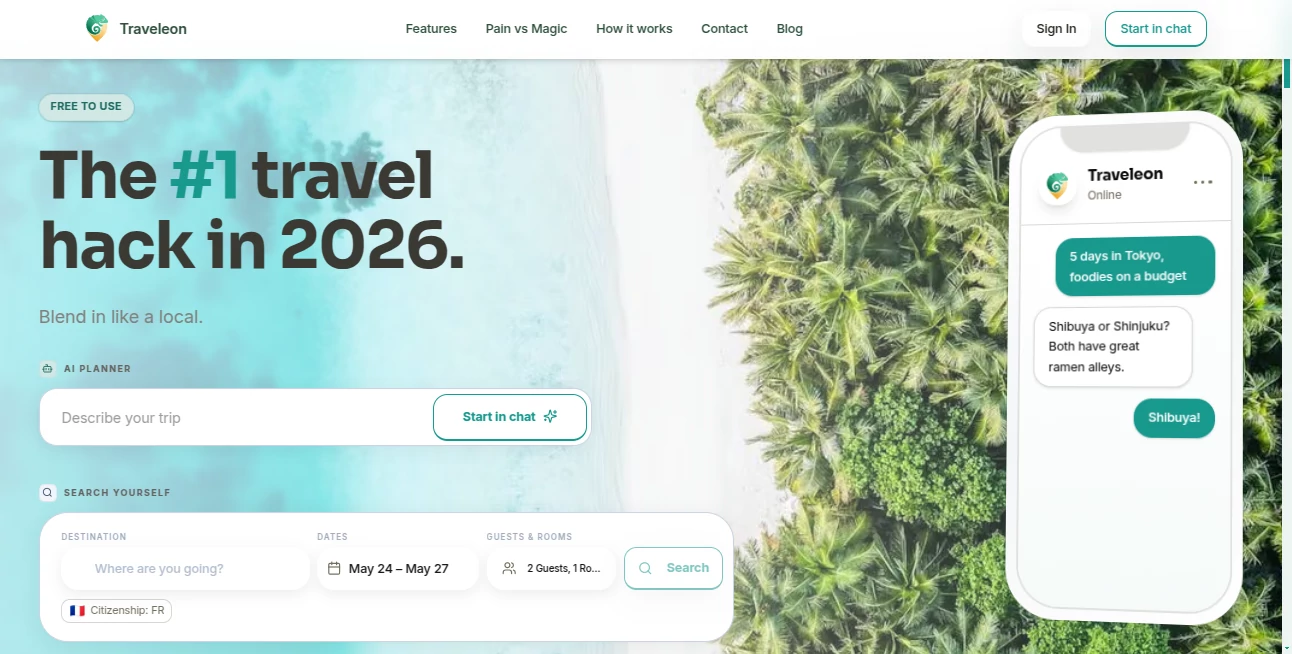
The experience starts as a conversation. There's no form to fill out, no filter panel to configure, no dropdown menus to click through. You type what you want the way you'd describe it to a knowledgeable friend, and the AI handles the rest.
For those who prefer a more traditional search flow, there's also a conventional search interface — destination, dates, guests and rooms — right on the homepage. Both paths lead to the same place: a clean, well-organized view of options with prices, so you're never left guessing what something costs.
The design carries a visual warmth that matches the subject matter. Destination moodboards — hand-scouted scenes from places like Bali cliffs, Tokyo neon districts, and Santorini sunsets — give the platform a genuine sense of place rather than feeling like a sterile booking engine.
Accuracy & Performance
The inventory is powered by partnerships with established travel data providers, so you're not looking at scraped listings of uncertain reliability. Prices are live and connected to real booking infrastructure — when you see a hotel at $95 per night, that's an actual rate, not an estimate that changes when you click through.
The AI's ability to interpret natural language requests is notably strong. It handles nuanced prompts well — "boutique hotel near the beach in Barcelona" or "beach vibes in Rio under $500 for three days" — and returns options that genuinely match the brief rather than generic results that technically satisfy the keywords. It also handles the kind of back-and-forth refinement that real trip planning involves: ask it to adjust the budget, swap a neighbourhood, or shorten the trip, and it recalculates without you having to start from scratch.
Capabilities
The platform covers the full planning-to-booking journey in one place:
- AI itinerary builder: Describe your trip in plain language and receive a complete day-by-day itinerary with hotel recommendations, activities, and estimated costs — built in seconds, not hours.
- Hotel search across 3M+ properties: From budget guesthouses to boutique design hotels, the inventory spans the full range and covers destinations worldwide.
- Activity and tour booking: Over 300,000 activities and tours across 190+ countries, sourced through the Viator integration — day trips, food tours, guided excursions, and cultural experiences.
- Collaborative trip planning: Share a single link with your travel group. Everyone can view, vote on options, and suggest changes in real time — the kind of feature that ends the group chat debate before it starts.
- One-click booking: When the group reaches consensus, everything can be booked in a single step. No switching between platforms, no re-entering details.
- Destination moodboard exploration: Browse curated visual collections of destinations organized by atmosphere and aesthetic — useful for travellers who know the vibe they want before they know the destination.
Security & Privacy
Booking infrastructure is handled through established partner networks — ETG, RateHawk, Viator, and ZenHotels — which means payment processing and reservation management runs through systems that handle this kind of transaction at scale. The platform is operated by Scarabyte Digital S.R.L., registered in Bucharest, Romania, and terms of service are clearly accessible from the main site. For a free-to-use product backed by real booking partners, the trust infrastructure is solid.
Use Cases
Think about the last time you planned a trip with a group of friends. Someone suggests a destination, someone else has strong opinions about hotels, a third person wants to add a day trip, and the fourth just wants someone to make a decision. That specific scenario — collaborative trip planning with actual conflicting preferences — is where this tool earns its keep most visibly. The shared link, live voting, and real-time editing features turn that chaotic group chat into a structured, manageable process.
But it works just as well for solo travellers and couples who want the convenience of having everything in one place without the research burden:
- Budget travellers who need to stay within a daily spend limit and want the AI to surface options that actually fit — rather than manually filtering across multiple platforms
- Food-focused travellers who want itineraries built around culinary experiences in a destination they're unfamiliar with
- Business travellers who need a hotel and a few activity recommendations for a tight weekend window, without spending an hour researching
- Families planning multi-destination trips who need accommodation that works for different ages and preferences
- Spontaneous travellers who decide to go somewhere on short notice and need a complete, bookable plan within minutes
The destination moodboard feature also serves an underappreciated use case: travellers who are feeling wanderlust but don't have a specific place in mind yet. Browsing by atmosphere — "Santorini sunset energy" or "Tokyo neon vibes" — is a genuinely different and more inspiring way to discover where to go next.
Pros and Cons
What works particularly well:
- Free to use — genuinely, not just for a limited trial period
- The conversational AI interface is fast and understands natural language requests without needing perfectly structured prompts
- 3M+ hotels and 300K+ activities is real inventory depth, not a curated shortlist
- Collaborative planning features are well-thought-out and solve a real problem for group travel
- Trusted partner integrations mean prices and availability are live and bookable
- The moodboard exploration feature adds genuine discovery value beyond pure utility
- Works as both a chat-first AI tool and a traditional search interface — good for different types of users
Limitations worth noting:
- Newer platform — the depth of user reviews and community content that older booking platforms have accumulated over years isn't there yet
- The AI works best with reasonably specific prompts; very vague inputs ("plan me a trip somewhere nice") may need a follow-up or two to refine
- Flight booking is not currently part of the platform — you'll still need a separate tool for that leg of planning
- The platform is primarily designed around international hotel and activity booking; very local or niche accommodation types may have thinner coverage in some regions
Pricing Plans
The platform is free to use. There's no subscription required to access the AI planner, search hotels, explore activities, or build a collaborative itinerary. Revenue comes through the booking partnerships — when you book a hotel or activity through the platform, the platform earns a commission from the partner, which keeps the planning tool itself free for travellers.
This model means there's no paywall between you and the tool's core functionality. You can plan an entire trip, build out an itinerary, share it with your group, and refine it over several sessions without spending anything — you only pay when you actually book accommodation or activities, at the same prices you'd find through the partner platforms directly.
How to Use Traveleon
Getting started takes about thirty seconds. No account is required to begin planning — you can jump straight into the AI chat from the homepage.
- Step 1 — Open the chat: Click "Start in chat" from the homepage. You'll be dropped directly into the AI planner interface.
- Step 2 — Describe your trip: Type what you're looking for in plain English. Include destination, travel dates, group size, budget range, and any specific preferences — type of accommodation, interests, neighbourhood preferences. The more context you give, the more relevant the results.
- Step 3 — Review and refine: The AI returns hotel options, activity suggestions, and an estimated itinerary. Ask follow-up questions to adjust anything — different neighbourhood, lower price point, different activity type. It handles conversational refinement naturally.
- Step 4 — Share with your group: If you're planning with others, share the itinerary link. Group members can view options, vote on preferences, and suggest changes in real time.
- Step 5 — Book: When you're happy with the plan, book directly through the platform. Everything is confirmed through the partner booking systems.
Alternatively, if you already know where you're going and just want to search hotels, use the traditional search bar on the homepage — destination, dates, and guest count — to browse properties directly.
Comparison with Similar Tools
The obvious comparisons are the established travel booking giants — Booking.com, Hotels.com, Expedia, and Agoda on the accommodation side; Viator and GetYourGuide on the activities side. Those platforms have massive inventory and years of user reviews. What they lack is the conversational intelligence layer. You can search them, but you can't talk to them. You can filter results, but the platform won't proactively build you a budget-conscious three-day itinerary around your stated interests.
TripAdvisor is useful for inspiration and reviews but isn't a booking platform in the same sense. Google Hotels does search and comparison well but doesn't generate itineraries or handle activities in the same integrated way.
The more relevant comparison might be newer AI travel tools — but most of those are either limited to itinerary generation without real booking capability, or they hand you off to third-party sites to actually complete a reservation. The integration here between AI planning and live bookable inventory in a single interface is the meaningful differentiator. You're not generating a pretty PDF itinerary that you then have to execute across five different platforms. You're planning and booking in the same conversation.
The collaborative planning feature also stands out as genuinely uncommon. Most booking platforms are designed for a single decision-maker. This one is explicitly built for the messy, real-world reality of group travel decisions.
Conclusion
Travel planning has been unnecessarily complicated for too long. The process of turning a vague idea — "I want to go somewhere warm in May with two friends for under $600 each" — into a confirmed booking has required stitching together half a dozen different tools, none of which talk to each other.
This platform makes a genuinely compelling case that the whole thing can happen in one conversation. The AI is capable, the inventory is real, the booking infrastructure is backed by trusted partners, and the collaborative features solve a problem that anyone who's planned a group trip has felt. The fact that it's free to use removes the last reason to hesitate.
If you're planning a trip in 2026 — whether it's a weekend city break or a two-week multi-destination adventure — it's worth spending five minutes with this tool before you open a single other browser tab.
Frequently Asked Questions (FAQ)
Is it really free to use?
Yes. The planning, itinerary building, and collaborative features are all free. The platform earns through commissions from partner bookings — so you pay for accommodation and activities at standard rates, but the planning tool itself costs nothing.
How many hotels does it actually have access to?
Over three million hotels worldwide, sourced through partner integrations with ETG, RateHawk, and ZenHotels. Coverage spans budget to boutique across all major destinations.
Can I book flights through the platform?
Currently, the platform covers hotel and activity booking. Flight booking is not yet part of the offering — you'll need a separate tool for flights.
How does the collaborative planning feature work?
Once you've built an itinerary, you can share a link with your travel group. Other members can view the options, vote on their preferences, and suggest changes in real time — no account required for collaborators to view and vote.
Do I need an account to start planning?
No account is required to use the AI planner and explore options. You'll likely need to create an account to complete a booking, depending on the partner platform handling the reservation.
What countries and destinations are covered?
Activities and tours are available across 190+ countries. Hotel coverage is global, with inventory particularly strong in major travel destinations worldwide.
How does the AI understand my travel preferences?
The AI interprets natural language inputs and uses the details you provide — destination, dates, budget, travel style, interests — to filter and rank options from the live inventory. The more specific your prompt, the more tailored the results.