

















PolyDraft
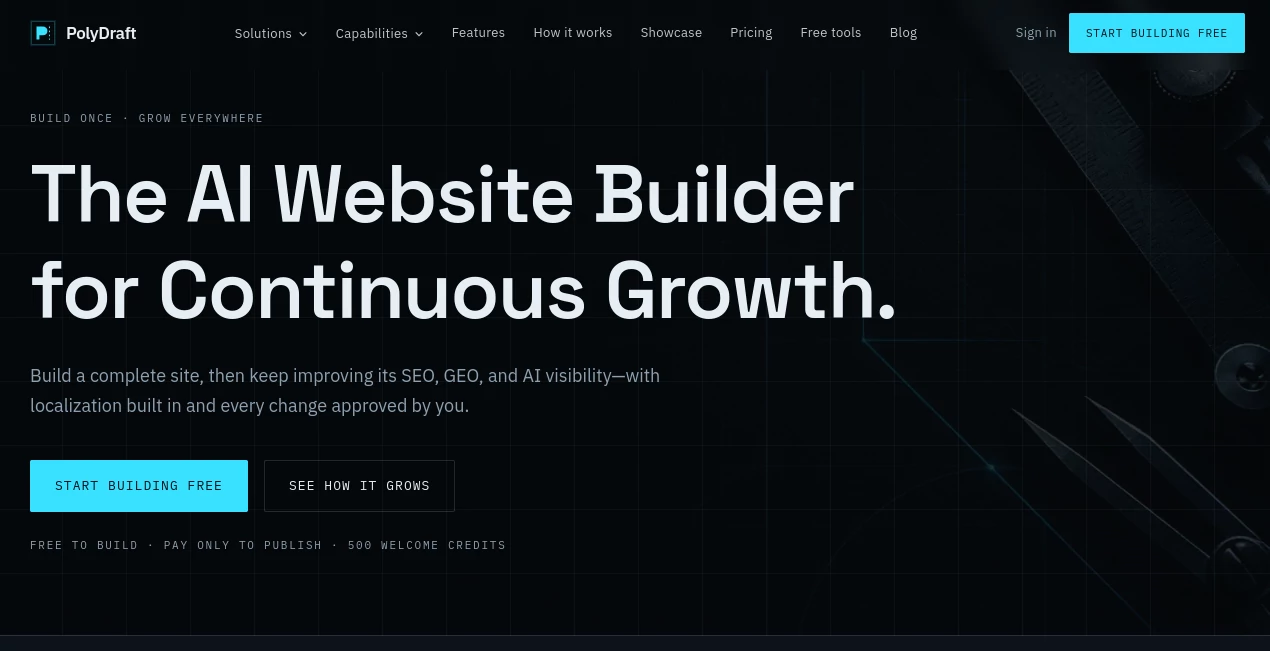
What is PolyDraft?
Building a website is no longer just about choosing a template, adding a few pages, and publishing them. For businesses that depend on organic traffic, the real challenge begins after launch: keeping content useful, improving search visibility, reaching new markets, and making sure modern AI assistants can understand the business.
PolyDraft is an AI website builder designed around that longer-term approach. Instead of focusing only on generating an attractive first version, it combines website creation with SEO automation, generative engine optimization, AI visibility, localization, and ongoing improvements. Users can describe their business in plain language or provide an existing website, then let the platform research, plan, write, build, and quality-check the site before publication.
One particularly appealing aspect is the ownership model. Websites can be deployed to the customer's own domain and cloud account, helping businesses avoid being permanently tied to a hosted website platform. The entire build can also be explored for free before paying to publish.
Key Features
- AI-assisted website creation from a business brief or existing website
- Live market and competitor research before content generation
- Keyword research based on search volume, difficulty, and search intent
- Continuous SEO recommendations after the initial website launch
- GEO features designed for AI answer engines and assistants
- Automatic technical SEO elements including metadata, schema, canonical URLs, breadcrumbs, sitemap, and robots.txt
- llms.txt generation and AI crawler access controls
- Localization for up to 100 languages on supported plans
- Hreflang, localized metadata, RTL support, and transcreation
- Built-in CMS, inquiry inbox, media library, and internal-link management
- One-click deployment to the customer's own cloud account
- Source code ownership and white-label options on supported plans
User Interface
The platform is designed around a conversational workflow rather than a traditional collection of complicated website-building controls. A business owner can start by describing what the company does, who it serves, and what it wants from the website. An existing website can also be supplied as a starting point.
The workflow is particularly interesting because users can watch the website take shape through a live preview. Instead of receiving an unexplained finished result, they can review the work, request changes in plain language, and decide what should eventually be published. This makes the experience more approachable for small businesses and teams that do not want to spend their time learning another technical interface.
Accuracy & Performance
A major strength is the research stage that happens before the website copy is produced. The system studies the relevant market and competing websites, uses live search demand information, and creates a page-level keyword plan. Each page can be assigned a primary money keyword, helping reduce the risk of multiple pages competing against one another.
The website-building process is also designed to include a quality-checking stage rather than stopping immediately after generating pages. The company reports that its builds can move from a brief to a live preview in under two hours, although the actual time will naturally depend on the size and complexity of a project.
Capabilities
The most useful capability is the combination of website generation and ongoing growth work. After the initial build, the system can identify opportunities involving keywords, content, internal links, technical SEO, GEO, and localization. Recommended changes are prepared for review instead of being pushed directly to the live website.
For international businesses, multilingual support is another strong point. Supported plans allow websites to be localized into multiple languages while handling elements such as hreflang, localized metadata, RTL layouts, and transcreation. This is more practical than simply translating every sentence word for word.
The platform also includes a built-in content management system, lead or inquiry inbox, media library, translation management, internal-link tools, and script injection. Agencies can benefit from team functionality, client access, project transfer, and white-label capabilities on higher plans.
Security & Privacy
Website ownership is one of the platform's clearest differentiators. Published websites can run under the customer's own domain and cloud account, and the service states that customers can keep their source code. This reduces dependence on proprietary hosting and gives businesses more control over their deployed website.
Another useful control is the approval-based publishing workflow. SEO, GEO, content, and localization improvements can be prepared by the system, but they are not automatically sent live without user approval. For a business website, that extra review step is valuable because it keeps a human responsible for deciding what becomes public.
The company also provides browser-based free utilities for tasks such as generating llms.txt and robots.txt. According to the product site, these utilities operate in the browser without requiring an account or sending the generated information to a server.
Use Cases
Small businesses can use the platform to create a professional website without assembling separate tools for website development, content production, SEO, and localization. A local service provider, for example, could describe its services and target market and use the resulting site as a foundation for attracting organic leads.
Startups can benefit from the continuous improvement model. Startup positioning often changes after the first few months, so being able to revise pages, keywords, messaging, and content without rebuilding the entire website can save considerable effort.
Agencies are another natural audience. The combination of project management, team seats, client workflows, source export, and white-label functionality can make the platform useful for delivering websites repeatedly rather than treating every client project as a completely separate process.
International companies can also use the localization features to adapt one website for different markets. Instead of creating a completely separate technical structure for every language, businesses can extend the same website and growth system across multiple regions.
Pros and Cons
- Pros: Free website building before publication, research-driven content creation, built-in technical SEO, ongoing SEO and GEO recommendations, AI-search readiness, multilingual localization, own-cloud deployment, source ownership, and human approval before changes go live.
- Cons: Publishing requires a paid subscription, the credit system may require some planning for larger projects, and businesses wanting complete control over every aspect of a website may still prefer a traditional development workflow.
Pricing Plans
The pricing model is straightforward: users can build and preview a complete website for free and only need a subscription when they are ready to publish. New accounts receive 500 welcome credits, while adding a payment method can unlock an additional one-time credit bonus without immediately starting a subscription.
- Starter: $39 per month, including 4,000 monthly credits, up to 2 projects, and support for up to 10 languages per site.
- Pro: $99 per month, including 10,000 monthly credits, up to 10 projects, up to 30 languages per site, and 3 team seats.
- Agency: $299 per month, including 30,000 monthly credits, up to 100 projects, up to 100 languages, 10 seats, and source-code export.
Annual billing is also available, with the published pricing page showing savings compared with monthly billing. Purchased top-up credits do not expire, while subscription credits refresh monthly. Refund requests are accepted within 14 days according to the company's published policy.
How to Use It
- Start by describing the business, its products or services, target customers, and goals in plain language.
- Alternatively, provide an existing website so the system can use the available business information as a starting point.
- Review the research, page plan, design direction, and keyword strategy generated for the project.
- Let the system research the market, write the pages, build the website, and run its quality checks.
- Use the live preview to inspect the finished pages and request changes where necessary.
- Review the recommended SEO, GEO, content, internal-linking, and localization improvements after the initial build.
- Approve the changes you want and publish the finished website to your own domain and cloud environment.
Comparison with Similar Tools
Many AI website builders concentrate primarily on producing a first version of a website quickly. That approach is useful when speed is the only priority, but it can leave businesses with another list of SEO tasks once the site goes live.
This platform takes a broader approach by connecting website creation with keyword research, technical SEO, AI-search visibility, localization, and ongoing optimization. It also places more emphasis on ownership because the finished website can be deployed to infrastructure controlled by the customer.
The distinction becomes especially noticeable for companies that expect their website to evolve. A simple AI builder may be enough for a temporary landing page, while a business looking for a continuously improved organic-growth asset may find the research, approval workflow, multilingual support, and post-launch optimization features more valuable.
Conclusion
For businesses that see a website as more than an online brochure, this platform offers an appealing combination of AI development and long-term growth tools. It handles much of the work involved in research, planning, writing, technical SEO, GEO, localization, and website construction while leaving the final publishing decision with the user.
The free-to-build model is another strong advantage because businesses can inspect the result before committing to a publishing subscription. Combined with own-cloud deployment and source ownership, it provides a level of control that is not always associated with AI website builders.
It is particularly well suited to small businesses, startups, agencies, and organizations targeting multiple markets. If the goal is to launch quickly while keeping SEO, AI visibility, and future growth in the same workflow, it is a compelling option worth testing.
Frequently Asked Questions (FAQ)
Can I build a website for free?
Yes. The full building process, including the brief, research, design direction, website creation, and live preview, can be used before paying. A subscription is required when you are ready to publish.
Does it support SEO?
Yes. SEO is integrated into the website-building process. Features include keyword research, page-level keyword planning, metadata, structured data, canonical URLs, breadcrumbs, XML sitemaps, robots.txt, internal-link planning, and ongoing SEO recommendations.
Does it support AI search and GEO?
Yes. The platform includes answer-first content structures, structured data, llms.txt, AI crawler controls, and entity-oriented signals designed to help AI assistants and answer engines understand website content.
Can I use my own domain?
Yes. Published websites can be deployed under your own domain and to your own cloud account.
Can I keep the source code?
Source-code ownership and export are available, with source export specifically listed among the features of the Agency plan.
How many languages are supported?
Localization can reach up to 100 languages on the highest plan. Lower plans support fewer languages per site, while localization includes features such as hreflang, localized metadata, RTL support, and transcreation.
Does it automatically publish SEO changes?
No. Recommended improvements are prepared for review. Users can inspect, modify, and approve changes before they are published.
Who can benefit most from this type of website builder?
Small businesses, startups, agencies, and companies expanding into international markets are among the strongest use cases. It is especially useful when the website needs to keep evolving after the initial launch rather than remaining unchanged.
AI Website Builder , AI SEO Assistant , AI Developer Tools , AI Marketing Plan Generator .
These classifications represent its core capabilities and areas of application. For related tools, explore the linked categories above.

PolyDraft Alternatives Product

Bolt AI

VercelAPP

Standard Com…

Aiso
Timestamp Ro…

volume shade…

GEO Checker

extractkeywo…

JSON to TOON…
