


















PRIME Intellect
What is PRIME Intellect?
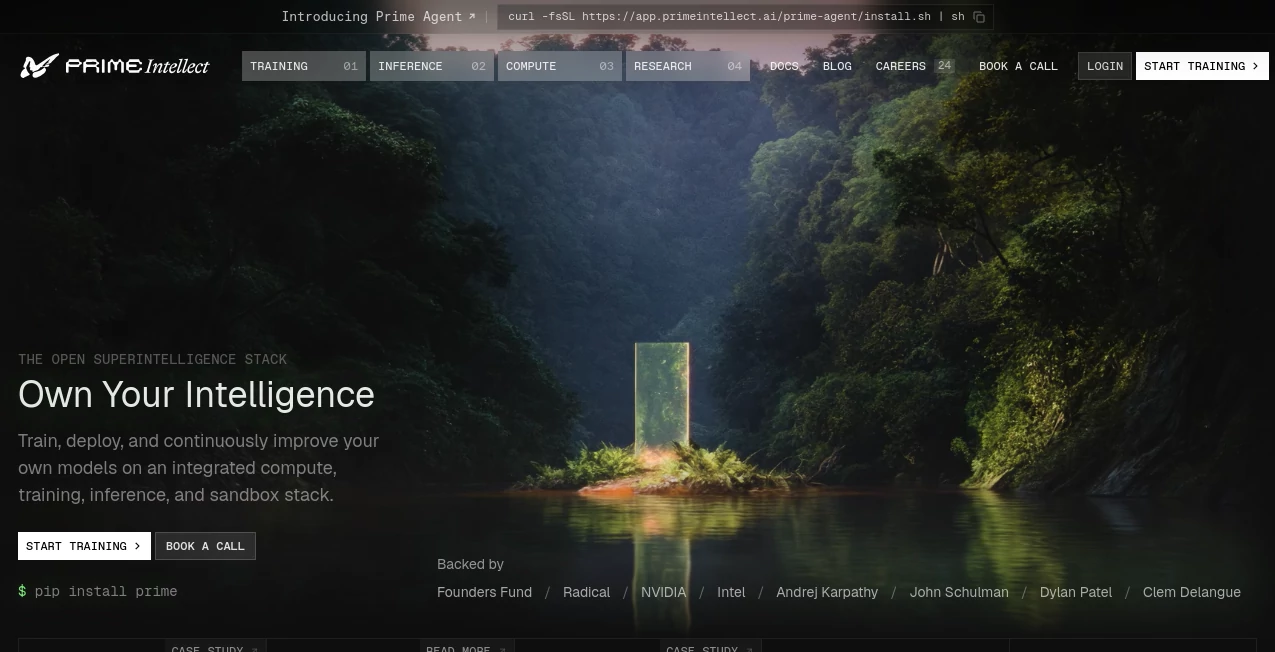
Prime Intellect is an AI infrastructure platform built for teams and researchers who want more control over how intelligent systems are trained, evaluated, deployed, and improved. Instead of treating model development as a collection of disconnected services, it brings compute, reinforcement learning environments, evaluations, training, inference, and secure sandboxes into one integrated workflow.
The platform is particularly interesting for developers working with open-weight language models and agentic systems. It supports the complete journey from creating an environment and testing a model to running training jobs and deploying customized models for inference. This makes it a practical option for organizations that want to build models around their own workflows rather than relying entirely on general-purpose frontier models.
One of its strongest ideas is the connection between production usage and future training. Teams can capture useful traces, identify failures, turn valuable misses into environments and evaluations, and use those results to create models that are more specialized for a particular business problem.
Key Features
- Reinforcement learning environments for creating and testing agent tasks.
- Access to more than 2,500 community RL environments through the Environment Hub.
- Hosted evaluations for benchmarking open-source models without managing evaluation infrastructure.
- Managed training workflows with visibility and control over training runs.
- Dedicated and serverless inference options for deployed models.
- Native LoRA support for serving customized adapters alongside base models.
- OpenAI-compatible serverless APIs for supported inference models.
- GPU compute ranging from individual GPUs to multi-node clusters.
- Support for distributed training workloads across different hardware configurations.
- Secure sandbox environments designed for large-scale reinforcement learning workloads.
- CLI-based workflows for initializing, developing, evaluating, and publishing environments.
- Access to open-source frameworks and infrastructure for reinforcement learning at scale.
User Interface
The interface is designed around the workflow of an AI developer rather than the simplicity of a consumer chatbot. Different areas focus on environments, evaluations, training, inference, and compute, making it possible to move between stages without rebuilding the project from scratch.
For developers who prefer working from the terminal, the platform also provides a CLI workflow. This is useful when environments and experiments are managed alongside source code, datasets, and other development assets. The combination of a web-based workspace and command-line tooling gives technical teams flexibility in how they manage experiments.
Accuracy & Performance
Performance depends heavily on the selected model, training configuration, environment, and available compute, so there is no single accuracy figure that represents the entire platform. Its evaluation system is instead designed to let developers benchmark models against defined tasks and compare results through hosted evaluations and public leaderboards.
The training infrastructure is built around reinforcement learning workflows where inference, orchestration, scoring, and training work together. This architecture is useful for agentic applications because the model can be evaluated against actual task behavior rather than only traditional static benchmarks.
The infrastructure has also been used for large distributed reinforcement learning research. The team behind the platform has demonstrated globally distributed training approaches, including a 32B-parameter model trained through asynchronous reinforcement learning across a distributed compute network.
Capabilities
The biggest advantage is breadth. A developer can create an RL environment, evaluate existing models, launch a managed training run, and deploy the resulting model without stitching together several unrelated infrastructure providers.
The platform supports open-weight models for hosted training and inference, while its compute marketplace provides access to GPUs for demanding workloads. Available infrastructure can include GPUs such as H100, H200, B200, B300, A100, GH200, and other configurations, depending on current availability.
For inference, teams can choose dedicated deployments for production workloads, LoRA serving for customized behavior, or serverless APIs for simpler access to supported models. This gives smaller experiments and production applications different paths without forcing every project into the same infrastructure setup.
Security & Privacy
Security is especially relevant when AI agents need to execute code or interact with tools. The platform provides sandbox environments designed for secure code execution in reinforcement learning workflows. Dedicated inference deployments can also provide private routing and production-oriented infrastructure for organizations with more demanding operational requirements.
Teams should still review the current documentation and configuration options before processing sensitive information. Security depends not only on the platform but also on model configuration, datasets, credentials, application architecture, and the way external tools are connected.
Use Cases
- AI Agent Training: Build environments that teach agents to perform specific tasks and improve their behavior through reinforcement learning.
- Model Evaluation: Benchmark open-source models against custom environments before choosing a model for production.
- Specialized Business Models: Train or adapt models around company-specific workflows instead of depending solely on general-purpose models.
- Research: Experiment with reinforcement learning, distributed training, reasoning models, and agent architectures.
- LLM Fine-Tuning: Use managed training workflows and LoRA-based customization to create more targeted model behavior.
- Production Inference: Deploy customized models through dedicated infrastructure or serverless APIs.
- Distributed AI Development: Use large GPU configurations and distributed infrastructure for demanding training experiments.
- Developer Workflows: Create, evaluate, train, and deploy models while keeping the development process connected through CLI and hosted tooling.
Pros and Cons
Pros
- Combines training, evaluation, inference, compute, and environments in one ecosystem.
- Strong focus on open-weight models and open AI development.
- Large collection of community-created reinforcement learning environments.
- Useful infrastructure for agentic AI and reasoning-model research.
- Supports both managed workflows and developer-oriented CLI tooling.
- Offers flexible inference options, including dedicated, serverless, and LoRA-based serving.
- Provides access to a broad range of GPU infrastructure.
Cons
- The platform is primarily aimed at developers, researchers, and technical teams rather than casual AI users.
- Training and GPU costs can become significant for large-scale experiments.
- Understanding reinforcement learning environments and model training is helpful for getting the most from the platform.
- Compute availability and pricing can vary depending on hardware and current capacity.
Pricing Plans
Pricing is usage-based across several parts of the platform rather than being presented as one simple consumer subscription. Compute is charged according to the selected GPU and instance configuration, with both on-demand and spot options available. Spot instances can offer substantial discounts compared with on-demand infrastructure, although they may be interrupted.
Hosted training also uses token-based pricing for supported models, with input, output, and training usage billed separately. For example, the current documentation lists different rates across models ranging from smaller Qwen and Llama variants to substantially larger models.
Because GPU availability, model selection, and infrastructure pricing can change, users planning a serious training project should check the current pricing shown in the platform before estimating their total cost.
How to Use the Platform
- Create an account and open a workspace for your project.
- Choose an existing reinforcement learning environment or create your own.
- Define the task, tools, evaluation logic, and reward criteria required by the environment.
- Run an evaluation against a suitable open-source model to establish a baseline.
- Review the results and identify where the model performs poorly.
- Launch a hosted training run using the environment and selected model.
- Monitor the training process and compare the resulting model against the baseline.
- Deploy the trained model through a suitable inference option.
- Use production traces and observed failures to improve environments and evaluations for future training runs.
Comparison with Similar Tools
Traditional cloud GPU providers are often excellent for obtaining raw computing resources, but they may require developers to assemble their own training, evaluation, inference, and orchestration stack. Dedicated model-training platforms can simplify particular parts of the process, while inference providers may focus mainly on serving models.
This platform takes a broader approach by connecting these stages. Its main distinction is the emphasis on reinforcement learning and continuous model improvement. For a developer who only needs a GPU for a conventional machine learning job, a general cloud provider may be simpler. For someone building agents, evaluating open models, training specialized behavior, and deploying the resulting models, the integrated workflow can be considerably more attractive.
The community Environment Hub is another notable difference. Instead of starting every experiment from an empty project, developers can explore existing environments and build on an ecosystem of shared work. That can reduce the amount of infrastructure work required before an experiment becomes useful.
Conclusion
Prime Intellect stands out as an infrastructure-focused platform for people who want to build and own more of their AI stack. Its combination of reinforcement learning environments, evaluations, managed training, GPU compute, inference, and sandboxing gives technical teams a path from an early experiment to a production model without separating every stage across unrelated services.
It is not designed to be the simplest AI tool for everyday users, and that is precisely its strength. Developers working on agents, reasoning models, specialized LLMs, or reinforcement learning applications can find considerably more value here than someone simply looking for a ready-made chatbot.
For organizations interested in turning their own workflows and production feedback into better AI systems, the connected approach is particularly compelling. Instead of continually waiting for a better general-purpose model, teams can experiment with building models that are specifically useful for the work they actually need to accomplish.
Frequently Asked Questions (FAQ)
What is this platform used for?
It is used to build, evaluate, train, deploy, and improve AI models, particularly open-weight language models and agentic systems. It combines reinforcement learning environments, hosted evaluations, model training, inference, and GPU compute.
Can I train my own AI model?
Yes. The hosted training infrastructure supports training workflows for supported open-weight models. Developers can use custom reinforcement learning environments and training configurations to specialize model behavior for particular tasks.
Does it support AI agents?
Yes. Agent development is one of the platform's central use cases. Developers can create environments involving tools, multi-step interactions, evaluations, and reward functions designed to improve agent behavior.
Can I deploy a trained model?
Yes. Trained models can be deployed through dedicated inference, serverless APIs, or LoRA serving depending on the requirements of the project.
Is it suitable for AI research?
Yes. Its reinforcement learning infrastructure, distributed training capabilities, model evaluations, open-source components, and access to GPU compute make it suitable for researchers and engineering teams experimenting with modern AI training techniques.
Does it provide GPU compute?
Yes. The compute infrastructure provides access to individual GPUs as well as larger multi-node configurations. Available hardware and prices vary according to current capacity.
Large Language Models (LLMs) .
These classifications represent its core capabilities and areas of application. For related tools, explore the linked categories above.
PRIME Intellect details
Website unavailable — View Alternatives
Pricing
- Free
Apps
- Web App
Categories

PRIME Intellect Alternatives Product

Jasper

Mage

Defapi

CoolVerdict

Random Promp…

Sourcetable

Debate Tello…

MacroMicro

Empiriolabs …
