
Prosperian
What is Prosperian?
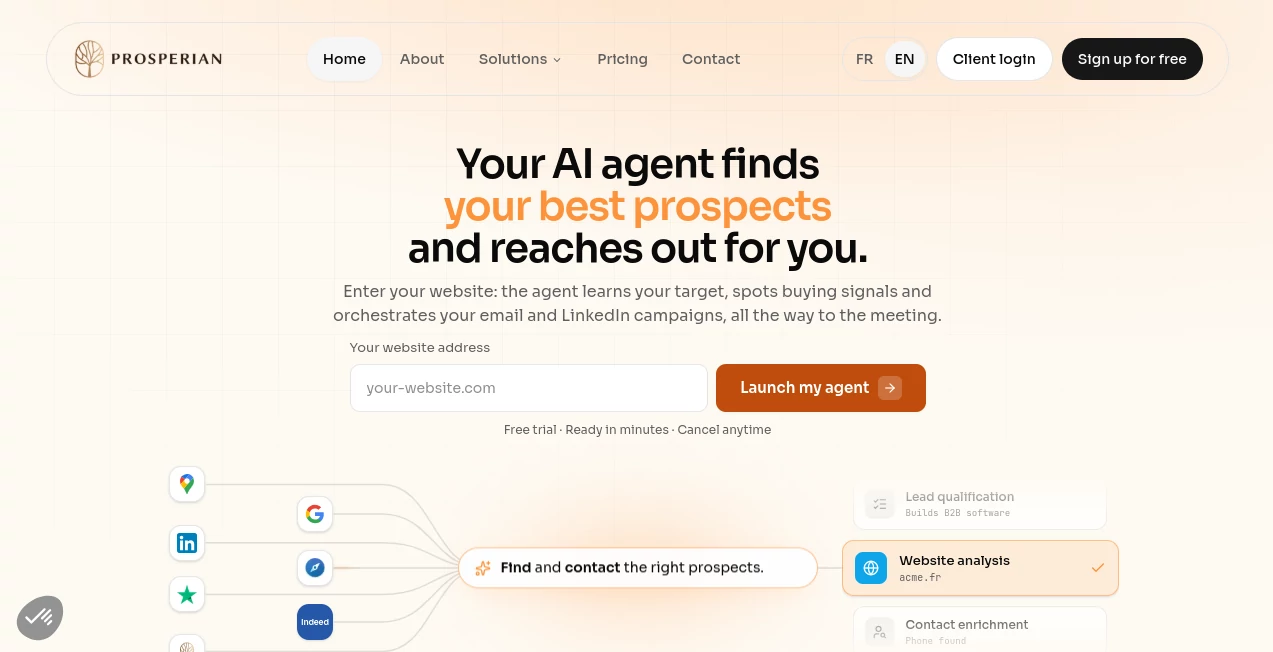
Prosperian is an autonomous B2B prospecting platform built for sales teams that want to spend less time searching for contacts and more time having useful conversations. Instead of simply handing over a large list of leads, it looks for buying signals, identifies promising accounts, enriches contact information, and helps run outreach campaigns through email, LinkedIn, and other channels.
The interesting part is how much of the process happens in one place. A company can provide its website, let the platform understand what it sells and who it targets, and then allow its AI agent to work through prospecting and outreach. For a small sales team, this can remove a surprising amount of repetitive research and campaign setup.
The platform is also designed with control in mind. Teams can let the agent operate automatically or use a copilot approach where messages are reviewed before they are sent. That balance makes it suitable for companies that want automation without completely giving up oversight.
Key Features
- AI-powered B2B prospect discovery and prioritization
- Buying-signal and lookalike-profile detection
- Automatic contact enrichment with verified email and phone information
- AI-generated personalized outreach messages
- Email and LinkedIn campaign orchestration
- Unified inbox for prospect responses
- Intent scoring for identifying stronger opportunities
- CRM and API integrations
- Email deliverability and warm-up tools
- Automatic campaign optimization based on performance
- Appointment scheduling and follow-up automation
- Copilot mode for approving messages before sending
User Interface
The interface is centered around the sales workflow rather than making users jump between a collection of disconnected tools. Prospect lists, intent signals, outreach sequences, responses, and campaign performance can be managed from the same environment.
One useful detail is the unified inbox. When a prospect responds, the reply can be brought into one place instead of forcing the sales representative to check several separate channels. CRM connections with platforms such as HubSpot, Salesforce, and Pipedrive also help keep prospect information connected to an existing sales process.
For a sales manager, the layout makes sense because the important question is not simply how many contacts were found, but which prospects deserve attention now.
Accuracy & Performance
Lead volume alone is rarely a good measure of prospecting quality. The platform takes a different approach by looking at signals such as a job change, fundraising activity, expressed intent, or other indications that an account may be more receptive to an offer.
Contact enrichment is another important part of the workflow. The system can search for verified email addresses, phone numbers, and updated prospect information before outreach begins. This can make a noticeable difference when sales teams normally spend hours checking and completing contact records manually.
Campaign performance is also used as feedback. The agent analyzes responses and campaign results, reduces activity that is not converting, and strengthens approaches that perform better over time. This creates a more iterative workflow instead of leaving a sales sequence running unchanged for weeks.
Capabilities
The platform covers a broad part of the outbound sales process. It can start with a company's website, understand the business and target audience, identify potential accounts, enrich contacts, qualify prospects, personalize messages, and move interested prospects toward meetings.
Multichannel outreach is particularly useful for teams that do not want email to be their only point of contact. The Pro plan combines email and LinkedIn in the same sequence, while the broader platform can also incorporate phone-based activity and a parallel dialer.
Another useful capability is the choice between full automation and human approval. A company can let the agent handle routine prospecting independently, or keep a person involved before messages are sent. That makes the system easier to adapt to different sales cultures and levels of automation.
Security & Privacy
Privacy is an important consideration for any platform handling business contacts and sales data. The company states that its service is GDPR compliant and that its infrastructure is hosted in the European Union.
For larger organizations, the Enterprise offering adds advanced controls such as customized roles and permissions and SSO/SAML support. CRM and API integrations are also designed to connect the prospecting workflow with existing business systems rather than forcing companies to abandon their current sales stack.
As with any automated prospecting platform, businesses should still configure their campaigns responsibly and make sure their outreach practices comply with the privacy and marketing rules applicable to their target markets.
Use Cases
- B2B Sales Teams: Build prospect lists, prioritize accounts, and automate repetitive outreach tasks.
- Startups: Create an outbound sales process without immediately assembling a large prospecting operation.
- Sales Agencies: Manage prospect discovery and multichannel campaigns for different clients.
- Founders: Spend less time researching prospects and more time handling qualified conversations.
- Marketing and Sales Teams: Use buying signals and intent information to coordinate campaigns around better opportunities.
- Recruitment and Professional Services: Identify relevant companies and decision-makers using targeted prospecting workflows.
Pros and Cons
Pros:
- Automates a large part of B2B prospecting
- Combines lead generation, enrichment, outreach, and optimization
- Uses buying signals rather than relying only on large contact databases
- Supports personalized email outreach at scale
- Multichannel sequences are available on the Pro plan
- Offers CRM and API integrations
- Includes a unified inbox for responses
- Can operate automatically or with human approval
- Provides email deliverability and warm-up features
Cons:
- The more advanced multichannel features require the Pro plan
- Teams looking for extensive customization may need the Enterprise offering
- Results depend on the quality of the target market, offer, data, and campaign strategy
- Automated outreach still requires responsible campaign configuration and monitoring
Pricing Plans
The platform currently offers a 14-day free trial without requiring a credit card. The Starter plan is designed for email prospecting, while the Pro plan adds LinkedIn and broader multichannel functionality. Enterprise pricing is customized for larger teams.
- Starter: €23 per month with annual billing, or €29 per month on monthly billing. Includes AI prospecting by email, automatically generated prospects, unlimited AI-personalized emails, contact enrichment, deliverability and warm-up tools, and CRM/API integrations.
- Pro: €79 per month with annual billing, or €99 per month on monthly billing. Adds LinkedIn automation, coordinated email and LinkedIn sequences, unified inbox, intent scoring, and a parallel dialer.
- Enterprise: Custom pricing for larger teams. Includes custom AI agents, customized contact volumes, a dedicated account manager, custom roles and permissions, and advanced SSO/SAML security.
The company also states that data and AI usage can be handled through credits, with one credit valued at €0.05. Pricing and included features can change, so checking the current plan details before subscribing is recommended.
How to Use It
Getting started is relatively straightforward. First, provide your company website so the platform can understand what you sell and who your target audience is. It can then connect with an existing CRM such as HubSpot, Salesforce, or Pipedrive.
Next, define the type of prospects you want to reach. The agent can identify relevant accounts, monitor buying signals, and enrich contact information. Instead of manually building every prospect list, the system continuously works toward finding accounts that match the desired profile.
Once the prospects are ready, create or activate an outreach campaign. The AI can personalize messages based on the prospect and available context. Depending on the selected plan, email and LinkedIn can be coordinated within the same sequence.
Finally, monitor responses and campaign performance. You can allow the agent to optimize campaigns automatically or use the approval-based copilot mode when your team wants more control over outgoing communication.
Comparison with Similar Tools
Traditional lead databases are mainly useful for finding contact information, while basic email automation tools focus on sending predefined sequences. This platform takes a broader approach by combining prospect discovery, enrichment, intent signals, personalized outreach, campaign optimization, and meeting progression.
Compared with using several separate sales tools, the main advantage is consolidation. A team can potentially reduce the number of disconnected steps between discovering an account and starting a conversation with it. This is especially appealing for smaller sales teams where one person may currently handle research, list building, copywriting, outreach, follow-ups, and CRM updates.
There is also an important difference in how outreach is handled. Rather than treating every prospect identically, the system is designed to consider the prospect's context and available intent signals before deciding when and how to engage.
Conclusion
For B2B companies that still spend too many hours finding prospects, checking contact details, writing repetitive emails, and managing follow-ups, this platform offers a practical way to automate much of that workload.
Its strongest point is not simply AI-generated messaging. The bigger advantage is the complete workflow: identify promising accounts, enrich the data, personalize outreach, coordinate multiple channels, collect responses, and learn from campaign performance.
The combination of automation and human control is also well considered. Teams that want a hands-off system can let the agent work continuously, while companies with stricter approval processes can review messages before they are sent. With entry-level pricing starting at €23 per month with annual billing and a free trial available, it is an approachable option for businesses that want to test AI-assisted B2B prospecting without committing to a large sales technology stack.
Frequently Asked Questions (FAQ)
What is this platform used for?
It is designed for B2B prospecting and outbound sales. It helps businesses discover relevant prospects, enrich their contact information, personalize outreach, manage campaigns, and move qualified prospects toward meetings.
Can it find prospects automatically?
Yes. Its AI agent can generate prospect lists using buying signals and lookalike profiles, then enrich the contacts with information such as verified email addresses and phone numbers.
Does it support LinkedIn outreach?
Yes. LinkedIn automation and coordinated email and LinkedIn sequences are available with the Pro plan.
Does it integrate with CRM systems?
Yes. The platform supports CRM integrations including HubSpot, Salesforce, and Pipedrive, along with API connectivity for broader workflows.
Can I review messages before they are sent?
Yes. The copilot approach allows users to approve messages before they are sent instead of giving the agent complete autonomy.
Is it GDPR compliant?
The company states that its platform is GDPR compliant and that its infrastructure is hosted in the European Union. Businesses should still configure their prospecting activities according to the laws that apply to their specific markets.
Is there a free trial?
Yes. A 14-day free trial is available without requiring a credit card.
How much does the Starter plan cost?
The Starter plan costs €23 per month with annual billing or €29 per month with monthly billing.
How much does the Pro plan cost?
The Pro plan costs €79 per month with annual billing or €99 per month with monthly billing.
Is there an Enterprise plan?
Yes. The Enterprise plan uses custom pricing and is intended for larger teams that need dedicated support, customized AI agents, additional controls, custom contact volumes, and advanced security features.
AI Lead Generation , AI Sales Assistant , AI Email Marketing , AI CRM Assistant .
These classifications represent its core capabilities and areas of application. For related tools, explore the linked categories above.

Prosperian Alternatives Product

TrackRev

Sales Prospe…

Toflow AI

LSGRO

AILeadz.io

PineBill

LeadCanvas

ZoraInsights

Reloq