
ProxiesFi
What is ProxiesFi?
Choosing a proxy provider can be surprisingly difficult when every company highlights different strengths. One may promise speed, another focuses on large IP pools, while a third competes mainly on price. Proxies.fi takes a more practical approach by putting measurable performance data at the center of the decision.
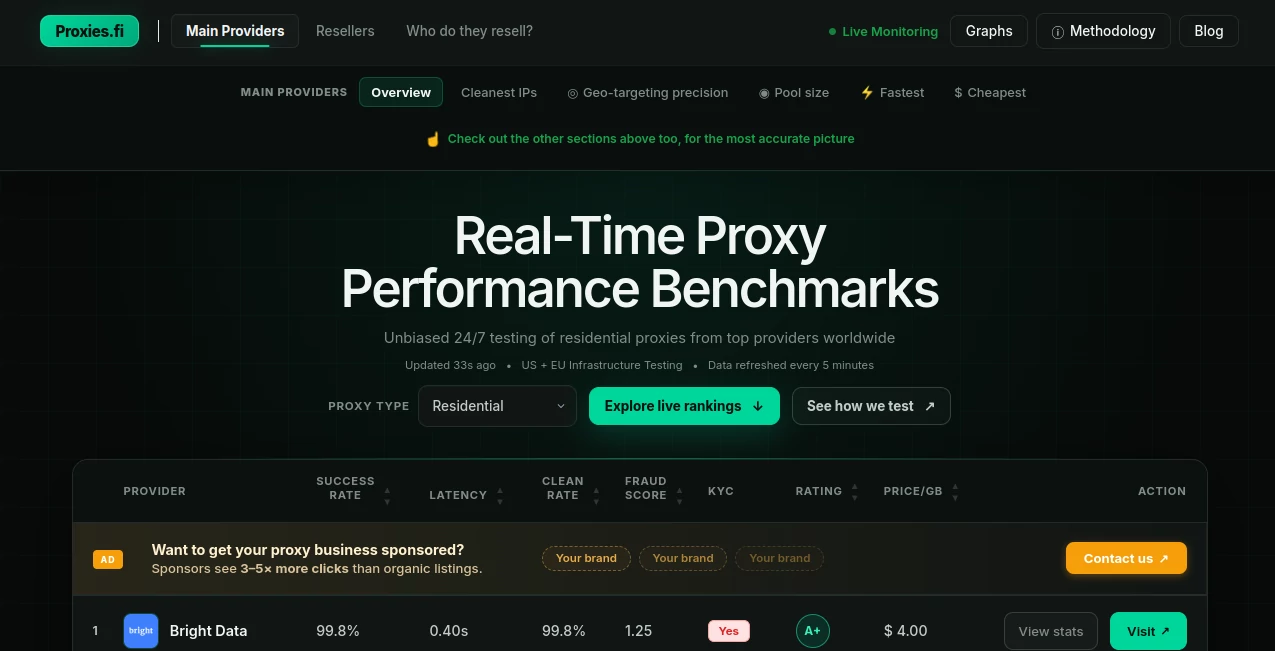
The platform provides live benchmarking of residential proxy providers, with continuous testing designed to show how different services actually perform rather than relying only on marketing claims. Its dashboard currently monitors 14 providers and refreshes performance data every five minutes, making it useful for anyone who wants a current view of the proxy market.
Instead of simply asking which proxy service is “best,” users can compare factors such as success rate, latency, clean IP rate, fraud score, KYC requirements, overall rating, and price per gigabyte. That makes the platform particularly useful when the right choice depends on a specific project rather than a generic ranking.
Key Features
- Real-time residential proxy performance benchmarking
- 24/7 continuous testing infrastructure
- Five-minute data refresh cycle
- US and EU-based testing infrastructure
- Provider comparisons based on measurable performance indicators
- Success-rate and latency comparisons
- Clean IP and fraud-score information
- Pricing comparisons based on cost per gigabyte
- KYC requirement visibility
- Dedicated rankings for speed, cleanliness, reliability, price, and other criteria
- Performance graphs and testing methodology information
- Option to explore or purchase the underlying raw dataset
User Interface
The interface is built around a straightforward comparison table, which is a sensible choice for a data-heavy service. Rather than forcing visitors through lengthy reviews, the main dashboard presents providers alongside the metrics that matter when evaluating proxy performance.
Users can select a proxy type and explore live rankings, while dedicated sections make it easier to focus on particular priorities. Someone interested in speed can concentrate on latency, while another user may care more about clean IP rates, fraud scores, or price.
The layout feels especially useful for comparison work because several important measurements are visible at once. It reduces the need to open multiple provider websites and manually collect figures before making a shortlist.
Accuracy & Performance
The strongest part of the platform is its emphasis on ongoing measurement. Testing runs continuously throughout the day, with multiple requests performed each minute and the displayed data refreshed every five minutes.
The current dashboard shows providers with success rates ranging from the mid-90% range to almost 100%, while latency measurements help reveal the practical difference between services. For example, the live table currently includes providers with latency below half a second as well as providers exceeding one second.
There is also more than raw speed to consider. Clean-rate and fraud-score measurements provide additional context, which can be important for websites and applications where suspicious or previously abused IP addresses create problems.
Because proxy performance can change over time, continuously refreshed benchmarks are more useful than treating a single historical test as a permanent verdict. The platform's methodology also states that testing is performed using infrastructure in the US and Europe, giving the results a defined testing environment.
Capabilities
The platform works less like a traditional proxy seller and more like a performance intelligence resource for the proxy market. Its main capability is bringing several decision-making factors into one place.
Visitors can examine overall rankings, identify faster providers, look for cleaner IP pools, compare reliability, investigate fraud scores, and check which services require KYC. Pricing can also be viewed alongside technical performance, allowing users to consider value instead of looking at cost in isolation.
The service also provides performance graphs and information about its testing methodology. For teams that need deeper analysis, a raw dataset is available as another resource, which can be useful when building their own comparisons or conducting more detailed research.
Security & Privacy
Security is an important consideration when selecting any proxy service, but this platform's role is primarily measurement and comparison rather than acting as the proxy provider itself. Its public benchmark focuses on indicators such as clean IP rates and fraud scores, helping users understand potential risks associated with different proxy networks.
The inclusion of fraud scoring is particularly valuable because an IP can be fast and reliable while still having a poor reputation. Looking at several metrics together gives users a more informed basis for evaluating providers before committing to a purchase.
Use Cases
Proxy researchers can use the platform to quickly compare multiple residential providers without collecting performance information manually.
Web scraping teams may find success rate, latency, clean IP rate, and fraud score especially useful when evaluating whether a provider is suitable for demanding collection workflows.
Marketing and automation teams can compare providers according to reliability and geographic performance before selecting a proxy network for their campaigns.
Developers can also use the benchmark data when testing different providers for applications that depend on stable connections and acceptable response times.
For procurement teams, the price-per-gigabyte comparison adds another useful layer. A cheaper provider is not necessarily the better deal if its success rate is significantly lower or its IP reputation creates additional operational problems.
Pros and Cons
Pros
- Live proxy benchmarking rather than static provider descriptions
- 24/7 continuous testing
- Data refreshed every five minutes
- Multiple technical and commercial metrics in one dashboard
- Useful comparisons of success rate, latency, cleanliness, fraud score, and price
- US and EU testing infrastructure
- Dedicated rankings for different proxy requirements
- Testing methodology and performance resources are available
Cons
- The benchmark focuses on a defined testing environment, so individual results may differ depending on location and workload
- Performance figures can change as proxy networks and providers evolve
- The platform is primarily a comparison and benchmarking resource rather than a replacement for testing a provider with your own workload
- Users looking for detailed qualitative reviews may need to combine the benchmark figures with their own research
Pricing Plans
The public platform is centered on proxy benchmarking and comparison rather than selling a conventional subscription-based proxy product. The dashboard presents provider pricing as a comparison metric, including current price-per-gigabyte figures, so visitors can evaluate cost alongside performance.
The displayed rankings currently show substantial differences between providers. Some services appear at well below one dollar per gigabyte, while others are several dollars per gigabyte. This makes the price column useful when searching for a balance between affordability and technical performance.
For users who need deeper analysis, the platform also provides access to its raw dataset as a separate resource. Anyone considering commercial proxy services should still verify the provider's current pricing directly before purchasing, since proxy pricing and plans can change.
How to Use the Platform
- Open the benchmarking dashboard and select the proxy type you want to investigate.
- Review the current provider rankings and compare success rates, latency, clean rates, and fraud scores.
- Check KYC requirements if that is an important factor for your project.
- Compare the price-per-gigabyte figures with the technical performance of each provider.
- Use the dedicated rankings when your priority is speed, clean IPs, reliability, affordability, or another specific characteristic.
- Review the testing methodology before drawing conclusions from the figures.
- Create a shortlist and perform your own tests with the providers that best match your requirements.
Comparison with Similar Tools
Many proxy comparison websites rely heavily on editorial reviews, provider claims, or manually collected pricing information. This platform takes a different route by emphasizing continuously measured performance.
That distinction matters when proxy quality is the main concern. A provider can look attractive on paper but behave differently under real requests. Metrics such as success rate and latency can reveal differences that a feature list may not show.
It is still sensible to use more than one source when making an important purchasing decision. The benchmark is particularly strong as a quantitative starting point, while direct provider trials can confirm whether the reported performance matches the requirements of a specific application.
Conclusion
For anyone comparing residential proxy providers, having current performance information in one place can save considerable research time. The combination of continuous testing, frequent data refreshes, provider rankings, technical metrics, reputation indicators, and price comparisons gives the platform a practical role in the proxy research process.
Its biggest advantage is the focus on measurable evidence. Rather than declaring one provider universally superior, it gives users several dimensions through which they can decide what matters for their own project. That makes the service particularly useful for developers, researchers, automation teams, and businesses that need to make a more informed proxy purchasing decision.
Frequently Asked Questions (FAQ)
What does the platform measure?
It measures residential proxy performance using factors including success rate, latency, clean IP rate, fraud score, KYC status, overall rating, and price per gigabyte.
How often is the benchmark data updated?
The public dashboard states that its data is refreshed every five minutes, while the underlying testing operates continuously.
How many providers are currently monitored?
The live dashboard currently lists 14 monitored providers.
Does the benchmark test proxies continuously?
Yes. The service states that its infrastructure performs 24/7 continuous testing, with multiple requests made per minute.
Where is the testing infrastructure located?
The published testing details identify US and EU-based infrastructure.
What is a clean IP rate?
A clean IP rate is an indicator of how frequently tested proxy IP addresses avoid reputation-related problems. It can be useful when assessing whether an IP pool is likely to encounter blocks or suspicious-IP checks.
Why should latency be considered when choosing a proxy?
Latency indicates how quickly requests receive a response. Lower latency can be valuable for workflows where response time has a direct effect on overall processing speed.
Is the cheapest proxy always the best option?
No. Price is only one part of the decision. A lower-cost provider may have weaker success rates, higher latency, poorer IP cleanliness, or a less favorable fraud score. Comparing cost with performance provides a more useful picture of overall value.
Can users access deeper performance information?
Yes. In addition to the main rankings, the platform provides performance graphs, testing methodology information, and an option to access the raw dataset.
Should benchmark results be tested before purchasing?
Yes. Benchmarks are valuable for narrowing down the choices, but individual results can vary according to geography, target websites, request patterns, and the specific proxy product being used. A small real-world trial is a sensible final step.
Other , AI Research Tool , AI Developer Tools , Business .
These classifications represent its core capabilities and areas of application. For related tools, explore the linked categories above.

ProxiesFi Alternatives Product

Lessgames

ChatFlowchart

AllInOneTools

Hugging Face

AI Entity

ttanonviewer

globalize.now

langextract.…

JSON to TOON…