Ravvi
What is Ravvi?
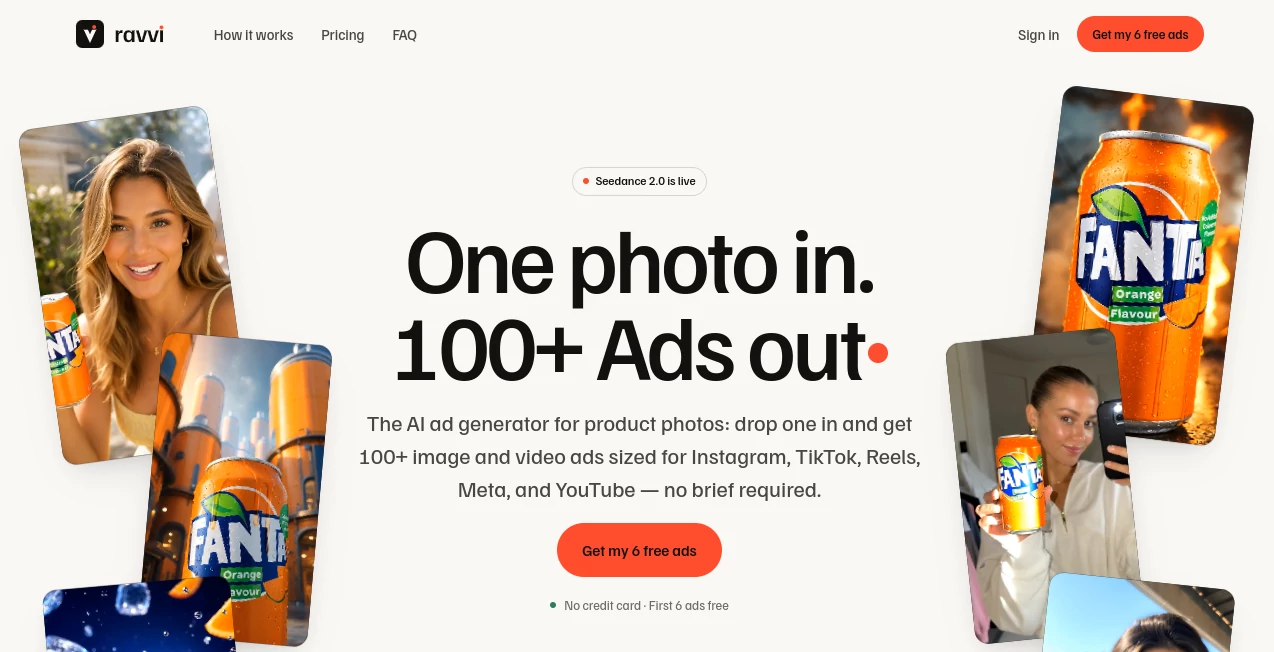
Creating enough advertising creatives for every social platform can quickly become one of the most time-consuming parts of running an online store. A single product may need lifestyle images, square social posts, vertical videos, product-focused visuals, and several variations for testing. Ravvi takes a much simpler approach: start with one product photo and turn it into a broad collection of ready-to-use advertising creatives.
The platform is designed primarily for e-commerce brands, agencies, small marketing teams, solo creators, and freelancers who need more creative output without adding another designer or spending days preparing briefs. A JPG, PNG, or WEBP product image is enough to get started, with no prompt-writing or complicated setup required.
What makes the workflow particularly interesting is its product-first approach. The system analyzes details such as colors, materials, and logo placement before creating new scenes, helping the generated advertising material stay visually faithful to the original product.
Key Features
- Generate more than 100 advertising assets from a single product photo.
- Create both image and short-form video advertisements.
- Produce creatives for Instagram, TikTok, Reels, Meta, YouTube, and other common formats.
- Automatically create wide, square, and vertical versions of advertising content.
- Generate complete campaigns with multiple visual directions.
- Choose between automated, bespoke, and director-style creative workflows.
- Use reference images to guide lighting, composition, color palette, and overall visual direction.
- Keep characters or influencers visually consistent across a collection of creatives.
- Regenerate individual results without replacing previous versions.
- Edit existing generations when a specific detail needs to be changed.
- Upscale images to 4K.
- Create talking-head and voiceover video content.
- Download organized advertising assets and platform-specific packages.
User Interface
The interface is built around a straightforward production process rather than a complicated creative workspace. The main task is simply uploading a product image and deciding how much control you want over the resulting campaign.
There are three main approaches. Full Campaign automatically explores a collection of visual styles, while Bespoke Campaign focuses on custom concepts. Director Campaign gives experienced marketers more control by allowing them to provide a brief and visual references.
This structure is useful because different projects need different levels of involvement. Someone preparing a quick weekend promotion can let the system handle most of the creative decisions, while an agency working with a strict brand identity can provide more direction.
Accuracy & Performance
One of the most important aspects of AI-generated product advertising is keeping the actual product recognizable. The platform analyzes product colors, materials, and logo placement before generating new scenes, with the goal of preventing the product from turning into a visually similar but incorrect version.
The production speed is another major advantage. The company reports that the first 20 creatives from a campaign are typically ready in under three minutes. A complete campaign can then expand into more than 100 assets across different formats and creative directions.
For a small e-commerce team, that difference can be substantial. Instead of waiting through several rounds of creative production, a marketer can generate a wide range of concepts during one working session and then decide which ideas are worth testing.
Capabilities
The system is more than a simple image generator. It combines product imagery, advertising concepts, different art directions, platform formats, and video generation into one workflow.
Full Campaign can automatically explore 20 visual directions. Bespoke Campaign is useful when a brand wants to explore specific concepts, while Director Campaign is aimed at projects where the creative direction matters more. Reference images can also be supplied to influence the lighting, composition, and visual mood.
Video creation is supported as well. Images can be turned into short clips between 4 and 15 seconds, with the output orientation following the intended advertising format. This makes the same product suitable for vertical short-form content, horizontal YouTube placements, or square social feeds.
The underlying workflow routes different tasks to different AI models. Image generation and editing use GPT Image, premium video generation uses Seedance 2.0, standard video generation uses Happy Horse, image upscaling uses Clarity Upscaler, and creative planning uses Claude through the platform's model infrastructure.
Security & Privacy
For businesses working with unreleased products, brand assets, or client campaigns, ownership and data handling are important considerations. The service states that customers own the generated assets, including commercial use, editing, republication, and resale to clients.
It also states that uploaded images are not used to train its models. However, the service uses external model providers for different generation tasks, and those providers process submitted prompts and media under their respective terms. Businesses handling confidential material should therefore review the applicable policies before uploading sensitive assets.
Use Cases
Small e-commerce brands can use the platform to turn a basic product photograph into a much larger advertising library. A new skincare product, for example, could be presented in clean studio scenes, lifestyle settings, editorial compositions, or social-media-oriented creative styles without organizing a separate photo shoot for every variation.
Paid advertising teams can also use the high volume of generated variations for creative testing. Instead of relying on one or two designs, marketers can explore different compositions and visual approaches and then identify which concepts deserve additional investment.
Agencies have another practical use case. A team handling multiple clients can produce a larger number of creative variations without increasing design scheduling at the same rate. Freelancers and solo creators can similarly use the automated workflow to handle more client deliverables while spending more of their time on strategy rather than repetitive production.
The platform can also be useful for seasonal campaigns. A product that needs new creative for a holiday promotion, product launch, limited-time offer, or major shopping period can be adapted into multiple advertising styles without starting the creative process from scratch.
Pros and Cons
Pros
- Turns one product image into a large collection of advertising creatives.
- Requires no prompt-writing for the automated workflows.
- Supports both static images and short video ads.
- Designed specifically around product advertising and e-commerce workflows.
- Supports multiple social and advertising formats.
- Offers different levels of creative control.
- Includes 4K image upscaling on paid plans.
- Generated assets include commercial usage rights according to the service.
- The first six ads can be tested without a credit card.
Cons
- The service is primarily focused on advertising creatives rather than general-purpose image generation.
- Large-scale production requires a paid subscription.
- Video generation can take longer than static image generation.
- Businesses with strict visual requirements may still need to review and refine generated creatives before publishing.
- External AI model providers are involved in parts of the generation workflow, so organizations with strict data policies should review provider terms.
Pricing Plans
The platform offers a free starting option that provides six ads without requiring a credit card. Paid subscriptions are available with annual billing and are aimed at different levels of creative production.
- Creator: $47 per month when billed yearly, with approximately 125 images per month, bespoke concept generation, Director's Cut shot planning, 4K upscaling, talking-head and voiceover video, premium video generation, and unlimited campaigns.
- Studio: $103 per month when billed yearly, with approximately 280 images per month. It includes the same core capabilities as Creator plus priority queue access.
- Scale: $240 per month when billed yearly, with approximately 650 images per month, the full creative feature set, and priority queue access.
Plans can be upgraded, downgraded, or canceled without a long-term contract. The free option is particularly useful for businesses that want to evaluate the quality of the generated product advertising before committing to a subscription.
How to Use It
- Upload a product photo in JPG, PNG, or WEBP format.
- Choose the level of creative control that fits the project.
- For an automated campaign, let the system explore multiple art directions automatically.
- For a more specific concept, use a bespoke campaign or provide a creative brief.
- Use reference images when a particular visual style, lighting setup, or composition needs to be followed.
- Generate the advertising creatives and review the different versions.
- Regenerate or edit individual results when necessary.
- Select the formats required for your advertising channels.
- Download the finished assets and prepare them for publication or campaign testing.
Comparison with Similar Tools
AI advertising platforms are not all designed around the same workflow. Some focus heavily on AI avatars and scripted video advertisements, while others concentrate on templates, brand kits, performance scoring, or campaign management.
This platform takes a more product-centered route. The product itself remains the focus, while the system creates different scenes, compositions, formats, and advertising concepts around it. That makes it particularly appealing to e-commerce businesses where packaging, physical appearance, materials, or product design are central to the advertisement.
Another meaningful difference is the balance between automation and control. A user can let the system generate a broad collection of concepts automatically, or move toward a director-style workflow with briefs, reference images, and character consistency. This makes the tool suitable for both fast experimentation and more deliberate creative production.
It is not designed to replace the advertising platform where campaigns are actually optimized and measured. Instead, its strongest role is the creative production stage: generating enough varied, properly formatted material for a marketing team to test in its own advertising channels.
Conclusion
Producing advertising creatives at scale has traditionally required a combination of product photography, designers, video editors, creative briefs, and multiple rounds of revisions. This approach can work well for major campaigns, but it becomes expensive and slow when a growing e-commerce brand needs dozens of variations every week.
The platform offers a practical alternative by starting with something most online stores already have: a product photo. From there, it can create multiple visual directions, formats, and video variations while keeping the product at the center of the creative.
Its strongest appeal is the combination of speed and creative volume. A small team can explore many advertising ideas without turning every variation into a separate production project. For brands, agencies, freelancers, and performance marketers who need a steady stream of product-focused advertising material, that can make the creative process considerably easier to manage.
Frequently Asked Questions (FAQ)
What type of content can be created?
The platform creates product-focused image and video advertisements, including wide, square, and vertical formats for channels such as Instagram, TikTok, Reels, Meta, and YouTube.
Do I need to know how to write AI prompts?
No. The automated workflows are designed to work without prompt writing. Users can simply upload a product image and choose the desired creative direction.
How many ads can one product photo produce?
The service is built around high-volume creative generation. A full campaign contains 20 initial creative directions and can expand into more than 100 advertising assets across formats and variations.
Can I create video advertisements?
Yes. Product images can be animated into short video clips between 4 and 15 seconds. The resulting video can be prepared for vertical, horizontal, or square advertising placements.
Can I use the generated assets commercially?
According to the service, customers own their generated assets and can use, edit, republish, and resell them commercially, including when delivering creative work to clients.
Does the service train AI models on uploaded images?
The service states that it does not train models on customers' uploaded images. Because different generation tasks are handled through external model providers, businesses should also review the relevant provider policies when working with sensitive material.
Is there a free option?
Yes. New users can receive their first six ads for free without entering a credit card.
Can I regenerate an advertisement?
Yes. Individual results can be regenerated, while editing tools can be used when only certain details need to be changed. Previous versions are retained rather than simply overwritten.
Who is this tool best suited for?
It is particularly well suited to small e-commerce brands, DTC businesses, agencies, paid social teams, freelancers, and solo creators who need a high volume of product advertising creatives without managing a large production workflow.
AI Ad Creative Assistant , AI Ad Generator , AI Advertising Assistant .
These classifications represent its core capabilities and areas of application. For related tools, explore the linked categories above.

Ravvi Alternatives Product
Husslix1.1

LyricStudio
Adchat

Quso AI

Shutterstock

Lutains

Sprokl
TrackRev

ScriptHook