
Rierino AI Agent Builder
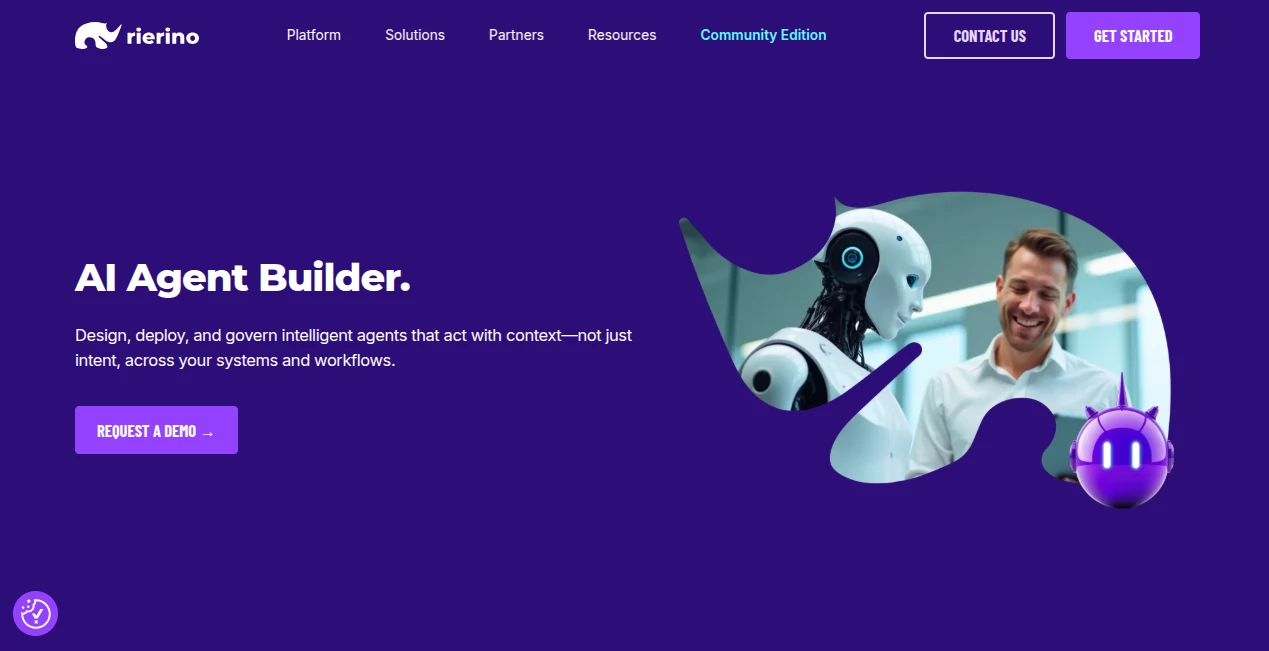
What is Rierino AI Agent Builder?
Modern businesses need AI that goes far beyond answering questions. They need intelligent systems capable of interacting with business applications, executing workflows, making controlled decisions, and integrating with existing infrastructure. This platform was created to meet those expectations by combining enterprise-grade automation with a visual low-code development experience.
Instead of limiting AI to conversational interfaces, it enables organizations to build agents that understand business context, communicate with APIs, trigger workflows, connect to databases, and even interact with IoT devices or physical systems. The result is a flexible environment where teams can create production-ready AI solutions without rebuilding the same logic for every project.
Another major advantage is its execution-first architecture. Developers, architects, and operations teams can reuse workflows across different models, protocols, and deployment environments while maintaining complete governance over security, permissions, and business rules. This makes it especially attractive for enterprises that require both innovation and operational reliability.
Key Features
- Visual low-code AI agent builder
- Multi-LLM compatibility with public and private models
- Reusable workflows across different business scenarios
- Native API and backend integration
- Built-in orchestration engine for complex automation
- Support for MCP, A2A, and Web of Things protocols
- Role-based access control and policy enforcement
- Automatic versioning and audit logging
- Real-time event processing and business rules
- Cross-channel deployment for web, mobile, APIs, and messaging
User Interface
The interface focuses on productivity rather than complexity. Visual workflow designers replace large amounts of manual coding, allowing developers to assemble sophisticated automation through reusable components. Configuration screens are organized logically, making it easier to manage models, prompts, integrations, permissions, and deployment settings from one place.
Even for complex enterprise projects, navigation remains clear, helping technical teams collaborate efficiently while reducing development time.
Accuracy & Performance
One of the strongest aspects of the platform is its ability to combine AI reasoning with structured business logic. Instead of relying solely on language models, responses can be validated through workflows, business rules, external APIs, and live enterprise data. This significantly improves reliability for real-world operations.
The architecture also supports multiple language models, allowing organizations to choose different providers depending on cost, compliance, or performance requirements while maintaining consistent execution logic.
Capabilities
The platform is designed for much more than conversational assistants. AI agents can execute workflows, retrieve enterprise data, trigger notifications, automate approvals, integrate with ERP and CRM platforms, communicate through APIs, and coordinate with other agents.
Its modular architecture allows organizations to reuse automation logic across departments, reducing duplicated work and simplifying long-term maintenance. Built-in support for external services, custom tools, event-driven processes, and physical devices further expands the range of possible use cases.
Security & Privacy
Enterprise environments require strict governance, and security is integrated into every layer. Role-based access control, execution policies, version history, audit logs, and controlled runtime behavior help organizations maintain compliance while deploying intelligent automation.
Human approval workflows can also be incorporated for sensitive actions, ensuring that AI operates within clearly defined business boundaries instead of making unrestricted decisions.
Use Cases
- Enterprise workflow automation
- Customer support automation
- Business process orchestration
- Internal AI assistants
- Contract review and compliance
- ERP and CRM integration
- Multi-agent collaboration
- IoT and smart device automation
- API-driven business operations
- Cross-channel AI deployments
Pros and Cons
- Pros
- Enterprise-ready architecture
- Visual low-code development
- Supports multiple LLM providers
- Strong governance and security controls
- Reusable workflows across projects
- Flexible integration with existing systems
- Suitable for large-scale deployments
- Cons
- May provide more functionality than smaller businesses require.
- Enterprise capabilities can require planning before implementation.
- Some advanced integrations may require technical knowledge.
Pricing Plans
A free Community Edition is available for evaluation and development. Enterprise deployments include additional capabilities, governance features, and commercial support. Organizations can request a demonstration or contact the vendor for enterprise pricing based on their infrastructure and requirements.
How to Use Rierino AI Agent Builder
- Create an account or deploy the Community Edition.
- Configure your preferred language model.
- Design an agent using the visual builder.
- Connect APIs, databases, or business systems.
- Define workflows, rules, and permissions.
- Test agent behavior using real business scenarios.
- Deploy across web applications, APIs, mobile apps, or enterprise systems.
- Monitor activity through logs, version history, and governance tools.
Comparison with Similar Tools
Many AI agent platforms focus primarily on prompt engineering or chatbot experiences. This solution differentiates itself by treating AI agents as fully operational business components rather than isolated conversational interfaces.
Its combination of low-code development, backend orchestration, reusable workflows, enterprise governance, multi-model compatibility, and native integration capabilities makes it particularly well suited for organizations building production-scale AI systems instead of simple assistants.
Conclusion
Organizations looking to move beyond experimental AI projects will appreciate the platform's emphasis on execution, governance, and scalability. It combines intelligent automation with enterprise architecture, allowing AI agents to participate directly in business operations while remaining secure and manageable.
Whether the objective is automating internal processes, connecting enterprise systems, deploying AI across multiple channels, or building sophisticated multi-agent workflows, this solution provides the flexibility and control required for long-term success.
Frequently Asked Questions (FAQ)
Can it work with different AI models?
Yes. Multiple commercial, open-source, and private language models can be integrated depending on organizational requirements.
Is it suitable for enterprise deployments?
Yes. The platform is specifically designed for enterprise-scale automation with governance, security, and reusable architecture.
Can AI agents connect to existing business systems?
Yes. Agents can integrate with APIs, databases, ERP systems, CRM platforms, workflows, and external services.
Does it support workflow automation?
Yes. Visual orchestration tools allow complex business workflows and automations to be designed without extensive manual coding.
Is there a free version available?
Yes. A Community Edition is available for developers and organizations that want to evaluate the platform before adopting enterprise capabilities.
AI Workflow Management , AI API Design , AI Business Ideas Generator , AI Developer Tools .
These classifications represent its core capabilities and areas of application. For related tools, explore the linked categories above.
Rierino AI Agent Builder details
Website unavailable — View Alternatives
Pricing
- Freemium
Apps
- Web App
Categories

Rierino AI Agent Builder Alternatives Product

LocaFlow

GetVivix

HeyZinc

Neurohelper

Simple Dev T…

Emergent
Kimi K2.5

ShipAhead

Skillselion