
Scaleway
What is Scaleway?
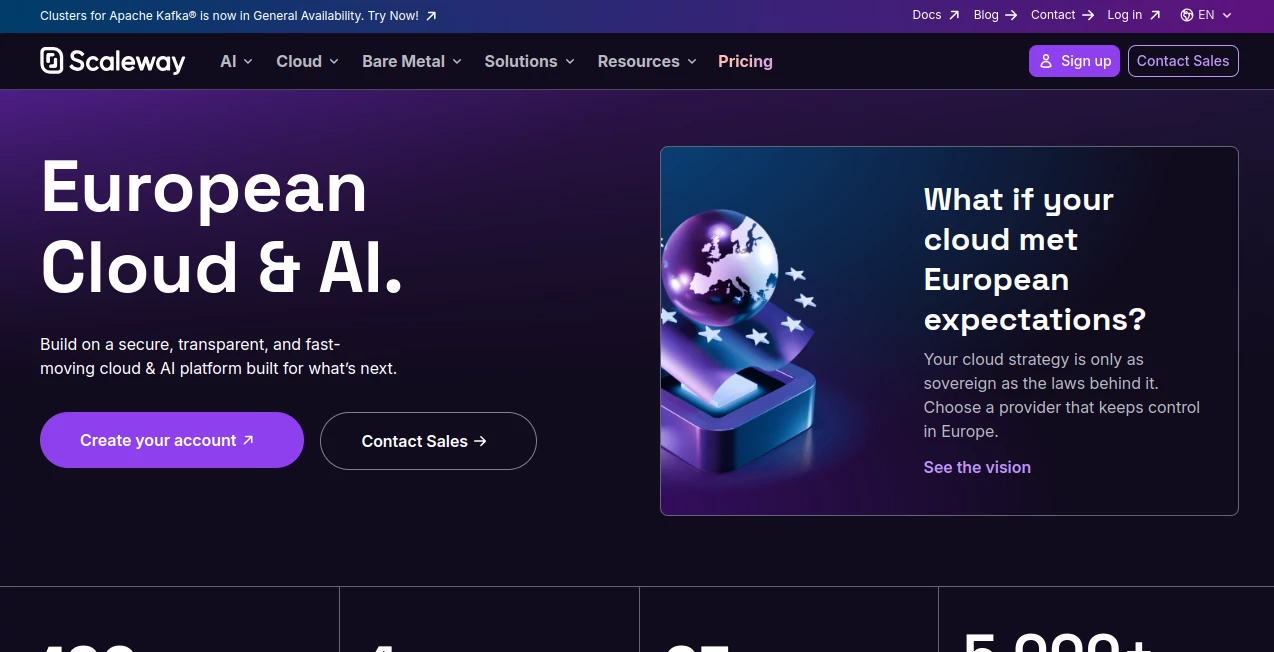
Scaleway is a European cloud and AI platform built for developers, startups, technology companies, and organizations that need dependable infrastructure without giving up control over their data. Its portfolio covers everything from virtual machines and dedicated servers to managed databases, Kubernetes, serverless computing, storage, networking, and GPU-powered AI infrastructure.
What makes the platform particularly interesting is its European focus. Customers can build applications and services on infrastructure designed around data sovereignty, transparent pricing, and open technologies. For a developer launching a new SaaS product or a team running demanding AI workloads, having compute, storage, networking, and specialized GPU resources under one cloud ecosystem can make infrastructure planning considerably simpler.
Key Features
The platform brings together more than 100 cloud and AI products, giving users plenty of room to start small and expand as their requirements change. Virtual Instances cover development, general-purpose, compute-optimized, and memory-optimized workloads, while bare-metal options provide dedicated hardware for applications that require greater control.
AI workloads are another major part of the offering. GPU instances include NVIDIA L4, L40S, and H100 options, while AI services also include generative APIs and dedicated AI infrastructure. For teams building modern applications, the combination of GPU computing and cloud-native services can remove much of the infrastructure work that would otherwise sit between an idea and a working product.
User Interface
The cloud environment is designed around developers and technical teams rather than casual users. Services can be managed through the cloud console, while APIs, command-line tools, documentation, tutorials, and code examples provide additional ways to work with infrastructure.
The product ecosystem is organized into areas such as Compute, Storage, Network, Containers, AI, Databases, Security, and Managed Services. That structure makes it easier to find the right building block instead of navigating through an unrelated collection of hosting products.
Accuracy & Performance
For a cloud infrastructure provider, performance is less about a single benchmark and more about having the right resources available for different workloads. The platform offers multiple compute profiles, dedicated bare-metal machines, serverless services, Kubernetes infrastructure, and specialized GPUs.
Its European infrastructure is distributed across multiple regions and availability zones, which can help businesses design applications for resilience and lower latency. The availability of compute-optimized and memory-optimized instances is also useful when a standard virtual machine is not the right fit for a particular workload.
Capabilities
The range of capabilities is one of the strongest aspects of the platform. Developers can deploy virtual machines, dedicated servers, containers, Kubernetes clusters, serverless applications, databases, object storage, block storage, private networks, load balancers, and security services from the same ecosystem.
AI teams have access to GPU infrastructure for model development and inference, along with generative AI APIs and larger GPU-based environments. This makes the platform suitable for projects ranging from a simple web application to more demanding machine learning and generative AI workloads.
There are also managed services for technologies such as PostgreSQL, MySQL, Redis, MongoDB, OpenSearch, and RabbitMQ. For a small engineering team, managed services can be particularly valuable because they reduce the amount of routine infrastructure maintenance required.
Security & Privacy
Security and data sovereignty are central to the platform's positioning. Its infrastructure is European, and the company emphasizes GDPR compliance, data control, and protection from extraterritorial legislation such as the US CLOUD Act.
Security capabilities include native DDoS protection, identity and access management, secret management, encryption key management, private networking, and web application security services. The provider also states that its infrastructure is operated around the clock with a dedicated security incident response team.
Its security portfolio includes ISO/IEC 27001:2022 certification and HDS certification for health data hosting, while SecNumCloud qualification is currently undergoing assessment. Organizations working in regulated environments should still review the exact certification and service scope applicable to their particular architecture before deployment.
Use Cases
SaaS applications: Development and production workloads can be hosted using virtual machines, containers, Kubernetes, managed databases, storage, and networking services.
AI and machine learning: GPU instances and AI services provide infrastructure for model training, inference, experimentation, and generative AI applications.
Web applications: Developers can combine compute instances with load balancing, storage, private networks, domains, DNS, and edge services to build complete application stacks.
Data-intensive projects: Managed databases, object storage, block storage, and specialized compute options make the platform suitable for applications handling significant amounts of structured and unstructured data.
Containerized applications: Kubernetes and serverless container services can help engineering teams deploy applications without building every part of the underlying orchestration layer themselves.
European data hosting: Organizations that need greater control over where their information is stored can use European infrastructure and architecture options designed around data sovereignty.
Pros and Cons
- Pros: Broad cloud and AI product portfolio
- Pros: Strong European data sovereignty positioning
- Pros: Virtual machines, bare metal, Kubernetes, serverless, storage, databases, and networking in one ecosystem
- Pros: Dedicated NVIDIA GPU options for demanding AI workloads
- Pros: Transparent, pay-as-you-go pricing across many services
- Pros: Extensive developer documentation, APIs, CLI tools, and technical resources
- Cons: The large product catalog can feel overwhelming for someone new to cloud infrastructure
- Cons: Advanced services require technical knowledge to configure correctly
- Cons: Pricing and resource availability vary considerably depending on the selected infrastructure and workload
Pricing Plans
Instead of relying on one fixed subscription, the platform generally uses service-based cloud pricing. Customers can choose the resources they need and pay according to the selected products and consumption model.
Virtual Instances are available across several workload categories, while dedicated servers, bare-metal infrastructure, GPUs, storage, databases, serverless services, and networking have their own pricing structures. Some services also provide savings options for customers willing to commit to longer usage.
One useful aspect of the pricing approach is transparency. The provider publishes product-level pricing and emphasizes predictable billing, with many services offering free egress. Because infrastructure costs can vary significantly between workloads, checking the current pricing calculator before deploying a production architecture is recommended.
How to Use It
Start by creating an account and identifying the workload you want to deploy. A small application might only need a virtual machine, while a larger SaaS product could require containers, a managed database, object storage, private networking, and load balancing.
For an AI project, begin by estimating the model size, GPU requirements, storage needs, and expected traffic. From there, select an appropriate GPU or AI service and connect it to the rest of your application infrastructure.
Developers can also use APIs and command-line tools when they prefer infrastructure-as-code or automated deployment workflows. The documentation and tutorials are useful for moving from a basic test environment toward a more structured production setup.
Comparison with Similar Tools
Compared with traditional hosting providers, this platform offers a much broader infrastructure stack. It is not limited to website hosting or virtual private servers; users can move into Kubernetes, serverless computing, managed databases, GPU infrastructure, private networking, and AI services as their requirements grow.
Compared with large global hyperscalers, its strongest distinction is its European identity and focus on sovereignty, transparent pricing, and open technologies. That can be especially attractive to European businesses or teams that want more control over where their data and infrastructure reside.
For developers, the decision ultimately comes down to workload requirements. A simple website may not need such a broad cloud ecosystem, but a growing software company, AI startup, or engineering team can benefit from having many infrastructure components available from one provider.
Conclusion
For developers who want more than basic hosting, this platform offers a substantial collection of infrastructure and AI services under one roof. Its combination of compute, bare metal, containers, serverless technology, databases, storage, networking, and GPU resources gives teams plenty of flexibility as projects evolve.
The European infrastructure and emphasis on data sovereignty add another compelling reason to consider it, particularly for organizations with privacy, regulatory, or regional hosting requirements. Pricing transparency is another welcome advantage for teams that need to keep a close eye on infrastructure spending.
It is not the simplest choice for someone who only wants to publish a small website, but for developers and businesses building serious applications, SaaS products, data platforms, or AI systems, the breadth of available infrastructure makes it a strong option worth evaluating.
Frequently Asked Questions (FAQ)
What is this platform mainly used for?
It is primarily used for cloud computing, application hosting, databases, storage, networking, containers, serverless applications, dedicated infrastructure, and AI workloads.
Can it be used for AI projects?
Yes. AI offerings include NVIDIA GPU instances, generative AI APIs, managed inference capabilities, and larger GPU infrastructure designed for demanding machine learning workloads.
Does it offer virtual machines?
Yes. Virtual Instances are available for development, general-purpose workloads, compute-intensive applications, and memory-intensive workloads.
Does it support Kubernetes?
Yes. The platform provides managed Kubernetes services as well as other container-focused products for deploying and scaling modern applications.
Is it suitable for European businesses?
It can be particularly attractive to European organizations because its infrastructure and services are designed around European data sovereignty, GDPR considerations, and regional data hosting.
Does it offer dedicated servers?
Yes. Dedicated server and bare-metal options are available for workloads that require dedicated hardware, higher control, or predictable physical resources.
How is cloud pricing calculated?
Pricing depends on the specific services and resources selected. The platform publishes pricing for compute, GPUs, storage, databases, networking, bare metal, and other services, allowing customers to estimate costs before deployment.
Is it suitable for startups?
Yes. Startups can begin with relatively small compute resources and expand into managed databases, containers, storage, networking, and AI infrastructure as their applications grow.
Can developers manage services through an API?
Yes. API access, command-line tools, documentation, tutorials, and developer resources are available for teams that want to automate cloud management and deployment workflows.
Other , Code & IT , AI Developer Tools , AI DevOps Assistant .
These classifications represent its core capabilities and areas of application. For related tools, explore the linked categories above.

Scaleway Alternatives Product

The Audio St…

Ultimate Too…

Project Mela

Black Screen

ChatView-AI …

ColoringWell

Website Clon…

Aback Tools

Hunty Zombie…