


















ShipFit
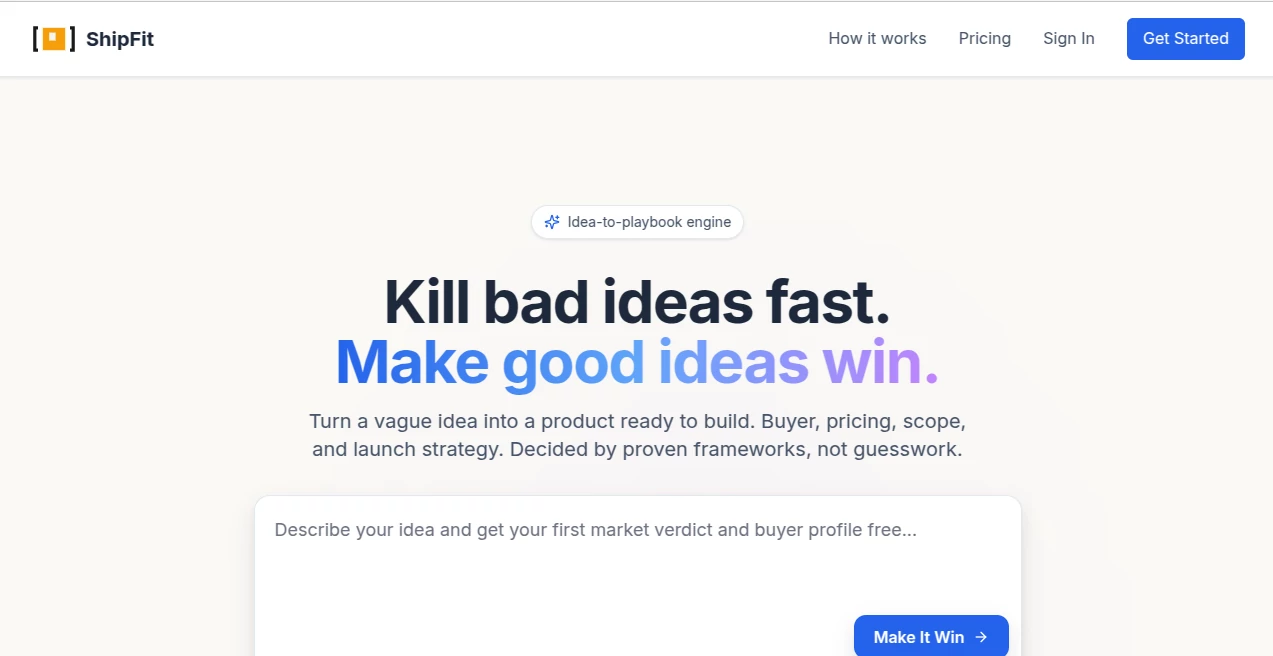
What is ShipFit?
Turning an idea into a real product is rarely difficult because founders lack ideas. The harder part is knowing which ideas deserve time, money, and development effort. ShipFit takes a structured approach to this problem by turning an early product concept into a practical decision-making playbook covering the market, buyer, pain points, competition, MVP scope, pricing, demand, and launch strategy.
The experience starts with something deliberately simple: a description of the problem or idea. From there, the platform works through a fixed sequence of decisions instead of treating product validation like an open-ended chat. This makes it particularly useful for founders who have a promising concept but want stronger evidence before committing weeks or months to development.
One of its strongest ideas is that validation should lead to decisions. Instead of stopping at market research, users can finish with a clearer buyer profile, product scope, pricing direction, launch plan, and technical handoff materials.
Key Features
- Structured nine-stage product validation process
- Market validation covering TAM, SAM, SOM, timing, and competition
- Buyer profiling with willingness-to-pay and purchasing considerations
- Pain-point ranking based on severity and frequency
- Competitive positioning using market evidence
- MVP scoping with Lean, Balanced, and Full approaches
- Pricing architecture and competitive pricing analysis
- Demand validation and smoke-test planning
- Launch strategies with practical channel playbooks
- Exports designed for modern AI coding environments
- Research supported by real-world sources and review platforms
- A library of established business and startup frameworks
User Interface
The interface is built around decisions rather than a conventional chatbot conversation. Each stage has a specific question, such as whether the product is worth building, who will pay, what problem hurts most, how the product can compete, and what should be included in the first version.
This approach keeps the workflow focused. A founder who tends to jump from idea to idea can see exactly what has been decided and what still needs attention. The guided sequence also makes the process easier to follow than a collection of disconnected research tools.
Accuracy & Performance
The platform puts considerable emphasis on evidence rather than relying entirely on generic AI-generated assumptions. Its market analysis can examine competitors, pricing, and customer complaints using sources such as company websites, Trustpilot, G2, App Store reviews, Google Play, and Capterra.
That distinction matters when evaluating a business idea. A polished answer saying that a market is “growing rapidly” is not particularly useful without evidence. The platform instead aims to connect important decisions with market signals and supporting sources.
Of course, market research should still be treated as decision support rather than a guarantee of success. Real customer conversations and actual buying behavior remain important once an idea moves beyond the research stage.
Capabilities
The core workflow covers nine major decisions. It begins with market validation, then identifies the buyer, ranks the problem, establishes a competitive angle, defines the V1 scope, develops a pricing structure, tests demand, plans the launch, and finally prepares the project for development.
The framework library adds another useful layer. It includes approaches such as The Mom Test, Jobs-to-be-Done, 7 Powers, Van Westendorp Price Sensitivity, Blue Ocean Strategy, Fake Door Testing, TAM/SAM/SOM analysis, Porter's Five Forces, market timing analysis, and unit economics.
The MVP stage is especially practical for founders who have a habit of putting too many features into version one. Candidate features can be evaluated and organized into a more realistic build sequence instead of becoming a two-year product roadmap.
Another interesting capability is the development handoff. Completed research can be exported into formats intended for environments such as Cursor, Claude Code, Windsurf, Replit, Lovable, v0, and Gemini. This can reduce the gap between deciding what to build and actually starting development.
Security & Privacy
Product ideas can contain sensitive business information, including positioning, pricing assumptions, customer research, and planned features. Anyone using an AI-powered business research platform should therefore review the provider's current privacy policy and terms before entering confidential information.
For early-stage validation, it is sensible to avoid submitting trade secrets, private customer information, credentials, unreleased proprietary code, or other information that does not need to be included in the research process.
Use Cases
- Startup idea validation: Founders can test whether a concept has a credible market before investing heavily in development.
- SaaS planning: SaaS founders can work through buyer definition, competition, pricing, MVP scope, and launch planning in one workflow.
- Product discovery: Product teams can use structured frameworks to rank problems and decide which capabilities belong in the first release.
- Solo founders: Individuals without a large strategy or research team can use the guided process to organize important product decisions.
- Non-technical founders: The workflow can help turn a business concept into a more concrete product specification before development begins.
- AI-assisted development: Exportable project instructions can provide a useful starting point for coding with modern AI development environments.
- Pricing research: Entrepreneurs can explore competitive positioning, pricing tiers, and unit economics before choosing a commercial model.
Pros and Cons
Pros
- Clear step-by-step product validation workflow
- Focuses on decisions rather than endless brainstorming
- Combines market research with product planning
- Includes established startup and business frameworks
- Useful MVP scoping and prioritization features
- Provides pricing and launch strategy guidance
- Supports exports for several AI coding environments
- Pay-as-you-go credits do not expire
Cons
- It is primarily designed for product and startup validation rather than general-purpose business analysis.
- Research outputs should still be checked against direct customer conversations and current market conditions.
- Users looking only for quick brainstorming may find the structured process more detailed than necessary.
- Some advanced validation work may require moving beyond AI research into real-world testing.
Pricing Plans
The platform currently offers a low-cost way to test the workflow without committing to a large subscription. The Taster Pack provides 10 credits for a one-time payment of $5 and covers the process through MVP scoping, including the market verdict, buyer profile, competitive angle, and MVP scope.
The Starter Pack provides 20 credits for a one-time payment of $10 and extends the workflow across all nine stages. It adds pricing strategy, launch planning, and exports for AI coding environments. Both pay-as-you-go options use credits that do not expire.
This pricing structure is particularly appealing for founders who are validating a single idea. Instead of paying for a recurring subscription immediately, they can purchase a small credit pack, test the concept, and decide later whether they need more capacity.
How to Use It
- Start with a concise description of the product idea and the problem it is intended to solve.
- Work through the market validation stage and review the available market evidence.
- Define the target buyer and understand who is most likely to pay for the product.
- Rank the customer's most important problems instead of treating every pain point equally.
- Review the competitive landscape and identify a realistic positioning angle.
- Define the V1 product scope and remove features that do not belong in the first release.
- Develop a pricing architecture based on competitors, positioning, and economics.
- Prepare a demand test to see whether potential customers are actually willing to take action.
- Create a launch plan covering suitable acquisition channels and messaging.
- Export the resulting product context and development instructions when the concept is ready to build.
Comparison with Similar Tools
Many AI assistants are useful for brainstorming business ideas, writing business plans, or generating product concepts. The main difference here is the emphasis on a fixed decision process. Rather than asking an AI assistant a series of unrelated questions, the workflow connects each decision to the previous one.
Traditional market research tools can also provide useful information, but they often leave the founder responsible for turning that information into a product decision. This platform attempts to connect research with concrete outputs such as buyer definition, MVP scope, pricing, demand testing, and launch planning.
It also sits between strategy software and AI development tools. The goal is not simply to generate a product specification or write code. The more interesting proposition is to decide whether the product deserves to be built before handing structured information to an AI coding environment.
Conclusion
For founders, product managers, and entrepreneurs who want to pressure-test an idea before building it, this platform offers a thoughtful alternative to unstructured AI brainstorming. Its strongest feature is the discipline of the workflow: market, buyer, pain, competition, scope, pricing, demand, launch, and finally development.
The combination of established frameworks, market evidence, MVP planning, pricing analysis, demand testing, and coding exports makes the experience more useful than a simple idea generator. It does not eliminate the need for talking to customers or testing a real market, but it can make those decisions more organized and considerably easier to act on.
For someone sitting on a promising SaaS or startup concept and wondering whether to build it, spending a few dollars on structured validation can be a much cheaper experiment than spending several weeks building the wrong product.
Frequently Asked Questions (FAQ)
What is this tool mainly used for?
It is designed to validate product ideas and turn them into structured plans covering the market, buyer, competition, MVP, pricing, demand, and launch.
Can it help me decide whether an idea is worth building?
Yes. The first stage produces a market verdict designed to help founders decide whether to proceed, pivot, or abandon an idea based on available evidence.
Does it help define an MVP?
Yes. The MVP stage creates a feature-focused scope and can organize the product into Lean, Balanced, and Full approaches rather than encouraging an oversized first release.
Can it help with pricing?
Yes. Its pricing stage covers pricing architecture, competitive positioning, and unit economics so founders can make a more informed commercial decision.
Can I use it for launch planning?
Yes. The launch stage provides channel-focused playbooks along with practical copy templates, social content ideas, and email sequences.
Does it work with AI coding tools?
Yes. The platform can export project information and instructions for environments including Cursor, Claude Code, Windsurf, Replit, Lovable, v0, and Gemini.
How much does it cost to get started?
The entry-level Taster Pack costs $5 for 10 credits, while the Starter Pack costs $10 for 20 credits. The credits do not expire.
Is it a replacement for customer interviews?
No. It can organize research and validation decisions, but direct conversations with potential customers and real-world demand testing remain important parts of evaluating a new product.
Who would benefit most from using it?
It is particularly useful for startup founders, solo entrepreneurs, SaaS builders, product teams, and non-technical founders who want to validate an idea and create a practical path toward development.
AI Roadmap Generator , AI Research Tool , AI Business Ideas Generator , AI Consulting Assistant .
These classifications represent its core capabilities and areas of application. For related tools, explore the linked categories above.

ShipFit Alternatives Product

ModelsLab

HISAB 360

Chrome Sidek…

KoloQR

Skygen AI

Debate Tello…

ForexCoupons

SaasThink

AlphaTax
