


















Site Audit Score
What is Site Audit Score?
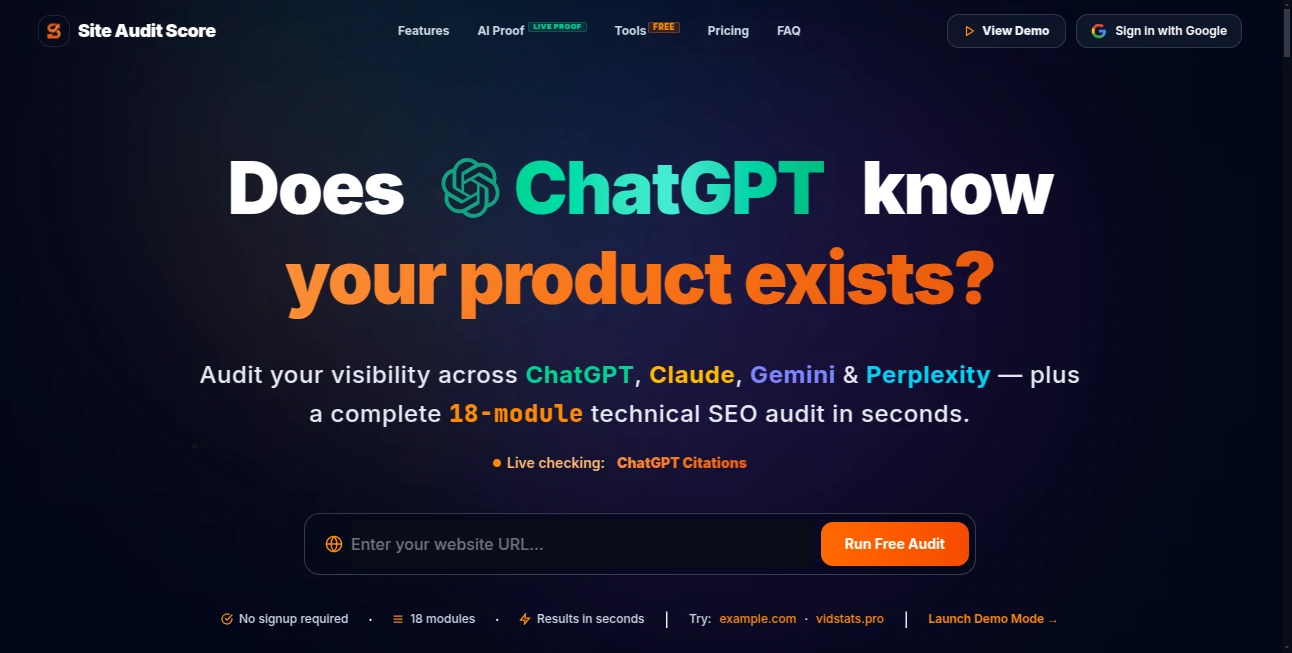
Site Audit Score is a website auditing platform built for people who want a clearer picture of how their website performs in search engines and AI-powered search environments. Instead of jumping between several separate tools, users can enter a website address and receive a broad audit covering technical SEO, on-page factors, content, schema, performance, accessibility, mobile readiness, and AI visibility.
One of its most interesting aspects is the combination of traditional SEO auditing with visibility across generative platforms such as ChatGPT, Gemini, Claude, and Perplexity. This makes the service particularly relevant for website owners who are no longer thinking only about Google rankings, but also about how their brand and content are discovered and referenced by AI systems.
The audit can be started without creating an account, and the website states that results are produced within seconds. For someone trying to find the biggest technical or visibility problems on a site without spending an afternoon checking individual reports, that is a practical approach.
Key Features
- 18 parallel website audit modules
- Technical SEO and crawlability checks
- On-page SEO analysis
- Content and E-E-A-T evaluation
- JSON-LD and schema markup validation
- Image optimization checks
- Sitemap and website architecture analysis
- AI and GEO visibility analysis
- SXO and user experience checks
- Core Web Vitals and page performance analysis
- Security and response-header checks
- Link and internal linking analysis
- Accessibility auditing
- International SEO checks
- Mobile optimization checks
- Indexability and link equity analysis
- SEO drift monitoring concepts
User Interface
The interface keeps the starting point simple: enter a website URL and launch an audit. The results are organized into separate modules, making it easier to understand which part of a website needs attention rather than presenting one large, confusing score.
The report structure is especially useful for marketers and developers who want to move from a high-level overview to individual technical checks. Categories such as Technical, On-Page, Content, Schema, Images, Architecture, AI/GEO, Performance, Security, Mobile, and Indexability give the audit a logical structure.
Accuracy & Performance
The platform is designed to run multiple audit modules in parallel rather than treating every check as a separate sequential process. This approach is useful when speed matters, particularly during a website launch, SEO review, migration, or client audit.
Its performance module looks at important metrics such as Largest Contentful Paint, Interaction to Next Paint, Cumulative Layout Shift, First Contentful Paint, and Time to First Byte. The audit also examines image dimensions, lazy loading, modern image formats, and other factors that can affect page experience.
Capabilities
The technical SEO section goes beyond basic metadata checks. It examines canonical tags, robots.txt directives, redirect chains and loops, HTTP response codes, and crawl-related configuration. The on-page module reviews title tags, meta descriptions, heading structure, keyword placement, and thin content signals.
There is also a strong focus on site architecture. Sitemap validation, orphan-page detection, click depth, duplicate metadata, and near-duplicate content checks can help reveal structural problems that are easy to miss when reviewing individual pages manually.
For modern search strategies, the AI and GEO module is one of the more distinctive parts of the platform. It evaluates visibility and citation signals across major generative search systems, including ChatGPT, Gemini, Claude, and Perplexity. This gives businesses another way to think about discoverability beyond conventional search rankings.
Security & Privacy
The service is designed around website auditing rather than requiring extensive technical setup on the user's server. The site promotes a zero-setup audit experience, allowing a website URL to be submitted directly for analysis.
As with any external auditing service, businesses should still review the provider's privacy policy and terms before using it for sensitive or private websites. For public-facing websites, the URL-based audit model keeps the initial process straightforward.
Use Cases
Website owners can use the platform as a quick health check before making major SEO decisions. For example, if organic traffic suddenly falls, an audit can help identify issues involving indexing, redirects, metadata, technical configuration, performance, or site architecture.
SEO professionals can also use it when reviewing a new client website. Rather than preparing a report from several unrelated tools, the 18-module structure provides a broader starting point for identifying areas that deserve deeper investigation.
Developers may find the technical sections useful during website migrations and redesigns. Canonical configuration, robots.txt rules, HTTP responses, sitemap structure, performance metrics, and mobile behavior are all areas where small mistakes can have large consequences.
It is also useful for businesses beginning to focus on generative search. A website can perform reasonably well in traditional search while still having limited visibility in AI-generated answers. The AI/GEO checks provide a way to investigate that newer layer of discoverability.
Pros and Cons
- Pros: Broad coverage across 18 audit modules.
- Pros: Combines technical SEO with AI and GEO visibility analysis.
- Pros: Includes useful checks for Core Web Vitals and page performance.
- Pros: Covers sitemap structure, indexing, schema, images, links, accessibility, and mobile SEO.
- Pros: The initial audit does not require a lengthy setup process.
- Cons: The breadth of the report may feel overwhelming to beginners.
- Cons: AI visibility metrics are part of a relatively new and evolving area of search measurement.
- Cons: A website audit identifies problems, but technical fixes may still require developer or SEO expertise.
Pricing Plans
The platform currently promotes a free audit experience that allows users to enter a website URL and inspect the available audit results without signing up first. This is a useful way to understand the type of information provided before deciding whether the service fits a particular workflow.
Because pricing and credit-based access can change as the product develops, users should check the current pricing section on the website before purchasing credits or choosing a paid option. The free audit is particularly convenient for a first assessment or for testing the platform on a prospective project.
How to Use the Tool
- Open the website auditing platform.
- Enter the URL of the website you want to analyze.
- Start the free audit.
- Wait for the audit modules to complete their checks.
- Review the overall findings and individual module scores.
- Look closely at technical SEO, indexing, schema, performance, content, and architecture issues.
- Review the AI/GEO section to understand how the website may appear across generative search platforms.
- Prioritize the issues that have the greatest potential effect on search visibility and user experience.
- Apply the recommended fixes and run another audit when appropriate.
Comparison with Similar Tools
Many SEO platforms concentrate heavily on keyword rankings, backlinks, or traditional technical auditing. This platform takes a somewhat broader route by putting technical SEO and AI visibility in the same auditing workflow.
For someone who only needs a backlink database or keyword research platform, a specialized SEO product may be a better fit. However, website owners looking for a consolidated technical review can benefit from having crawlability, metadata, schema, performance, accessibility, architecture, and AI visibility checks together.
The AI/GEO component is particularly useful for teams adapting their SEO strategy to the growing role of generative search. Rather than treating AI discovery as a completely separate subject, the audit places it alongside the technical foundations that make a website easier for search systems to understand.
Conclusion
A good website audit should do more than produce a number. It should help explain why a website is performing the way it is and point toward practical areas for improvement. That is where this platform makes a strong impression.
Its combination of 18 audit modules, technical SEO analysis, performance checks, schema validation, site architecture review, and AI visibility monitoring gives website owners a wide view of their search presence. The ability to start with a URL and receive results without a complicated setup also makes it approachable for quick investigations.
For SEO professionals, developers, marketers, and site owners who want to understand both traditional search health and emerging AI visibility, it offers a useful starting point for finding problems and deciding what deserves attention next.
Frequently Asked Questions (FAQ)
What does the platform audit?
It audits multiple areas of a website, including technical SEO, on-page SEO, content, schema, images, site architecture, AI/GEO visibility, user experience, performance, security, links, accessibility, international SEO, mobile optimization, and indexability.
Does it check AI search visibility?
Yes. The AI/GEO module evaluates visibility and citation-related signals across platforms such as ChatGPT, Gemini, Claude, and Perplexity.
How many audit modules are included?
The website currently presents 18 parallel audit modules covering different aspects of SEO, website health, performance, and AI visibility.
Can I run an audit without signing up?
Yes. The website currently offers a free audit that can be started by entering a website URL, with no signup required for the initial audit experience.
Does it check Core Web Vitals?
Yes. The performance module checks metrics including LCP, INP, CLS, FCP, and TTFB as part of its website performance analysis.
Can it check schema markup?
Yes. The schema module checks JSON-LD structures, rich-result eligibility, common schema types, BreadcrumbList markup, required properties, and structural relationships.
Is it useful for SEO agencies?
It can be useful for agencies that need a broad first-pass audit of client websites. The combination of technical, on-page, architecture, performance, and AI visibility checks can provide a practical starting point for a more detailed SEO review.
Is the audit a replacement for an SEO professional?
No. An automated audit is best viewed as a diagnostic starting point. It can identify technical and optimization issues, while strategic decisions and complex fixes may still require an experienced SEO specialist or developer.
AI SEO Assistant , AI Analytics Assistant .
These classifications represent its core capabilities and areas of application. For related tools, explore the linked categories above.
Site Audit Score details
Website unavailable — View Alternatives
Pricing
- Free
Apps
- Web App
Categories

Site Audit Score Alternatives Product

Meev

Read

LLaMaRush

Serplux

Ecom Mediate…

igrecent

Lutains

AiDisco

Domain Rank …
