


















SocialKit
What is SocialKit?
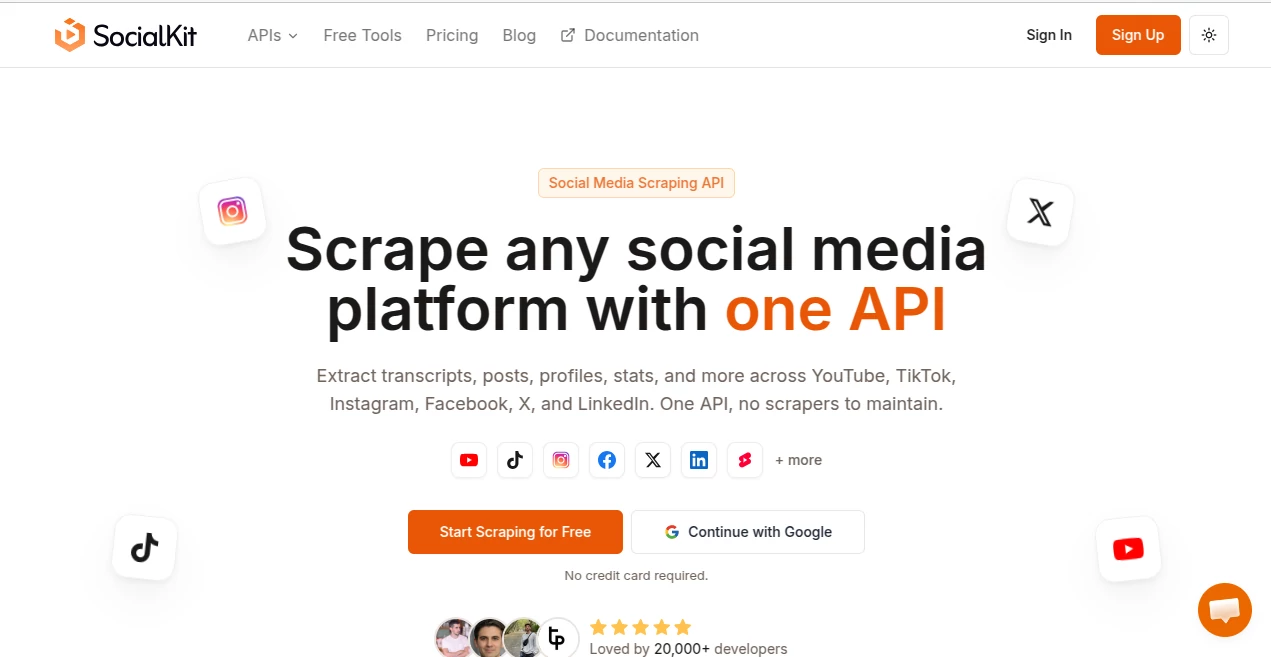
SocialKit is a modern platform built for developers, marketers, automation specialists, and AI teams that need reliable access to structured social media data. Instead of maintaining multiple scrapers for different platforms, it offers a unified API that retrieves transcripts, summaries, engagement metrics, profiles, comments, posts, and other valuable information from popular social networks through a consistent JSON response.
Whether you're creating AI agents, building analytics dashboards, monitoring creators, researching competitors, or automating content workflows, this platform dramatically reduces development time. It supports leading platforms including YouTube, TikTok, Instagram, Facebook, X (Twitter), LinkedIn, and even uploaded video files, making cross-platform data collection remarkably straightforward.
One of the most impressive aspects is its developer-first philosophy. Clean documentation, predictable API responses, generous testing options, and seamless integration with automation tools allow teams to focus on building products rather than maintaining fragile scraping infrastructure.
Key Features
User Interface
The dashboard is intentionally simple and easy to navigate. Developers can quickly explore available endpoints, test API requests, inspect sample JSON responses, and integrate endpoints without unnecessary complexity. Documentation is organized clearly, making onboarding much faster than many competing data extraction services.
Accuracy & Performance
The service returns structured data instead of raw HTML, eliminating the need for complex parsing logic. AI-generated summaries, transcripts, profile statistics, engagement metrics, comments, and search results are delivered in standardized JSON formats, allowing applications to consume data consistently across multiple platforms.
Capabilities
The platform supports more than forty APIs covering YouTube, Shorts, TikTok, Instagram, Facebook, X, LinkedIn, and video files. Available capabilities include transcript extraction, AI summaries, comments, creator profiles, engagement statistics, playlist information, company data, searches, hashtags, downloads, and custom AI analysis. It also integrates with REST APIs, MCP servers, automation platforms, and AI frameworks for advanced workflows.
Security & Privacy
API authentication is handled through secure access keys, while structured endpoints reduce unnecessary exposure to raw web content. Businesses can integrate data into internal dashboards, AI pipelines, databases, or enterprise workflows while maintaining predictable and secure API access.
Use Cases
Development teams can build AI assistants that summarize social media content automatically. Marketing agencies can monitor creator performance across multiple platforms without switching between separate tools. Research organizations can collect engagement metrics for trend analysis, while SaaS companies can enrich products with transcripts, profile information, and video insights.
Content creators can transform long videos into blog articles, newsletters, summaries, or documentation. Automation specialists can connect workflows to platforms like Zapier, Make, or n8n, enabling social media data to flow directly into spreadsheets, CRMs, knowledge bases, or reporting systems.
Pros and Cons
Pros
- Supports multiple major social platforms through one unified API.
- Clean JSON responses reduce development time.
- Comprehensive transcript and AI summary capabilities.
- Developer-friendly documentation.
- Easy integration with AI agents and automation tools.
- Free plan available for testing.
Cons
- Primarily designed for developers and technical users.
- Credit-based pricing may require monitoring for large-scale projects.
- Advanced implementations benefit from API experience.
Pricing Plans
A free plan allows new users to test the service without requiring a credit card. Paid subscriptions scale with monthly credits and higher request limits, making them suitable for startups, growing businesses, and enterprise teams. Larger plans include increased throughput and priority support for demanding production workloads.
How to Use SocialKit
Start by creating an account and obtaining an API access key. Choose the desired endpoint based on the type of social media data you need, such as transcripts, summaries, comments, profile information, or engagement statistics. Send the target URL through the API request, receive a structured JSON response, and integrate the results into your application, AI workflow, dashboard, or automation platform.
Comparison with Similar Tools
Many scraping solutions focus on a single social platform or require developers to maintain multiple independent scrapers. This platform simplifies the entire process by providing one consistent API across several major networks. Its combination of AI-powered summaries, transcript generation, standardized responses, automation support, and extensive endpoint coverage makes it especially valuable for modern AI applications and SaaS products that depend on reliable social media data.
Conclusion
For teams that rely on social media intelligence, structured content extraction, or AI-powered automation, this platform offers an impressive balance of flexibility, reliability, and developer experience. Instead of spending valuable engineering resources maintaining scrapers for each network, developers receive production-ready APIs that simplify data collection across multiple platforms. Its broad feature set, excellent documentation, and scalable pricing make it a compelling choice for startups, enterprises, marketers, and AI builders alike.
Frequently Asked Questions (FAQ)
Does it support multiple social media platforms?
Yes. It supports YouTube, TikTok, Instagram, Facebook, X (Twitter), LinkedIn, and video files through a unified API.
Can it generate AI summaries?
Yes. Video summaries, key points, transcripts, and structured AI-ready outputs are available through dedicated endpoints.
Is there a free plan?
Yes. A free tier allows developers to test the APIs before upgrading to paid plans.
Who is this platform designed for?
It is ideal for developers, AI engineers, SaaS companies, marketing teams, automation specialists, and researchers who need structured social media data.
Can it be integrated into automation workflows?
Yes. It works with REST APIs, AI frameworks, MCP, and automation platforms such as Zapier, Make, and n8n.
AI Research Tool , AI API Design , AI Analytics Assistant , AI Developer Tools .
These classifications represent its core capabilities and areas of application. For related tools, explore the linked categories above.

SocialKit Alternatives Product

Toonifyit

Standard Com…

tanship
JSON to TOON…

Docubix

Free Marketi…

CoolVerdict

freellm.net

Yorph AI
