
Socialprofiler
What is Socialprofiler?
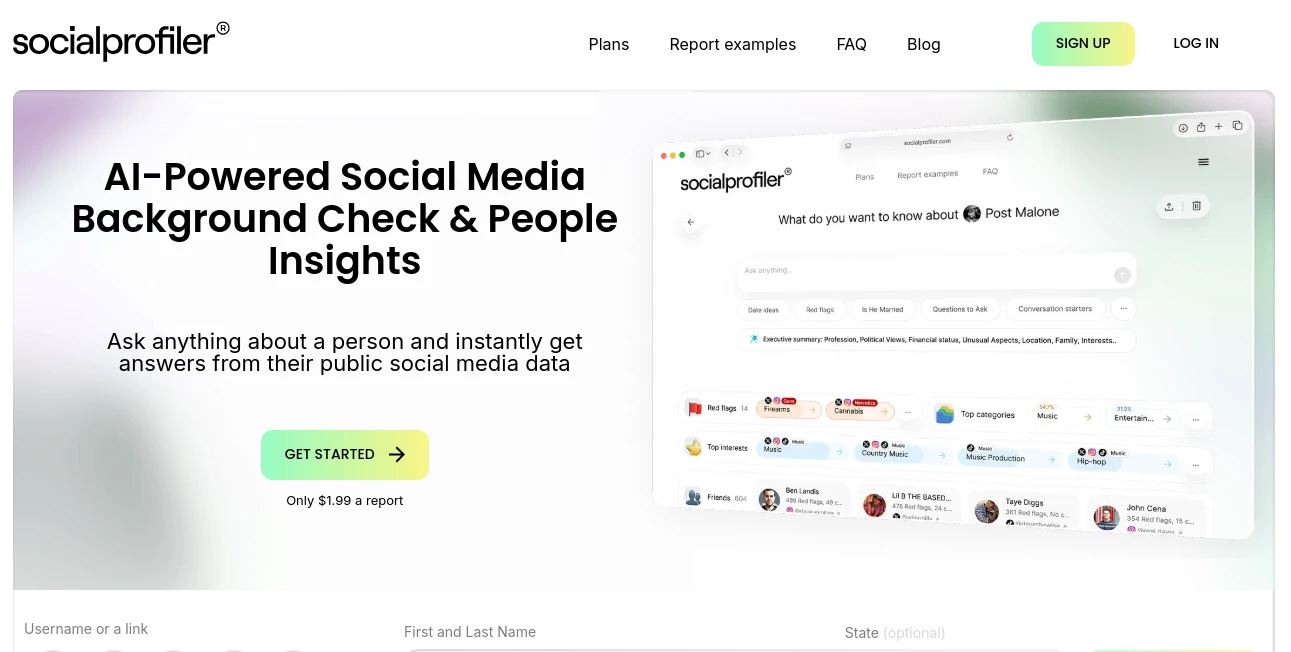
Understanding someone’s public online presence can take a surprising amount of time. A few profiles can quickly turn into hundreds of posts, follows, likes, hashtags, and connections to review. Socialprofiler brings that scattered information together and turns public social media activity into a structured personal interest assessment.
The service analyzes public activity across Instagram, Facebook, TikTok, and X, looking beyond basic profile information to identify patterns in interests, connections, follows, likes, posts, and other publicly available signals. Its reports are designed to give users a quicker way to understand what a person appears to care about without manually scrolling through multiple social networks.
One particularly useful feature is the interactive AI experience. Instead of simply receiving a long static report, users can ask questions about the profile and explore areas such as interests, lifestyle, profession, location, unusual activity, compatibility, and potential concerns. This makes the experience more practical when the user has a specific question rather than wanting to read every available data point.
The platform is intended for personal research, social media screening, relationship-related research, business due diligence, investigative work, and other situations where understanding a public social footprint can provide additional context.
Key Features
- Analysis of public social media profiles across Instagram, Facebook, TikTok, and X.
- Detection and categorization of hundreds of thousands of potential interests.
- AI-generated summaries that turn large amounts of profile information into readable insights.
- AI-powered identification of potentially risky, controversial, or unusual interest signals.
- Analysis of follows, likes, posts, shares, hashtags, geotags, and social connections when publicly available.
- Reverse social media lookup using a username or phone number.
- Search using a person's first and last name with an optional state.
- Interactive reports that allow users to investigate individual interests and the accounts associated with them.
- Questions and conversational analysis for exploring specific aspects of a profile.
- Network analysis for examining connections and shared interests.
- API access for developers and organizations that want to integrate profile analysis into their own applications.
User Interface
The user experience is built around a straightforward search process. Users can begin with information such as a social media username, profile link, or a person's name and optionally provide additional identifying information. Once a suitable profile is selected, the service creates a report that organizes the available findings into understandable sections.
The interactive nature of the reports is one of its strongest usability advantages. Rather than forcing users to dig through an enormous amount of raw social media information, the interface gives them a way to focus on particular interests and investigate the accounts behind those classifications.
For someone researching a potential business partner or trying to learn more about a new personal connection, this approach can save considerable time. The experience feels more like researching a profile than manually browsing several social networks one by one.
Accuracy & Performance
The platform states that it uses AI, big data analysis, graph matching, layering, and data clustering to categorize public social media activity. Its system is designed to connect seemingly separate signals and organize them into broader and more specific interest categories.
The service reports coverage of more than 350,000 unique interests and more than 28,000 potentially risky, controversial, or unusual interest signals. These numbers illustrate the depth of its classification system, although users should still treat automated assessments as contextual insights rather than absolute facts about a person.
Results are generated from publicly available information, so the quality of an assessment naturally depends on the amount and quality of public activity associated with the profile. Private accounts are not accessed, which means the available information can vary substantially between individuals.
Capabilities
The system goes beyond simply finding a social media account. It attempts to build a broader picture from the public activity surrounding that account. For example, a person's followed pages may reveal recurring topics, while likes, posts, hashtags, and connections can add additional context.
The AI summary is particularly helpful when a report contains a large number of individual interests. Instead of expecting the user to interpret every classification, the system condenses the information into a readable overview and allows users to ask follow-up questions.
For developers, an API is also available. The documented workflow includes authentication, report creation, profile selection, confirmation, progress monitoring, and retrieval of the completed report. This makes the service more interesting for organizations that need profile analysis as part of an existing workflow rather than as a standalone website.
Security & Privacy
Privacy is an important consideration for any service dealing with social media information. The platform states that it works with publicly available data and does not access private social media accounts. Users do not need to provide the target person's social media password to generate an assessment.
The service also states that the person being researched is not notified when a report is requested. Reports can be removed from the user's dashboard after review, providing an additional way to manage previously generated searches.
There is also an important limitation to understand: the service is not FCRA compliant and should not be used for employment, housing, credit, or other purposes that require an FCRA-compliant consumer report. Users should therefore consider the intended use of any information before relying on an assessment for an important decision.
Use Cases
There are several situations where a structured view of public social activity can be useful. The value is especially clear when information is spread across multiple platforms and manually checking each one would take too long.
- Dating and new relationships: Learn more about a public online presence before meeting someone or developing a new relationship.
- Family and home access: Research publicly available information about caregivers, tutors, housekeepers, contractors, or other people who may have access to a home.
- Business due diligence: Gain additional context when researching potential partners, founders, or business connections.
- Sales and networking: Discover shared interests that may help create more relevant conversations with prospects and professional contacts.
- Private investigations: Organize publicly available social information and identify connections or interests that may deserve further research.
- Legal research: Support certain research activities such as jury-related research, interviews, and investigations, while following applicable laws and professional requirements.
- Personal self-auditing: Review your own public social footprint and understand what your publicly visible activity may communicate about your interests and lifestyle.
- Network analysis: Explore relationships, followers, connections, and common interests around a particular public profile.
Pros and Cons
- Pros: Broad social media coverage, large interest taxonomy, interactive AI analysis, red flag detection, reverse lookup capabilities, network insights, and API availability.
- Pros: Reports can reduce the time required to manually review multiple social platforms.
- Pros: Public-only analysis means private social media accounts are not accessed.
- Cons: Results depend on the amount of public information available about the person.
- Cons: Automated interest classifications should be interpreted as signals and context rather than definitive statements about someone's character.
- Cons: The service is not suitable for purposes that require FCRA compliance.
- Cons: Static report downloads are not currently provided because the reports are designed around interactive functionality.
Pricing Plans
The current subscription structure offers three main options. The Personal plan costs $6.99 per month and includes 2 reports per month. The Family plan costs $19.99 per month and includes 10 reports per month. The Professional plan costs $199.99 per month and includes 200 reports per month.
All listed plans include the AI Summary feature. The Professional plan is aimed at higher-volume users and also provides shareable report links. The service states that there are no long-term contracts and subscriptions can be canceled at any time.
Pricing and included report allowances can change, so users should verify the current plan details before subscribing.
How to Use It
- Open the service and choose the type of search you want to perform.
- Enter a public social media username or profile link, or provide a person's first and last name with an optional state.
- Review the available matching profiles and select the individual you want to analyze.
- Start the assessment and allow the system to compile publicly available social media information.
- Review the categorized interests, connections, activity signals, and AI-generated summary.
- Use the interactive questions to investigate specific areas of the profile.
- Search individual interests to see the public accounts and activity associated with those classifications.
- Use the findings as additional context while keeping in mind that automated assessments are not definitive judgments.
Comparison with Similar Tools
Traditional people-search and background-check services tend to focus on public records, contact information, address history, or other conventional datasets. Social media research takes a different approach by examining what a person's public online behavior may reveal about their interests and connections.
That distinction makes this service particularly interesting when the question is not simply “Who is this person?” but rather “What does this person's public online activity suggest they are interested in?”
Another difference is the interactive AI layer. Instead of presenting only a fixed collection of search results, the platform allows users to ask questions about the information found in a report. This can make it easier to move from a broad overview to a specific area of interest.
For users who need conventional criminal, financial, employment, or tenant screening, a specialized compliant background-check provider may be more appropriate. For understanding public social activity and interest patterns, however, this approach offers a more focused alternative.
Conclusion
Social media research can become tedious when information is scattered across several platforms. This service tackles that problem by bringing public activity from major social networks into a structured assessment and adding AI-powered analysis on top of it.
Its large interest classification system, interactive reports, red flag detection, reverse lookup capabilities, and API make it more than a simple social profile search. It is particularly useful for people who need to understand patterns and interests rather than simply locate an account.
The most important point is to use the results responsibly. Public social media activity can provide useful context, but it should not automatically be treated as a complete representation of a person's identity or character. With that distinction in mind, the platform can be a practical research tool for personal, professional, investigative, and networking scenarios.
Frequently Asked Questions (FAQ)
What information can be analyzed?
The service analyzes publicly available information from Instagram, Facebook, TikTok, and X. Depending on availability, this can include profiles, follows, likes, posts, shares, hashtags, geotags, and social connections.
Can private social media accounts be analyzed?
No. The service states that it does not access private accounts. The assessment relies on information that is publicly available.
Does the person know that I searched for them?
The service states that the person being researched is not notified when a report is requested, and there is no connection between the researcher and the social media user being analyzed.
Does it require a person's social media password?
No. A target person's password is not required. Searches can be started using information such as a username, profile link, or name.
Is the service FCRA compliant?
No. It is not an FCRA-compliant consumer reporting agency and should not be used for employment, housing, credit, or other purposes that require an FCRA-compliant report.
Is there an API?
Yes. An API is available for developers and organizations. The documented API supports authentication, report creation, profile selection, analysis monitoring, and retrieving completed reports.
Can reports be downloaded as PDFs?
The reports are designed to be interactive, so static PDF downloads are not currently offered. Professional subscribers can generate shareable links for reports.
How much does it cost?
The current listed plans start at $6.99 per month for the Personal plan with 2 reports. The Family plan is $19.99 per month for 10 reports, while the Professional plan is $199.99 per month for 200 reports.
What can the AI summary tell me?
The AI summary condenses information found in a profile into a more readable overview. Depending on the available public data, it can provide insights related to interests, profession, location, lifestyle, family, unusual aspects, and other profile characteristics.
Other , AI Research Tool , AI Analytics Assistant , AI Legal Assistant .
These classifications represent its core capabilities and areas of application. For related tools, explore the linked categories above.

Socialprofiler Alternatives Product

Prelight

Grok

AlphaTax

GEO Checker
WhatsMyName …

SciDraw AI
DidYouSEO

CoinIQ

Meev