
Spanlens
What is Spanlens?
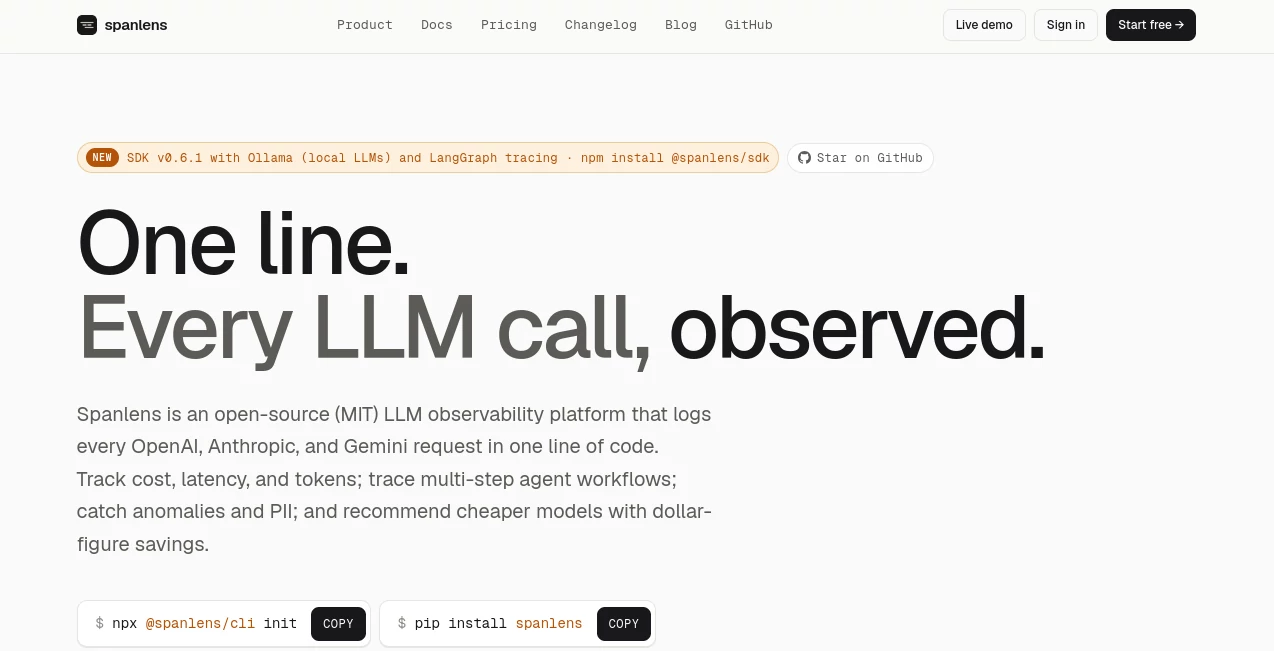
Building AI-powered applications is exciting, but keeping track of every model request, response, cost, and performance metric quickly becomes challenging as projects grow. This platform was created to solve exactly that problem by giving developers complete visibility into their language model workflows without requiring a complicated setup.
Instead of spending hours debugging scattered logs or estimating API costs, teams can monitor every request from a single dashboard. From token usage and latency to prompt evaluation and anomaly detection, it provides a practical way to understand what happens behind every AI interaction. The lightweight integration makes adoption remarkably simple while offering enterprise-grade insights that benefit startups, independent developers, and large engineering teams alike.
Because it supports popular AI providers and modern development frameworks, it naturally fits into existing workflows. Whether the goal is reducing operational costs, improving prompt quality, or tracing complex AI agents, the platform delivers meaningful analytics that help teams ship more reliable AI products with confidence.
Key Features
User Interface
The dashboard is thoughtfully organized, allowing developers to inspect requests, compare prompt versions, monitor spending, and review traces without unnecessary complexity. Navigation feels intuitive, making it easy to move from high-level analytics to individual API calls in just a few clicks.
Accuracy & Performance
Every request is captured with detailed information including latency, token consumption, model selection, and associated costs. Multi-step AI workflows can be visualized through trace trees, helping developers identify slow operations, unexpected behavior, or expensive execution paths. The lightweight architecture introduces minimal overhead, making it suitable even for production environments.
Capabilities
- LLM request monitoring
- Real-time cost tracking
- Token usage analytics
- Latency monitoring
- Agent workflow tracing
- Prompt version comparison
- Model recommendation engine
- Prompt evaluation system
- Dataset replay for testing
- Anomaly detection
- Security scanning for sensitive information
- User analytics
- Budget alerts
- Exportable logs and datasets
- Self-hosting support
Security & Privacy
Security has clearly been considered from the beginning. Sensitive information such as API keys can be automatically masked before storage, while personally identifiable information is detected during logging for additional review. Organizations that require strict data governance can deploy the platform within their own infrastructure, allowing AI workloads to remain inside private environments.
Use Cases
- Monitoring production AI applications.
- Tracking token consumption across multiple AI providers.
- Reducing monthly language model expenses.
- Debugging complex AI agent workflows.
- Evaluating prompt improvements before deployment.
- Comparing different language models using real production data.
- Building reliable AI products with detailed observability.
- Managing enterprise AI infrastructure with complete visibility.
Pros and Cons
Pros
- Very simple integration process.
- Supports several leading AI providers.
- Excellent request tracing capabilities.
- Detailed cost and token analytics.
- Open-source with self-hosting options.
- Useful prompt evaluation and experimentation features.
- Security-focused logging system.
- Suitable for individual developers and enterprise teams.
Cons
- Some advanced collaboration features are available only in higher plans.
- Teams new to observability may need time to fully utilize every analytics feature.
- Large-scale deployments benefit most from the premium plans.
Pricing Plans
The platform offers a generous Free plan for smaller projects with core monitoring capabilities. Paid plans introduce longer data retention, additional team members, advanced alerting, webhooks, Slack integrations, and higher request limits. Enterprise customers can request custom deployments and tailored infrastructure configurations. Self-hosting is also available for organizations that require complete control over their data.
How to Use Spanlens
Getting started requires only a few steps.
- Create an account or deploy a self-hosted instance.
- Install the supported SDK or configure the proxy.
- Replace the existing AI client with the provided integration.
- Run your application normally.
- Open the dashboard to review requests, costs, traces, and analytics.
- Use prompt evaluations and experiments to continuously improve AI quality.
Comparison with Similar Tools
Compared with traditional monitoring platforms, this solution focuses specifically on language model observability rather than general application metrics. It combines request logging, tracing, cost optimization, evaluation workflows, prompt experimentation, and security scanning into a unified environment. The open-source approach and self-hosting support also make it an attractive alternative for organizations that want flexibility without sacrificing visibility.
Conclusion
Reliable AI applications require far more than powerful language models. Understanding costs, monitoring performance, tracing complex workflows, and protecting sensitive information are equally important for long-term success. This platform brings all of those capabilities together in an elegant, developer-friendly experience. Whether you're building an internal AI assistant, customer-facing chatbot, or sophisticated multi-agent system, it provides the operational insight needed to improve quality while keeping infrastructure efficient and predictable.
Frequently Asked Questions (FAQ)
Is there a free plan?
Yes. A free plan is available for smaller projects and includes the essential monitoring features.
Can it monitor multiple AI providers?
Yes. It supports several popular language model providers, making it easier to monitor applications using different models.
Does it support self-hosting?
Yes. Organizations can deploy the platform within their own infrastructure for greater privacy and control.
Can it help reduce AI costs?
Yes. Built-in cost analytics, token tracking, and model recommendations help identify opportunities to lower operational expenses.
Who is this platform best suited for?
It is ideal for AI developers, engineering teams, SaaS companies, startups, and enterprises that build production-grade applications powered by large language models.
Large Language Models (LLMs) , AI Analytics Assistant , AI Developer Tools , AI Monitor & Report Builder .
These classifications represent its core capabilities and areas of application. For related tools, explore the linked categories above.

Spanlens Alternatives Product

igrecent

Candidate Sc…

DidYouSEO

Nestify

Sellerview.ai

Prelight

Mage Flow AI…

PatentFig AI

freellm