
SpeakCoach
What is SpeakCoach?
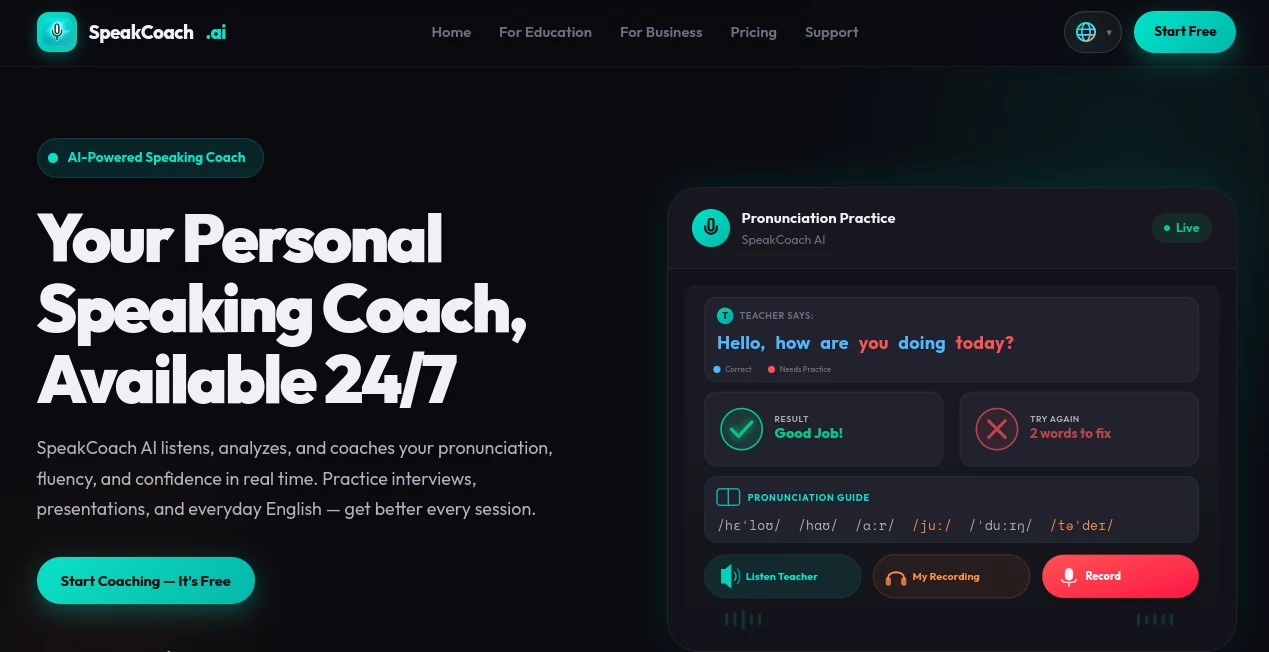
Improving spoken English is different from studying vocabulary or completing grammar exercises. You can understand English well and still hesitate when it is time to speak. This AI-powered speaking coach is designed to make that practice more practical by listening to spoken answers, analyzing performance, and turning each attempt into useful feedback.
The platform is particularly useful for learners preparing for English speaking tests such as OPIc, as well as anyone who wants to become more comfortable speaking English aloud. Instead of simply telling learners whether an answer is right or wrong, it examines several aspects of the response, including pronunciation, grammar, vocabulary, fluency, task performance, content, and structure.
That approach makes practice feel more purposeful. A learner can record an answer, review the resulting assessment, identify a weak area, and try again rather than waiting until the next lesson to discover the same mistake.
Key Features
- AI-powered English speaking analysis
- Speech recording and automatic transcription
- Detailed pronunciation, grammar, vocabulary, and fluency feedback
- Seven-area speaking assessment for OPIc practice
- Estimated speaking level based on the recorded response
- Large collection of practical speaking questions
- Topic and question-type filtering for targeted practice
- Model answers for higher-level responses
- Native-style shadowing practice
- Practice history and progress tracking
- Full-length mock speaking tests
User Interface
The experience is built around a simple cycle: choose a question, speak your answer, and review the analysis. This is an important design choice for a speaking practice product because users should spend their time talking rather than navigating through complicated menus.
The practice environment also supports focused preparation. Learners can work on specific OPIc-style topics such as travel, home and neighborhood, hobbies, role-playing, comparisons, and issue-based questions. Someone preparing for an upcoming test can therefore spend less time searching for suitable material and more time actually speaking.
Accuracy & Performance
One of the more useful aspects of the platform is the breadth of its assessment. A response is not reduced to a single generic score. The analysis can break performance down into pronunciation, grammar, vocabulary, fluency, task performance, content, and structure.
This makes the feedback easier to act on. For example, a learner may discover that vocabulary is already strong while fluency and answer structure are holding the response back. That is much more useful than simply being told to “practice more.”
The service also provides an estimated OPIc level using the ACTFL-based range from NH through AL. The result should be treated as a practice indicator rather than a guaranteed official examination score, but it can still provide a helpful reference point between real tests.
Capabilities
The platform goes beyond basic conversation prompts. Its practice library includes hundreds of OPIc-style questions, with filtering designed around different question types and everyday subjects. This gives learners a way to deliberately target areas where they feel less confident.
Another useful feature is the combination of model answers and shadowing. Rather than reading an example and moving on, learners can listen to a higher-level response and practice reproducing its pronunciation and delivery. For students who know what they want to say but struggle to sound natural, this can make repetition considerably more productive.
There is also a mock-test mode designed around the structure of an actual OPIc-style session. A longer practice session can contain multiple questions and provide an overall breakdown afterward, helping users become more comfortable with sustained speaking rather than isolated one-minute answers.
Security & Privacy
Because the product works with recorded speech, privacy is an important consideration. Users should review the current privacy policy and terms before submitting personal or sensitive information through voice recordings.
The available product information indicates that recorded speech is processed for AI analysis and that the service is intended to use this information to provide its speaking-analysis features. AI-generated assessments should also be understood as guidance for learning rather than professional or official examination results.
Use Cases
- OPIc preparation: Practice realistic speaking questions and receive structured feedback before the actual examination.
- Pronunciation practice: Use repeated recordings and analysis to become more aware of pronunciation problems.
- Fluency improvement: Practice speaking without stopping to translate every sentence mentally.
- Interview preparation: Rehearse answers aloud and identify areas that make responses sound less natural.
- Daily English practice: Build a consistent speaking routine without needing to arrange a lesson with a tutor.
- Targeted weakness training: Focus practice on areas such as grammar, vocabulary, fluency, pronunciation, or answer structure.
- Mock-test preparation: Complete longer practice sessions to become more comfortable with test-style speaking.
Pros and Cons
- Pros: Detailed speaking analysis, multiple assessment categories, practical OPIc-focused questions, model answers, shadowing practice, progress tracking, and a free entry-level option.
- Pros: The feedback is more actionable than a simple pass-or-fail result because learners can see which parts of their speaking need attention.
- Pros: Practice can be repeated immediately, making it convenient for short daily study sessions.
- Cons: AI scoring cannot perfectly reproduce the judgment of a human examiner in every situation.
- Cons: Learners looking for broad language-learning courses rather than speaking and OPIc preparation may find the focus relatively specialized.
- Cons: The quality of automated feedback can depend on the clarity of the recording and the learner's speaking conditions.
Pricing Plans
A free option is available for learners who want to try the speaking-analysis experience before paying. The free tier includes a limited amount of practice together with AI feedback and scoring.
Paid plans are designed for more frequent practice. The Pro package includes unlimited practice, access to more than 500 OPIc questions, question-type filtering, and detailed AI feedback. A Premium package adds features such as full mock exams, native shadowing, and more advanced progress tracking.
Pricing and promotional offers can change, so users should check the current pricing page before subscribing.
How to Use SpeakCoach AI
- Open the service and create an account.
- Choose an English speaking question or an OPIc practice topic.
- Read the prompt and prepare your response.
- Record yourself answering the question naturally.
- Submit the recording for AI analysis.
- Review the scores and detailed feedback.
- Identify the weakest area in your response.
- Practice the same question again while applying the feedback.
- Use model answers and shadowing when you need help with natural delivery.
- Track your results over time to see whether your speaking performance is improving.
Comparison with Similar Tools
Many English-learning applications concentrate on vocabulary, grammar exercises, or general conversation. This product takes a narrower and more useful approach for learners who specifically need to improve spoken performance.
Its strongest distinction is the combination of recorded speaking, multi-category assessment, OPIc-oriented questions, estimated proficiency levels, and repeated practice. Instead of treating every learner as if they have the same problem, the feedback can reveal whether pronunciation, fluency, vocabulary, grammar, content, task performance, or structure deserves more attention.
For someone preparing specifically for a speaking examination, this focused workflow can be more practical than using a general language-learning application. On the other hand, learners who want extensive reading, writing, grammar, or vocabulary courses may still need additional learning resources alongside it.
Conclusion
For English learners, one of the hardest parts of improving speaking is knowing what to fix after finishing an answer. This AI speaking coach addresses that gap by turning recorded practice into structured feedback.
The combination of OPIc-focused questions, seven-area analysis, estimated levels, model answers, shadowing, and mock exams gives learners a clear path from practice to improvement. It is especially appealing to students who prefer short, repeatable sessions and want measurable feedback rather than simply spending more time speaking.
If your goal is to become more confident answering English speaking questions or prepare for an OPIc-style examination, this is a practical tool worth adding to your study routine. The biggest benefit comes from using the feedback actively: record, review, correct, and speak again.
Frequently Asked Questions (FAQ)
What is this AI speaking coach designed for?
It is primarily designed to help learners practice spoken English, with a strong focus on OPIc preparation. It analyzes recorded answers and provides feedback across several speaking categories.
Can it analyze pronunciation?
Yes. Pronunciation is one of the areas included in its speaking assessment, alongside grammar, vocabulary, fluency, task performance, content, and structure.
Can beginners use it?
Yes. Learners at different levels can use speaking prompts and repeated recordings to practice. However, users with very limited English foundations may benefit from combining speaking practice with basic grammar and vocabulary study.
Does it provide an official OPIc score?
No. The estimated level is intended as a practice and learning reference. It should not be considered a replacement for the official OPIc examination result.
Is there a free plan?
Yes. A free option is available with limited practice and AI feedback. Paid plans provide additional practice capacity and advanced features.
AI Education Assistant , AI Speech Recognition , AI Speech to Text , AI Voice Assistants .
These classifications represent its core capabilities and areas of application. For related tools, explore the linked categories above.

SpeakCoach Alternatives Product

bridger west…

Gizmo

Sourcetable

Traecta

MP3toMIDI

Speechara

Fish Voice

SuperAI

TurboScribe