
SpyTrend
What is SpyTrend?
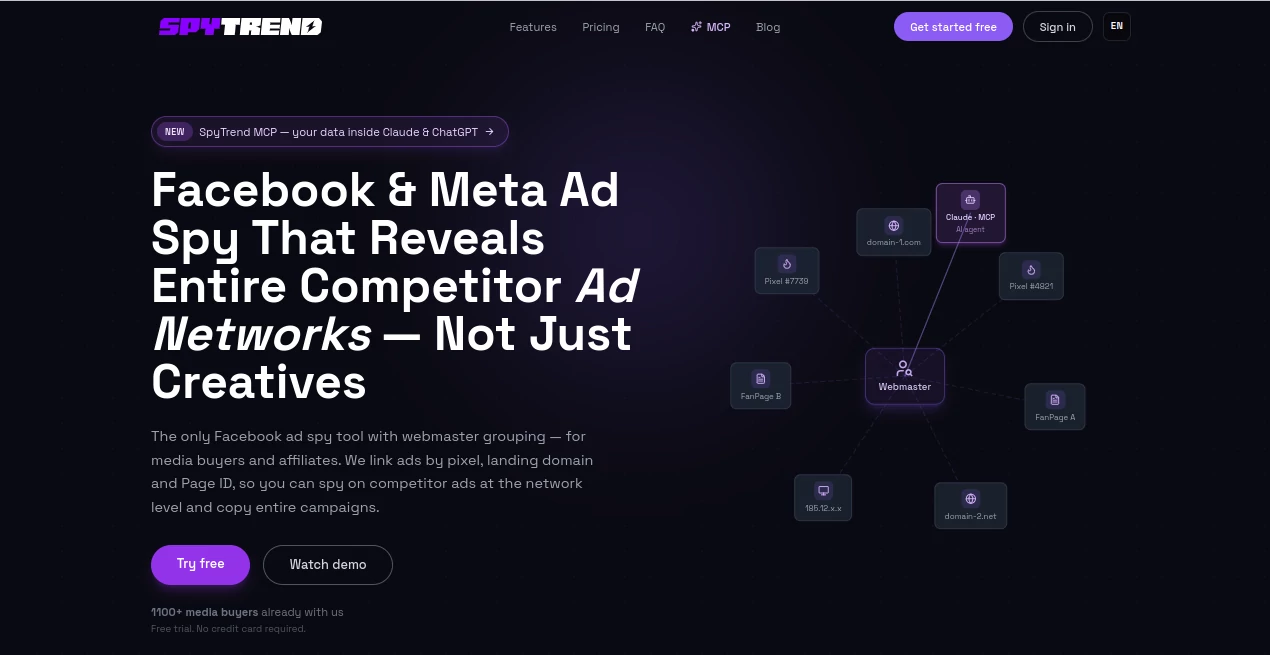
SpyTrend is a competitive advertising intelligence platform built for media buyers, affiliates, performance marketers, and agencies that want to understand what competitors are actually running. Instead of showing isolated advertisements without much context, the platform connects ads through pixels, landing domains, Page IDs, and other identifiers to reveal broader advertising networks.
Its database contains more than 1.1 billion ads, with over 230 million new Meta ads added each month from public sources. Searches are designed to return results in less than a second, making it practical for marketers who need to investigate a market without spending hours moving between public ad libraries and separate research tools.
The real advantage becomes clear when researching an active competitor. Rather than asking only which creative they are using, you can investigate their domains, fan pages, landing pages, advertising activity, geographic targeting, and the creative approaches that continue to appear over time.
Key Features
- Webmaster Grouping: Ads can be connected through pixel IDs, domains, Page IDs, and IP addresses to create a broader view of a competitor's advertising operation.
- Pixel Intelligence: The platform connects advertisements, landing pages, pixels, and related infrastructure to expose relationships that are easy to miss when looking at individual ads.
- Creative Analytics: Duplicate advertisements can be consolidated so marketers can focus on unique creative concepts and see how frequently they are reused.
- Real-Time Monitoring: Advertising activity is monitored with live status information, helping users distinguish between active, inactive, and vanished campaigns.
- Custom Keyword Tracking: Users can define their own keywords and geographic targets to follow advertisements relevant to a particular niche.
- Vertical Classification: The platform organizes advertising data across 33 verticals, making research more focused than browsing an unfiltered advertising database.
- GEO Trends: Geographic information helps marketers investigate how advertising activity differs between markets and countries.
- AI and MCP Access: The platform can connect with compatible AI assistants through MCP, allowing users to investigate its advertising database using natural-language requests.
User Interface
The interface is designed around search, filtering, and investigation rather than complicated reporting workflows. A marketer can select a vertical, investigate active webmasters, open related advertising profiles, and move from a specific advertisement to its associated domains and pages.
The workflow is particularly useful when a campaign needs to be researched quickly. For example, someone investigating e-commerce advertising in a particular country can narrow the results by vertical and geography, inspect active advertisers, and then examine the wider network connected to a promising campaign.
Accuracy & Performance
Speed is one of the platform's strongest practical features. The website reports search responses of less than one second, while its advertising database is continuously refreshed rather than relying solely on delayed snapshots.
The use of deduplication also makes research easier to interpret. Instead of treating dozens of copies of essentially the same creative as separate discoveries, users can identify unique creative concepts and examine how frequently those concepts are being reused.
The platform also provides days-active information, which can be useful as a research signal. A campaign that has remained active for several days may deserve closer attention than an advertisement that appeared briefly, although activity duration should be treated as an indicator rather than proof of profitability.
Capabilities
The platform goes beyond ordinary ad searching by connecting several layers of advertising information. Users can search advertisements, investigate advertisers, explore webmasters, examine creatives, and inspect destinations associated with campaigns.
This makes it suitable for competitive research where the important question is not simply, "What advertisement is running?" but rather, "How is this advertiser building and distributing the campaign?"
Another useful capability is AI-assisted research through MCP. Compatible AI clients can query the advertising database using plain-language instructions, allowing marketers to ask questions about advertisers, creatives, webmasters, geographic activity, and related domains without manually applying every filter.
Security & Privacy
The service states that its advertising intelligence is based on publicly available data. Payment processing is handled through Stripe, and subscriptions can be cancelled from account settings.
For MCP connections, the platform uses OAuth authorization. The connector is designed around read-only access, meaning the connected AI client cannot change or delete information in the user's account. Users can also revoke the connection through their account settings.
Use Cases
Competitor Research: Media buyers can investigate competitors beyond individual advertisements and identify related domains, pages, pixels, and campaign structures.
Creative Research: Advertisers can study creative concepts that are being repeatedly used and compare different approaches before developing their own campaigns.
Affiliate Marketing: Affiliates can research active advertisers and webmasters within specific verticals and geographic markets, helping them understand which offers and campaign structures deserve further investigation.
E-commerce Research: Store owners can examine advertising activity in their market, investigate competing products, and study the creative and landing-page approaches used by other advertisers.
Agency Reporting: Marketing agencies can use the broader campaign view to create competitor reports that explain advertising networks rather than simply presenting screenshots of individual ads.
Market Discovery: Geographic trends and vertical classification can help marketers compare advertising activity across different countries and niches.
AI-Assisted Research: Teams using compatible AI clients can connect the advertising database through MCP and ask research questions in natural language instead of manually navigating every search filter.
Pros and Cons
Pros
- Large advertising database with more than 1.1 billion indexed ads.
- More than 230 million new Meta ads added each month.
- Webmaster grouping provides a broader view of competitor advertising operations.
- Pixel, domain, and Page ID connections can reveal relationships between campaigns.
- Fast search experience with reported response times below one second.
- Real-time advertising status and monitoring.
- Deduplication makes large creative datasets easier to analyze.
- Custom keyword and geographic tracking.
- MCP integration enables natural-language research through compatible AI assistants.
- A free Starter plan is available without requiring a credit card.
Cons
- The deepest intelligence is focused on Meta and Facebook advertising.
- Google Ads and native advertising networks are not covered.
- The most advanced research features require a paid subscription.
- New users may need some time to understand webmaster grouping and pixel-based relationships.
- Advertising activity should be treated as competitive intelligence rather than direct proof that a campaign is profitable.
Pricing Plans
The platform currently offers a free Starter option with limited access to its advertising database, basic ad information, and basic search capabilities.
The Pro plan costs $79 per month and adds unlimited searches, full Webmaster Grouping, Pixel & Landing Intelligence, deduplication, data export, 90 days of history, and one user. It includes one AI category, while additional AI categories are available for an extra monthly fee.
For teams, the Team plan starts at $63.20 per seat per month and supports between four and twenty members. It includes the Pro features for team members, centralized billing, invitation links, and priority support. A seven-day money-back guarantee is also offered on first-time payments.
How to Use the Tool
Start by creating an account and selecting the advertising vertical that matches the market you want to investigate. Choosing a relevant niche helps reduce unnecessary results and makes the initial research much more focused.
Next, search for advertisements, keywords, advertisers, domains, or other relevant signals. Use geographic and activity filters to narrow the results and identify campaigns that have remained active.
When you find an interesting advertisement, open its related profile and investigate the connected domains, pages, pixels, creatives, and other available information. This is where the broader network view becomes more valuable than simply saving an advertisement screenshot.
For AI-assisted workflows, compatible MCP clients can be connected through the platform's official MCP endpoint. After authorization, users can ask research questions in natural language and allow the AI assistant to retrieve relevant advertising information.
Comparison with Similar Tools
Traditional ad-spy platforms often concentrate on individual advertisements, which can be useful when searching for creative inspiration but may leave the wider campaign structure hidden. The approach here is different because advertisements can be connected to the infrastructure and entities behind them.
Compared with tools such as AdSpy, BigSpy, and similar advertising research platforms, the strongest distinction is the emphasis on Webmaster Grouping and Pixel Intelligence. The service also focuses on real-time status, custom tracking, vertical classification, and geographic research.
This does not necessarily make it the right choice for every marketer. Someone who only needs a basic collection of advertising creatives may prefer a simpler solution, while media buyers conducting deeper competitor research can benefit much more from the additional network-level information.
Conclusion
For marketers who need more than a gallery of competitor advertisements, this platform offers a much broader way to investigate paid acquisition. Its combination of a large advertising database, webmaster grouping, pixel intelligence, real-time monitoring, creative analytics, and geographic research makes it particularly relevant to performance marketing and affiliate research.
The most interesting part is the shift from studying individual ads to understanding the systems behind them. A single creative can provide inspiration, but seeing how domains, pages, pixels, advertisers, and campaigns connect can provide a much more useful picture of how a competitor operates.
With a free entry-level plan and a strong set of research features in the paid tiers, it is worth considering for media buyers and agencies that regularly spend significant time on competitive advertising research.
Frequently Asked Questions (FAQ)
What is this type of advertising intelligence platform?
It is a competitive advertising research platform that indexes publicly available advertising data and helps marketers search, filter, compare, and investigate campaigns across Meta and TikTok.
How is it different from a basic Facebook ad spy tool?
Instead of focusing only on individual advertisements, it connects advertisements using signals such as pixels, domains, Page IDs, and IP addresses. This creates a broader view of the advertising operation behind related campaigns.
Does it support TikTok advertising research?
Yes. TikTok is available as a second advertising data source alongside Facebook and Meta, although the deepest analysis and webmaster grouping capabilities are focused on the Meta ecosystem.
Does it provide Google Ads data?
No. Google Ads and native advertising networks are not currently part of the platform's supported advertising sources.
Can I use it for affiliate marketing?
Yes. Affiliate marketers can use the service to research advertisers, webmasters, domains, creatives, geographic markets, and active campaigns within specific verticals.
Is there a free plan?
Yes. The Starter plan is free and provides limited access to the advertising database, basic ad information, and basic search functionality.
How much does the Pro plan cost?
The Pro plan is currently priced at $79 per month and includes unlimited searches, Webmaster Grouping, Pixel & Landing Intelligence, deduplication, data export, 90 days of history, and one user.
Can it connect to AI assistants?
Yes. Its MCP integration allows compatible AI clients to access the advertising research database and perform searches using natural-language requests.
Is the advertising data real-time?
The platform states that advertising data is collected and monitored in near real time, with live status information for active, inactive, and vanished advertisements.
Can advertising activity prove that a campaign is profitable?
No. Days-active information can be a useful research signal, but continued activity alone does not guarantee profitability. Campaign performance depends on factors such as costs, conversions, targeting, margins, and the advertiser's overall business model.
AI Digital Marketing Generator , AI Research Tool , AI Analytics Assistant , AI Advertising Assistant .
These classifications represent its core capabilities and areas of application. For related tools, explore the linked categories above.

SpyTrend Alternatives Product

Free Marketi…

ZoraInsights

Lebesgue: AI…

RankPeak

AiProposer

TrackRev

Prelight

Ad Suite AI

Toonifyit