
















Startup.Ready.
What is Startup.Ready.?
Startup.Ready. is a structured startup readiness assessment and development system designed for early-stage founders who want a clearer view of where their business stands before making a major commitment. Instead of simply asking whether an idea sounds promising, it examines the foundations underneath the startup and highlights areas that may still need attention.
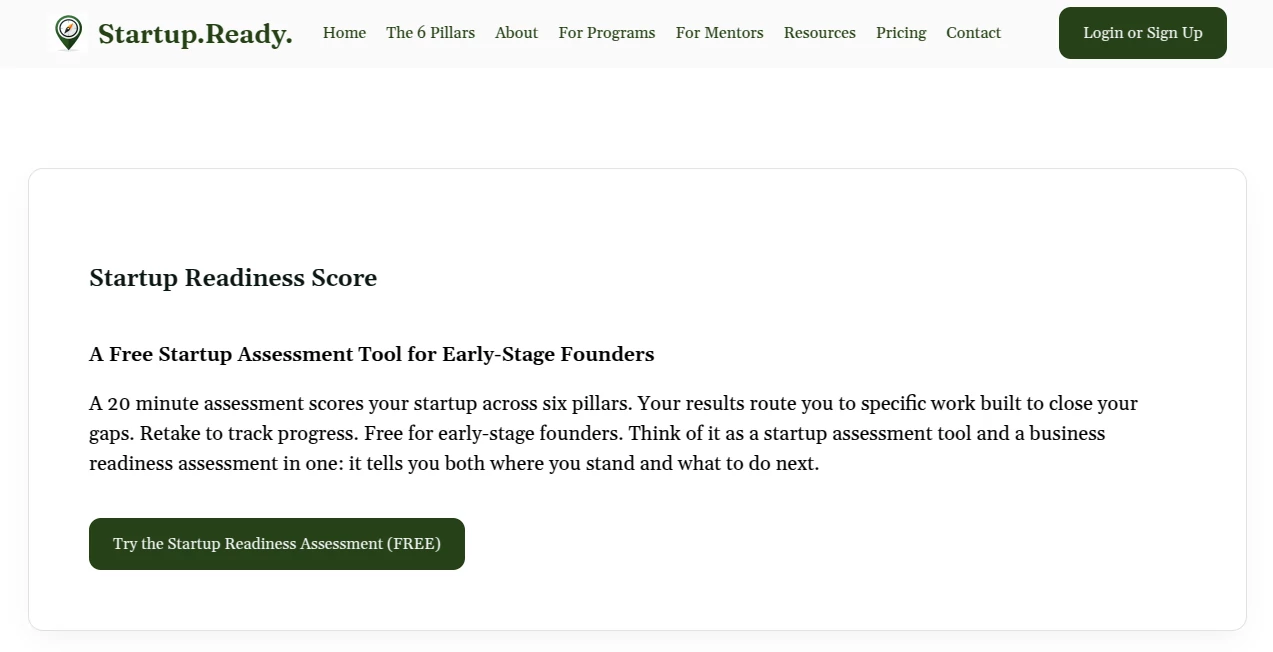
The assessment takes about 20 minutes and covers six important areas: Founder, Problem, Market, Business Model, Go-to-Market, and Financial. After completing the assessment, founders receive an overall readiness score from 0 to 150, individual pillar scores, a written diagnosis, and recommended actions based on their results.
What makes the approach particularly practical is that the assessment does not stop at a score. The recommendations can lead founders toward specific worksheets designed to address the gaps identified in their results, turning the assessment into a starting point for structured improvement.
Key Features
User Interface
The experience is built around a straightforward assessment process rather than a complicated collection of dashboards and settings. Founders answer a series of questions, receive their results, and can return to review their progress through the founder dashboard.
The results are presented in a way that is intended to make the findings easier to act on. Instead of leaving users with a long technical report, the system provides a concise diagnosis, pillar-by-pillar information, and a short list of recommended actions.
Accuracy & Performance
The assessment uses 33 questions distributed across six foundational pillars, with each pillar scored from 0 to 25. The resulting overall score ranges from 0 to 150 and is designed to provide a structured snapshot of startup readiness rather than a prediction of future success.
The scoring framework is based on research into startup failure and founder decision-making, combined with more than 15 years of experience working with early-stage founders. The methodology incorporates established approaches including Lean Startup, Jobs to Be Done, and Crossing the Chasm.
It is worth keeping the purpose of the score in perspective. A high or low result is not presented as a funding signal or a guarantee of success. Its value is in showing founders where their current assumptions appear strong, unclear, or insufficiently supported by evidence.
Capabilities
The assessment covers six core dimensions of a startup. The Founder pillar considers the human capacity, motivation, alignment, and ability required to execute. The Problem pillar examines whether the business is addressing a real and sufficiently urgent problem. Market focuses on identifying a reachable group that strongly experiences that problem.
The Business Model pillar looks at how value is created, delivered, and captured. Go-to-Market considers how potential customers can discover, evaluate, and act on the offering. Finally, the Financial pillar addresses costs, margins, runway, and the financial realities that influence the startup's ability to survive.
After scoring, the system identifies the most important gaps and provides up to three recommended actions in the free assessment experience. These actions connect to structured worksheets intended to help founders work directly on the areas that need attention.
Security & Privacy
An account is required so assessment results can be saved and associated with the founder. Users sign in with Google, allowing them to return to previous results and continue tracking their progress. The service states that card information is handled through Stripe and that payment card numbers are not stored by the platform.
The service also places restrictions on submitting sensitive personal information belonging to third parties and other unlawful or harmful material. As with any business assessment platform, founders should still avoid entering confidential information that is not necessary for the assessment.
Use Cases
The assessment is especially useful before an important startup decision. A founder validating an idea can use it to identify foundational weaknesses before investing heavily in development. Someone preparing an accelerator or incubator application can use the results to spot areas that deserve more attention before submitting an application.
It can also be useful before early fundraising conversations. Rather than discovering weaknesses during an investor conversation, founders can use the assessment as an internal checkpoint first.
Another practical situation is the founder who feels constantly busy but cannot identify what is actually holding the company back. A structured diagnostic can provide a useful starting point for that conversation.
Mentors, advisors, incubators, and accelerators can also use the framework as a common reference point when working with early-stage teams. Having a shared structure can make discussions more concrete than relying entirely on intuition or informal checklists.
Pros and Cons
- Pros
- Free access for the first two assessments.
- Six-pillar breakdown covering important startup foundations.
- Overall score from 0 to 150 with individual pillar scores.
- Plain-language diagnostic rather than only numerical results.
- Recommended actions connected to structured worksheets.
- Useful before fundraising, accelerator applications, or major startup decisions.
- Progress tracking is available for users who need repeated assessments.
- Cons
- The assessment does not replace customer interviews, market research, or experienced advisors.
- The free plan limits users to two assessments in total.
- The score should not be interpreted as a prediction of startup success.
- Founders looking for detailed financial forecasting or full business-plan software will need additional tools.
Pricing Plans
The platform uses a simple two-tier pricing structure. The Basic option is free and includes two assessments over the lifetime of the account. It provides the overall readiness score, six-pillar breakdown, diagnostic summary, clarity recommendations, and access to the top recommended worksheets.
The Pro plan is designed for founders who want to monitor development over time. It costs $14.99 per month or $149.99 per year. Pro includes up to eight assessments per month, a progress tracking dashboard, historical score comparison, the full worksheet library, and recommendations across the different pillars.
The recurring assessment model makes sense for founders who intend to work through identified weaknesses and then reassess their position every few weeks rather than treating the first score as a final answer.
How to Use the Assessment
Start by creating an account and beginning the assessment. Set aside roughly 20 minutes so you can answer the questions thoughtfully rather than rushing through them.
Once the assessment is complete, review the overall readiness score together with the six individual pillar results. Pay particular attention to the areas where the diagnosis identifies uncertainty or weak foundations.
Next, work through the recommended actions. The system connects the highest-priority recommendations with structured worksheets designed around the gaps identified in the assessment.
After making meaningful progress, take the assessment again. Comparing the new results with the previous score can help you see whether the work actually improved the areas that were previously holding the startup back.
Comparison with Similar Tools
Traditional startup checklists usually answer a simple question: which tasks have been completed? Business plans focus more heavily on how a company intends to operate and execute its strategy. Idea validation tools concentrate on whether potential customers want a particular solution.
This assessment takes a different position. Its central question is whether the underlying foundation is sufficiently clear and aligned to justify moving forward. That makes it particularly relevant at moments when a founder is about to increase the stakes by building further, applying to a program, raising capital, or committing more personal time and money.
It is therefore better viewed as a diagnostic checkpoint than as a replacement for customer discovery, financial modeling, market research, or professional startup advice.
Conclusion
For an early-stage founder, knowing what to work on next can be just as important as working hard. A startup can have a polished product, a growing task list, and an ambitious plan while still carrying unresolved assumptions underneath the surface.
This assessment provides a structured way to expose those gaps. Its combination of a six-pillar diagnostic, practical recommendations, targeted worksheets, and progress tracking makes it more actionable than a simple startup scorecard.
The free assessment is a sensible starting point for founders who want an outside structure for examining their business foundation. Those who want to repeatedly measure progress can move to the Pro plan and use the assessment as an ongoing checkpoint throughout the early stages of building their company.
Frequently Asked Questions (FAQ)
How long does the assessment take?
Most founders complete the assessment in about 20 minutes. It contains 33 questions across six startup readiness pillars.
How many times can I take the assessment for free?
The free tier allows two assessments in total. This gives founders an opportunity to establish a baseline and later measure progress.
What are the six pillars?
The six pillars are Founder, Problem, Market, Business Model, Go-to-Market, and Financial. Each pillar receives an individual score from 0 to 25.
What does the overall score mean?
The overall score ranges from 0 to 150 and provides a structured snapshot of startup readiness. It is intended to highlight strengths, gaps, and areas requiring attention rather than predict whether a startup will succeed.
Do I need a finished product or revenue?
No. The assessment is designed for founders from idea validation through early operating stages. You do not need an LLC, a completed product, or existing revenue to take it.
Does the assessment provide recommendations?
Yes. The results include recommended actions based on the areas where the assessment identifies important gaps. The free experience provides the top three recommendations, while the Pro plan provides broader worksheet recommendations.
Is there a paid plan?
Yes. The Pro plan costs $14.99 per month or $149.99 per year and adds additional assessments, progress tracking, historical comparisons, and access to the full worksheet library.
Can the assessment predict whether my startup will succeed?
No. The score is a diagnostic tool, not a success predictor or funding signal. It is intended to help founders understand their current foundation and decide where further work is needed.
Can mentors or startup programs use the framework?
Yes. The framework can be useful for mentors, advisors, incubators, and accelerators that want a structured way to discuss startup readiness and track development across early-stage teams.