

















Coach Call AI
Verified Blue CheckMark
Verified Blue CheckMark products are featured above free or unverified listings.
This badge indicates authenticity and builds trust, giving your product higher visibility across the platform.
Upgrade to get verified
Verified Blue CheckMark products are featured above free or unverified listings. This badge indicates authenticity and builds trust, giving your product higher visibility across the platform.
Upgrade to get verified
What is Coach Call AI?
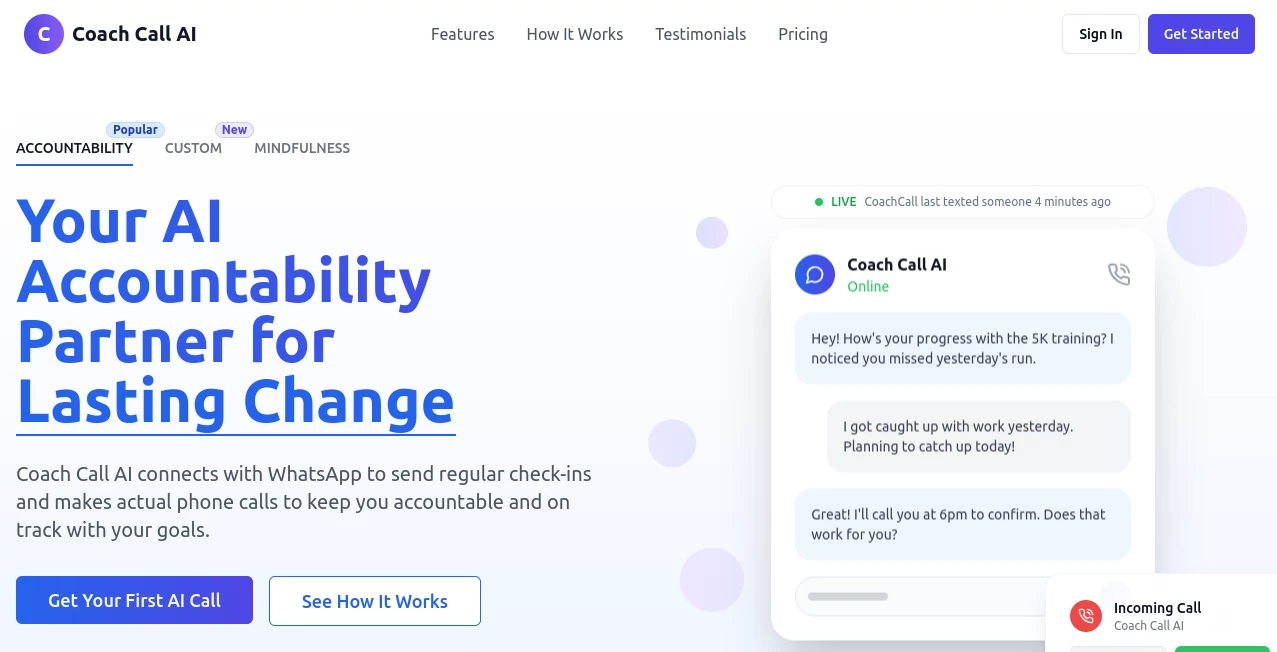
Sticking to a goal is often harder than setting one. Whether the goal is exercising regularly, finishing a project, waking up earlier, or simply building a better routine, motivation tends to disappear when there is no one checking in. Coach Call AI takes a more active approach by combining AI coaching with WhatsApp conversations and scheduled phone calls.
Instead of waiting for you to open an app and remember what you planned to do, the service can reach out to you at scheduled times. You can define your goals, choose when you want check-ins, and receive encouragement through WhatsApp or an actual phone call. This makes the experience feel closer to having someone actively keeping you accountable rather than simply recording tasks in a habit tracker.
The idea is particularly appealing for people who already know what they want to accomplish but struggle with consistency. A reminder is easy to ignore; answering a phone call and explaining your progress feels considerably more engaging.
Key Features
- Scheduled Phone Calls: Receive real phone calls at selected times to help you stay focused on your commitments.
- WhatsApp Integration: Connect through WhatsApp for regular check-ins and ongoing conversations without installing another dedicated messaging application.
- Goal Setting: Define the goals you want to work toward and customize the frequency of your accountability interactions.
- Achievement Tracking: Accomplishments and milestones can be captured from conversations and displayed as part of your progress journey.
- Progress Timeline: A visual record helps turn individual daily wins into a longer-term picture of progress.
- Custom Call Scheduling: Calls can be arranged around the moments when accountability is most useful.
- Coach Personalities and Voices: Users can choose a coaching voice and personality that better matches the type of encouragement they prefer.
User Interface
The experience is built around a relatively simple workflow rather than a complicated productivity dashboard. Users start by defining their goals and preferred check-in schedule, then connect WhatsApp through a QR code. From there, conversations and accountability interactions become part of the routine.
The progress dashboard adds another useful layer. Instead of leaving achievements scattered across conversations, the platform can organize milestones into a visual progress story. For someone working on a long-term goal, seeing that record develop can provide a small but meaningful psychological boost.
Accuracy & Performance
This is not primarily a tool where numerical accuracy or document processing determines its value. Its performance is better judged by how consistently it delivers scheduled interactions and how naturally it responds during accountability conversations.
The combination of WhatsApp messages and phone calls is particularly practical because it places the coaching experience inside communication channels people already understand. The real advantage comes when the timing of those interactions matches a user's routine. A workout reminder before the usual gym session, for example, can be much more useful than a generic notification appearing at an inconvenient hour.
Capabilities
The platform can be adapted to a surprisingly wide range of personal goals. Fitness routines, work projects, habit building, mindfulness, wake-up routines, evening reflection, and personal development are among the use cases presented on the website.
It can also be useful for people dealing with procrastination or difficulty maintaining routines. Rather than expecting users to constantly monitor their own progress, the system takes a more proactive role by initiating check-ins and scheduled calls.
Another interesting capability is the ability to switch the focus of the coaching experience. Someone might use it for exercise this month, shift toward a professional deadline later, and then concentrate on a personal habit. That flexibility makes the concept more suitable for changing priorities than a narrowly focused habit tracker.
Security & Privacy
Because the service can be involved in personal conversations, goals, habits, and phone communication, privacy is an important consideration. Users should review the current privacy information and service terms before sharing sensitive personal details through WhatsApp or phone conversations.
The platform's public-facing information emphasizes its coaching and accountability functionality rather than making broad security or regulatory compliance claims. For that reason, organizations or individuals with strict data-handling requirements should verify the applicable privacy policies directly before using it for confidential information.
Use Cases
Fitness Accountability: Schedule calls around workouts and use WhatsApp check-ins to maintain consistency with exercise goals.
Project Deadlines: Freelancers, developers, entrepreneurs, and professionals can use scheduled accountability interactions to stay focused on important milestones.
Habit Building: People trying to establish routines can use recurring check-ins to create more consistency around daily commitments.
Wake-Up Calls: Instead of relying only on a traditional alarm, users can schedule a motivational call to create a more active start to the day.
Procrastination: Regular accountability can be useful for people who repeatedly postpone tasks despite knowing exactly what needs to be done.
Mindfulness and Reflection: Morning check-ins can help set intentions, while evening conversations can provide an opportunity to reflect on what went well and what should change tomorrow.
Personal Development: Long-term self-improvement goals can be broken into smaller milestones and tracked over time.
Pros and Cons
Pros:
- Uses real phone calls instead of relying only on app notifications.
- WhatsApp integration makes daily communication familiar and convenient.
- Supports different types of personal and professional goals.
- Offers customizable call schedules and check-in frequencies.
- Tracks achievements and milestones over time.
- Provides different coach voices and personalities.
- Can be useful for people who struggle with consistency and procrastination.
Cons:
- Users who dislike receiving phone calls may prefer a less intrusive productivity solution.
- The value depends heavily on maintaining a consistent coaching schedule.
- It is designed around accountability rather than replacing a full project-management or habit-tracking system.
- Users should consider privacy implications before discussing highly sensitive information during AI conversations.
Pricing Plans
The current pricing structure offers three subscription levels designed around different levels of accountability.
Starter – $19/month: Includes weekly WhatsApp check-ins, two phone calls per week, basic progress tracking, single-goal setting, and email support.
Medium – $39/month: Adds daily WhatsApp check-ins, five phone calls per week, advanced progress tracking, multiple goals, priority support, custom call scheduling, and habit streak tracking.
Pro – $99/month: Includes the Medium features plus priority scheduling, an advanced analytics dashboard, personalized strategy sessions, a custom accountability framework, API access, and a dedicated account manager.
The website also presents yearly billing as an option with a stated saving of 17%, making the annual plan worth considering for users who already know they want to use the service for the long term.
How to Use It
Getting started follows a straightforward process. First, define the goal you want to work on and decide how frequently you want accountability check-ins. You can then select suitable times for phone calls based on your daily routine.
Next, connect your WhatsApp account using the QR-code setup provided by the service. Once connected, your AI coach can communicate with you through WhatsApp and send regular check-ins.
Scheduled phone calls add the more active accountability layer. For example, someone trying to exercise consistently could arrange a call around workout time, while a freelancer could use calls before an important project milestone.
As conversations take place, achievements can be recorded and displayed in the progress dashboard. Over time, this creates a clearer picture of how consistently you are moving toward your goals.
Comparison with Similar Tools
Traditional habit trackers usually expect the user to open an application, mark a task as complete, and review their own statistics. That approach works well for disciplined users, but it can become easy to ignore when motivation drops.
AI chat-based coaches offer more interaction, but they can still be passive because the user generally has to start the conversation. The approach here is different: scheduled phone calls and WhatsApp check-ins make the system more proactive.
It is also different from hiring a human accountability coach. A human coach can provide deeper personal judgment and emotional understanding, but the cost and scheduling requirements can be significantly higher. An AI-based service sits somewhere between a conventional productivity app and a dedicated coaching relationship, particularly for people who mainly need regular prompts, encouragement, and follow-through.
The strongest reason to choose this type of solution is therefore not simply the presence of AI. It is the combination of proactive communication, voice calls, messaging, goal tracking, and scheduled accountability in one experience.
Conclusion
For anyone who repeatedly sets goals but struggles to follow through, an accountability system can be more valuable than another productivity dashboard. The combination of scheduled phone calls, WhatsApp conversations, progress tracking, and customizable coaching makes this service an interesting option for building more consistent routines.
Its appeal is especially clear for people who respond better when someone actively checks whether they completed a commitment. Whether the goal is getting to the gym, finishing a work project, waking up on time, or developing a new habit, having an AI coach initiate the conversation can add a useful layer of pressure and encouragement.
It is not intended to replace every productivity or coaching solution. Instead, it focuses on one specific problem exceptionally well: helping people stay accountable after the initial excitement of setting a goal has disappeared.
Frequently Asked Questions (FAQ)
What does this AI accountability service do?
It acts as an AI accountability partner that communicates through WhatsApp and scheduled phone calls to help users stay committed to personal, professional, fitness, and habit-related goals.
Does it make real phone calls?
Yes. Scheduled phone calls are one of its central features, allowing users to receive accountability and motivational calls at selected times.
Do I need to install another messaging app?
No additional messaging application is required for the WhatsApp communication feature. The setup connects the user's WhatsApp account through a QR code.
Can I choose when I receive calls?
Yes. Call scheduling can be customized so accountability interactions occur at times that fit the user's routine and goals.
What kinds of goals can I use it for?
It can be used for fitness, habits, productivity, project deadlines, personal development, wake-up routines, mindfulness, and other goals where regular accountability is helpful.
Can it track my achievements?
Yes. The platform can automatically capture achievements and milestones from conversations and present them through a visual progress timeline.
Is it suitable for procrastination?
It can be useful for people who have difficulty following through on commitments because the system proactively checks in rather than waiting for the user to open an app.
What pricing plans are available?
The current website lists Starter at $19 per month, Medium at $39 per month, and Pro at $99 per month. Annual billing is also presented with a stated 17% saving.
Can I use it for more than one goal?
Multiple goal setting is included in the Medium plan and above, while the Starter plan focuses on a single goal.
Is it a replacement for a human coach?
It can provide regular AI-based accountability and encouragement, but it should not be considered a complete replacement for a qualified human coach when professional or specialized guidance is required.