
Submify
What is Submify?
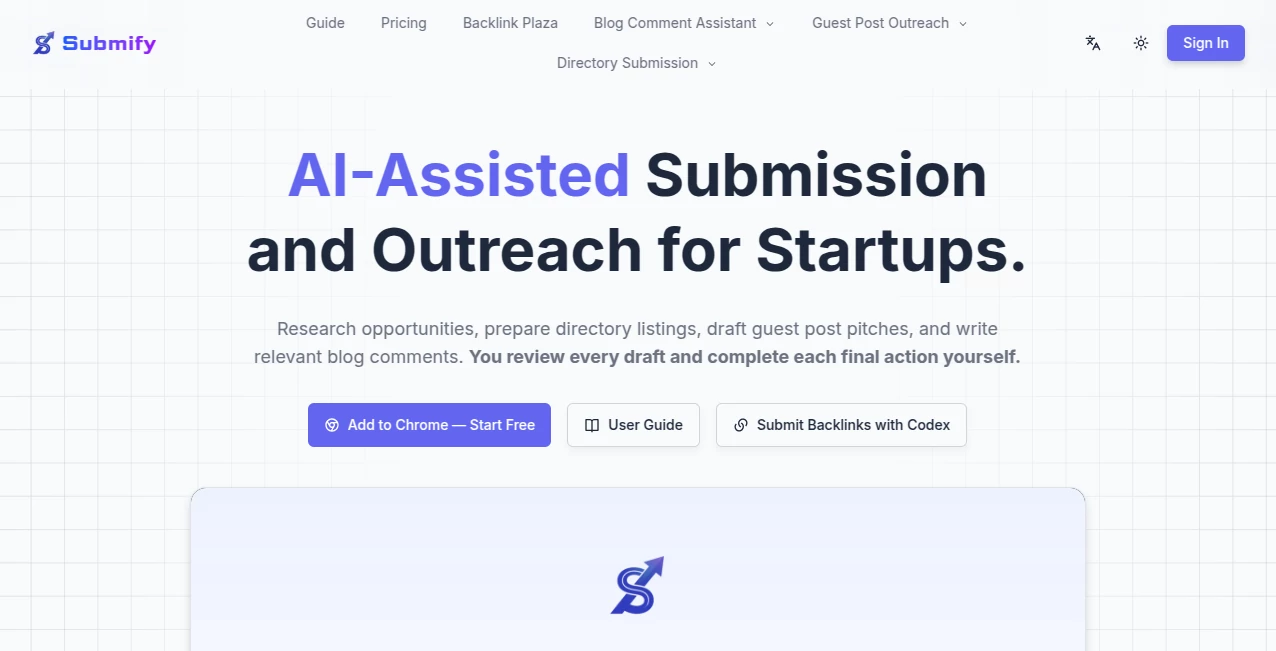
Submify is an AI-assisted platform designed to make directory submissions, guest post outreach, and backlink-related tasks less repetitive for startups, SaaS companies, marketers, and agencies. Instead of relying on generic templates or unattended automation, it combines page-aware research, editable AI-generated drafts, browser-based form assistance, and human review.
The idea is straightforward: you provide your product information once, choose a relevant opportunity, and let the system prepare the content around the actual page you are working with. You still make the final decision and complete the final action yourself. That approach is particularly useful for founders who want to build distribution and visibility without turning their outreach process into a completely automated black box.
For example, a startup submitting to several directories may need different descriptions, categories, tags, and field lengths for every destination. Preparing all of that manually can become surprisingly time-consuming. The platform is designed to reduce that repetitive work while keeping the user involved.
Key Features
- Context-aware drafts based on the target page and product profile.
- Directory research and a dedicated opportunity library.
- Browser-based autofill for common submission fields.
- Guest post opportunity research and personalized pitch drafting.
- Article-aware blog comment drafting.
- Smart category, tag, and pitch-angle suggestions.
- Short and long content variants for different field limits.
- Multi-project workspace for managing several products.
- Custom CSV list import for bringing your own opportunities.
- Reusable logos, screenshots, and other media assets.
- Activity tracking for pending, submitted, published, rejected, and outdated opportunities.
- Human-controlled final actions, including login, CAPTCHA, sending, posting, and final submissions.
User Interface
The workflow is built around a browser extension and a central workspace. Rather than forcing users through a complicated campaign builder, the process follows a practical sequence: create a product profile, select an opportunity, prepare an editable draft, review it, and then take the final action.
This structure makes sense for directory work because every website can have slightly different fields and requirements. Product details such as the description, tagline, category, audience, and reusable assets can be stored and reused instead of being copied from one document to another.
The multi-project workspace is another useful touch for people working with more than one product. An agency, for instance, can keep separate product profiles and submission activity instead of mixing everything into a single campaign.
Accuracy & Performance
The strongest part of the workflow is its emphasis on context. Rather than simply inserting the same paragraph into every submission, the system examines public details from the target page and uses those details when preparing content.
It can also adjust wording according to the audience and channel. A directory listing, guest post pitch, and blog comment do not need to sound alike, and adapting the draft to each situation can make the resulting content feel more appropriate.
There is an important distinction, however. The platform assists with research, drafting, and form completion; it does not promise that every submission will be accepted or that every backlink will improve rankings. Website owners, editors, and search engines ultimately control those outcomes.
Capabilities
The platform covers several parts of an outreach workflow rather than focusing only on form filling. Directory research helps users find potential submission targets, while the opportunity library provides a starting point for discovering relevant websites.
For outreach, it can prepare publication-specific guest post pitches and generate comments based on the article being viewed. The system can also recommend tags and angles and create different versions of copy when a destination has strict length requirements.
Another practical capability is the ability to import a personal CSV list. This is valuable for marketers who already maintain their own collection of directories, publications, or outreach opportunities and do not want to rebuild that list from scratch.
Security & Privacy
One of the notable design choices is that sensitive final actions remain under the user's control. The platform does not automatically handle the final login, CAPTCHA, send, post, or submission action. Users review the generated material before deciding what to do with it.
The service also states that it does not require users to hand over directory login credentials. Since browser permissions, product data, and storage practices can change over time, users should still review the current privacy policy before using the service for a large campaign or storing business information.
Use Cases
Startup directory submissions: Founders can prepare product listings for multiple directories without rewriting the same information from scratch each time.
SaaS launches: A new SaaS product can maintain a reusable profile containing its positioning, description, audience, categories, and media assets, making launch distribution easier to organize.
SEO outreach: Marketers can research potential directory and publication opportunities and prepare relevant content before deciding which sites are actually worth pursuing.
Guest post outreach: Instead of sending a generic pitch to every publication, users can prepare drafts that take the target publication and its audience into account.
Blog engagement: Article-aware comment drafting can help users prepare responses that relate to the actual discussion rather than dropping unrelated promotional text into a comment section.
Agencies: Teams managing several clients or products can separate projects, track activity, reuse assets, and work from their own opportunity lists.
Pros and Cons
Pros
- Combines directory submissions and outreach workflows in one platform.
- Uses target-page context instead of relying solely on fixed templates.
- Keeps the user responsible for final actions.
- Supports multiple projects.
- Allows custom opportunity lists through CSV import.
- Provides reusable product and media information.
- Offers activity tracking for submission workflows.
- Includes multilingual support in its available plans.
Cons
- It does not guarantee directory acceptance, backlinks, or improved search rankings.
- Users still need to review generated content before publishing or submitting it.
- Not every website or form can necessarily be handled automatically.
- Third-party websites can change their forms, policies, or submission requirements.
- Large-scale campaigns may require a paid plan.
Pricing Plans
The service offers a free plan alongside paid Pro and Agency options. The free tier is designed as an entry point and includes 10 AI autofill credits per month, access to 10 starter directories, one project, basic form recognition, manual progress tracking, and basic multilingual support.
The Pro plan is listed at $39 per month on the regular monthly pricing, with lower annual pricing available. It expands the workflow with unlimited AI autofill, 1,000 fast AI autofills, access to more than 200 premium directories, support for up to 10 projects, additional AI tone styles, smart tag recommendations, cloud-synced media assets, and CSV/PDF reporting.
The Agency plan is listed at $139 per month on the regular monthly pricing, with lower annual pricing available. It adds unlimited projects, 5,000 fast AI autofills, unlimited whitelist directory imports, advanced semantic rewriting, beta API access, white-label client backlink reports, and collaboration for teams of up to five seats.
The free option is a sensible way to understand the workflow before committing to a larger campaign. Users who regularly manage multiple submissions may find the additional directory access and project capacity of the paid plans more useful.
How to Use It
Start by creating a product profile with the basic information that will be reused throughout the workflow. This can include the product name, website, tagline, description, positioning, category, audience, and supporting assets.
Next, choose an opportunity that fits the product. This could be a startup directory, publication, or article. The system uses information from the target page together with the saved product profile to prepare an editable draft.
Review the generated content carefully. Check the facts, wording, relevance, formatting requirements, and any rules provided by the destination. If something does not fit, edit the draft before continuing.
Finally, complete the action yourself. The human-controlled approach means the user remains responsible for the final submission, message, post, login, or CAPTCHA rather than handing those decisions over to unattended automation.
Comparison with Similar Tools
Traditional directory submission is dependable but repetitive. Every website has its own fields, character limits, categories, and instructions, so a founder can spend hours moving information from one form to another.
Fully automated scripts take a different approach by attempting to complete actions without continuous human involvement. That can be convenient, but it also creates more room for outdated mappings, inappropriate submissions, and problems when a website changes its workflow.
This platform sits between those two approaches. It automates much of the research, drafting, and repetitive form preparation while leaving the final judgment with the user. For people who care about the quality and relevance of each submission, that middle ground can be more practical than either doing everything manually or handing the entire process to an unattended bot.
It is also broader than a simple directory autofill utility because its workflow includes guest post research, pitch drafting, blog comment assistance, opportunity tracking, reusable assets, and multi-project management.
Conclusion
For founders and marketers who have ever spent an afternoon filling nearly identical directory forms, the appeal is easy to understand. The repetitive parts of distribution are handled with AI assistance, while the decisions that can affect brand reputation and third-party relationships remain in human hands.
The combination of contextual drafting, opportunity research, reusable product profiles, browser assistance, and activity tracking makes it a useful addition to a startup's outreach workflow. It is not a shortcut to guaranteed rankings or instant backlinks, and it should not be treated as one. Its real value is reducing the administrative work around a process that still benefits from careful target selection and human judgment.
For a solo founder testing directory distribution, the free tier provides a low-risk starting point. For ongoing SEO and launch work, the larger plans offer more room for projects, directories, and outreach activity. Agencies handling several products can also benefit from the additional project and collaboration features.
Frequently Asked Questions (FAQ)
Does it automatically submit products to directories?
No. It assists with research, content preparation, and common form fields, but the user reviews the draft and handles the final submission action.
Can it be used for guest post outreach?
Yes. It can research publication opportunities and prepare personalized guest post pitches based on the target publication.
Can it generate blog comments?
Yes. Its blog comment workflow uses article context to help prepare relevant responses. Users can review and edit the response before posting.
Can I use my own directory list?
Yes. Users can import their own CSV lists and incorporate personal opportunity sources into the workflow.
Does it guarantee backlinks or higher rankings?
No. Directory owners, publishers, and search engines control acceptance, link treatment, indexing, and rankings. The platform helps prepare and organize the work but cannot guarantee those outcomes.
Can I manage multiple products?
Yes. The platform provides a multi-project workspace, with the number of projects depending on the selected plan.
Does it support different languages?
Yes. Multilingual support is included, with broader capabilities available depending on the plan.
Is human review necessary?
Yes. Reviewing generated content is recommended so that product claims, relevance, originality, and destination-specific requirements are correct before anything is submitted or published.
Who is it best suited for?
It is particularly useful for startup founders, SaaS teams, marketers, SEO professionals, agencies, and established products that regularly research directories or manage outreach campaigns.
AI Lead Generation , AI SEO Assistant , AI Workflow Management , AI Response Generator .
These classifications represent its core capabilities and areas of application. For related tools, explore the linked categories above.

Submify Alternatives Product

TruthSpine

Arobis AI Vi…

TrueSource AI

Marketbetter…

InspiroBot

seedancetwo2…

Wild and Fre…

Leado.co

AI Entity