


















Tenet Security
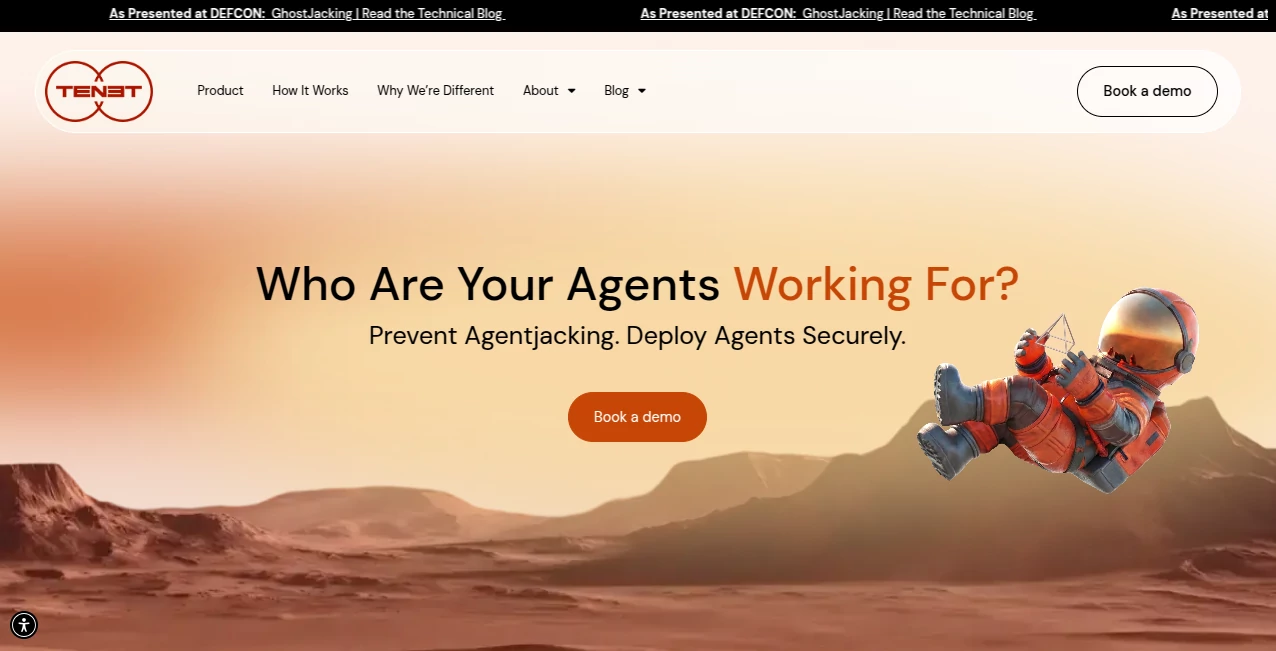
What is Tenet Security?
AI agents are moving far beyond simple chat and content generation. They can now call tools, access cloud resources, work with sensitive information, execute code, and make decisions with very little human intervention. That creates a security problem that traditional security products were not designed to handle.
Tenet Security is built specifically for this emerging agentic layer. It gives security teams visibility into what autonomous agents are doing across endpoints and cloud environments, while providing real-time protection against threats such as agent hijacking, prompt injection, data exfiltration, and malicious agent behavior.
The approach is particularly interesting for organizations that are moving AI agents from experiments into real production environments. Instead of simply monitoring an agent after something goes wrong, the platform is designed to understand what an agent is about to do and prevent dangerous actions before they are executed.
Key Features
- AI agent discovery across endpoint and cloud environments
- Real-time monitoring of agent sessions and actions
- Agentjacking and agent hijacking protection
- Detection of suspicious agent behavior and intent drift
- Protection against data and secrets exfiltration
- Visibility into MCPs, skills, tools, and agent interactions
- Runtime security without traditional proxies or gateways
- Continuous agent risk monitoring
- Pre-production security validation and red teaming
- Testing against OWASP Top-10 for Agents and MITRE ATLAS
User Interface
The platform is designed around the needs of security teams rather than everyday AI users. Its focus is on giving security professionals a clear view of agent activity, including the identity involved, the environment, tool calls, decisions, and other elements of an agent session.
One of the practical advantages is that the security layer is designed to operate where agents actually run. The company describes its deployment approach as lightweight, with no requirement to rebuild existing agents or introduce a traditional gateway between the agent and its environment.
For a security team investigating an unusual event, having the surrounding context matters. Instead of seeing a single suspicious request in isolation, the platform aims to reconstruct the broader agent session and show how the action fits into the agent's behavior.
Accuracy & Performance
Security monitoring for autonomous agents can easily become noisy if every unusual action is treated as a threat. The platform takes a different approach by examining the likely consequences of an agent's actions rather than relying only on static rules.
Its Agent-Side Simulation technology is designed to simulate where an agent's next actions could lead before those actions are carried out. When a path appears dangerous, the platform can block the action and provide a trace explaining the reason for the decision.
The company also states that its threat intelligence is informed by millions of agentic sessions, more than 100 detection mechanisms, production environments, and its global honeypot network. This focus on real-world agent behavior makes the platform particularly relevant to organizations dealing with autonomous systems rather than conventional software alone.
Capabilities
The platform covers the agent security lifecycle from discovery through validation. Organizations can first identify the agents operating throughout their infrastructure, understand their risk, monitor their activity, and then apply active runtime protection.
It can monitor coding agents, cloud-based agents, assistants, and customer-facing agents. Security teams can also gain visibility into connected MCPs and skills, helping them understand the wider collection of components an autonomous agent can interact with.
Another important capability is pre-production testing. Agents can be tested against real-world attack scenarios and security frameworks before they are allowed to interact with production systems. This makes the platform useful not only for incident response but also for secure AI deployment.
Security & Privacy
Security is the central purpose of the platform. Rather than treating an AI agent as another application to monitor from the outside, the technology is designed around the agent's runtime behavior.
The platform can detect and block threats including prompt injection, tool abuse, privilege escalation, agent hijacking, malicious sessions, and data exfiltration. It also focuses on agent-to-agent attacks, where compromising one autonomous agent could potentially provide a path toward another.
For organizations handling sensitive customer, financial, operational, or proprietary information, this runtime visibility can provide an additional layer of control over how AI systems interact with company infrastructure.
Use Cases
Enterprise AI security: Large organizations can discover autonomous agents operating across their infrastructure and continuously monitor their risk instead of relying on manual inventories.
AI coding environments: Development teams can protect coding agents that have access to repositories, terminals, APIs, credentials, and other development resources.
Customer-facing agents: Businesses deploying AI-powered assistants can monitor agent behavior and prevent manipulated sessions from turning into security incidents.
Cloud AI agents: Security teams can extend visibility and protection to autonomous systems operating in cloud environments and interacting with production services.
AI security testing: Teams preparing an agent for production can test it against known agentic attack patterns and frameworks before giving it access to real infrastructure.
Incident investigation: When suspicious activity occurs, security professionals can examine the agent session, actions, tool usage, and surrounding context to understand what happened and why.
Pros and Cons
- Pros: Purpose-built for autonomous AI agents.
- Pros: Combines discovery, detection, protection, management, and validation.
- Pros: Provides runtime visibility into agent actions and tool calls.
- Pros: Supports active blocking rather than detection alone.
- Pros: Designed to work across endpoint and cloud environments.
- Pros: Supports security testing against OWASP Top-10 for Agents and MITRE ATLAS.
- Cons: It is primarily aimed at enterprises and professional security teams rather than casual AI users.
- Cons: Public self-service pricing is not listed, so organizations need to contact the team for commercial details.
- Cons: Teams looking for a simple consumer-oriented AI security tool may find the platform more advanced than necessary.
Pricing Plans
Public pricing plans are not currently displayed on the product website. Instead, organizations are encouraged to request a demo or an agent risk assessment from the team.
This pricing approach is understandable for an enterprise security platform because deployment requirements, infrastructure size, number of agents, security coverage, and organizational needs can vary significantly from one company to another.
For businesses evaluating the platform, requesting an agent risk assessment can also be a practical starting point because it allows the security team to understand the potential exposure of its existing AI agents before discussing a larger deployment.
How to Use the Platform
Start by connecting the platform to the environments where your AI agents operate. The discovery process is designed to identify agent footprints across endpoints and cloud infrastructure without requiring teams to rebuild their existing applications.
Once agents are discovered, security teams can review their risk, connected tools, MCPs, skills, and activity. The next step is continuous detection and investigation, where suspicious behavior and potentially malicious agent sessions can be examined in greater detail.
Runtime protection can then be applied to stop dangerous actions as they occur. Before deploying new agents into production, teams can also validate them against realistic attack scenarios and established agentic security frameworks.
For an organization just beginning its AI security program, starting with discovery and risk assessment is likely the most useful approach. It provides a clearer picture of what agents already exist before security policies are introduced across the environment.
Comparison with Similar Tools
Traditional endpoint security products are excellent at monitoring processes, files, and operating-system activity, but autonomous agents introduce another layer of behavior. An agent may make tool calls, interpret information, change its objective, interact with another agent, or access data through APIs without looking like a conventional endpoint attack.
Identity and access management products answer important questions about who can access a resource, while AI guardrails often concentrate on prompts and model inputs or outputs. Runtime agent security approaches the problem from another direction by examining what the autonomous system actually does while it is operating.
This makes the platform especially interesting for organizations that already have conventional security products but need additional visibility into autonomous AI behavior. Rather than replacing every existing security control, it is positioned as a specialized security layer for the agentic environment.
Conclusion
As AI agents gain access to more systems, data, and business processes, securing their behavior becomes just as important as securing the underlying infrastructure. An agent can be perfectly legitimate and still become dangerous if an attacker manages to manipulate its instructions, tools, or objectives.
The platform takes a forward-looking approach by combining agent discovery, runtime visibility, active protection, risk management, and security validation in one environment. Its Agent-Side Simulation technology is particularly notable because it focuses on predicting the consequences of an action before allowing the action to proceed.
For organizations building or deploying autonomous AI systems at scale, this can provide a valuable layer of control between experimental AI and production-ready agentic infrastructure. It is a strong option to consider when conventional security tools do not provide enough insight into what AI agents are actually doing.
Frequently Asked Questions (FAQ)
What does this platform protect?
It is designed to protect autonomous AI agents running across endpoints and cloud environments, including coding agents, assistants, cloud agents, and customer-facing agents.
What is Agentjacking?
Agentjacking is a class of attacks in which an autonomous AI agent is manipulated or hijacked so that it performs actions on behalf of an attacker rather than following its intended objective.
Can it detect AI agents across an organization?
Yes. The discovery capability is designed to identify agent footprints across infrastructure, including agents, MCPs, and connected skills.
Can it block attacks in real time?
Yes. The runtime protection layer is designed to detect malicious behavior and block dangerous agent actions while the session is taking place.
Does it support MCP security?
Yes. The platform provides visibility into MCPs and the tools and skills connected to AI agents, allowing security teams to include those components in their risk assessment.
Can agents be tested before production?
Yes. The validation capabilities allow organizations to stress-test agents against real-world attack scenarios, including OWASP Top-10 for Agents and MITRE ATLAS.
Does it require a proxy or gateway?
The platform is designed to operate directly where agents run and does not rely on traditional proxies or gateways for its runtime protection approach.
Is public pricing available?
No public pricing plans are currently displayed. Organizations can contact the team to request a demo and discuss their specific requirements.
AI Testing & QA , AI Developer Tools , AI DevOps Assistant .
These classifications represent its core capabilities and areas of application. For related tools, explore the linked categories above.
Tenet Security details
Website unavailable — View Alternatives
Pricing
- Freemium
Apps
- Web App
Categories

Tenet Security Alternatives Product

TokenCalcula…

Prelight
Kimi K2.5

KaneAI

ShipAhead

cznull

Sendmux

Nimbalyst

git-lrc
