Tracetify
What is Tracetify?
Understanding a successful competitor is not always about looking at its current traffic, rankings, or backlink profile. The more useful question is often how that company got there in the first place. Tracetify takes this approach by reconstructing the public history of a product, showing important events such as early mentions, launch activity, growth signals, and the channels that helped it gain attention.
Instead of producing a generic competitor summary, the platform turns publicly available evidence into a chronological research report. Users can enter a competitor's URL and receive information collected from multiple sources, making it easier to investigate what happened before a product became established.
This can be particularly useful for founders, growth marketers, SEO professionals, product researchers, and anyone trying to understand which early actions may have contributed to another company's growth. The emphasis on dated evidence also makes the research more practical: rather than simply asking what a competitor is doing today, you can examine what it did when it was still relatively small.
Key Features
- Competitor history reconstruction from a website URL
- Research across 12 different data sources
- Chronological launch and growth timelines
- Evidence-backed reports with links to original sources
- First-mention and early visibility research
- Backlink and referral-source analysis
- Traffic estimates and trend information
- Hacker News and Reddit archive research
- Wayback Machine history
- Google Trends and SERP visibility data
- Advertising library research
- Action-oriented verdicts based on historical events
User Interface
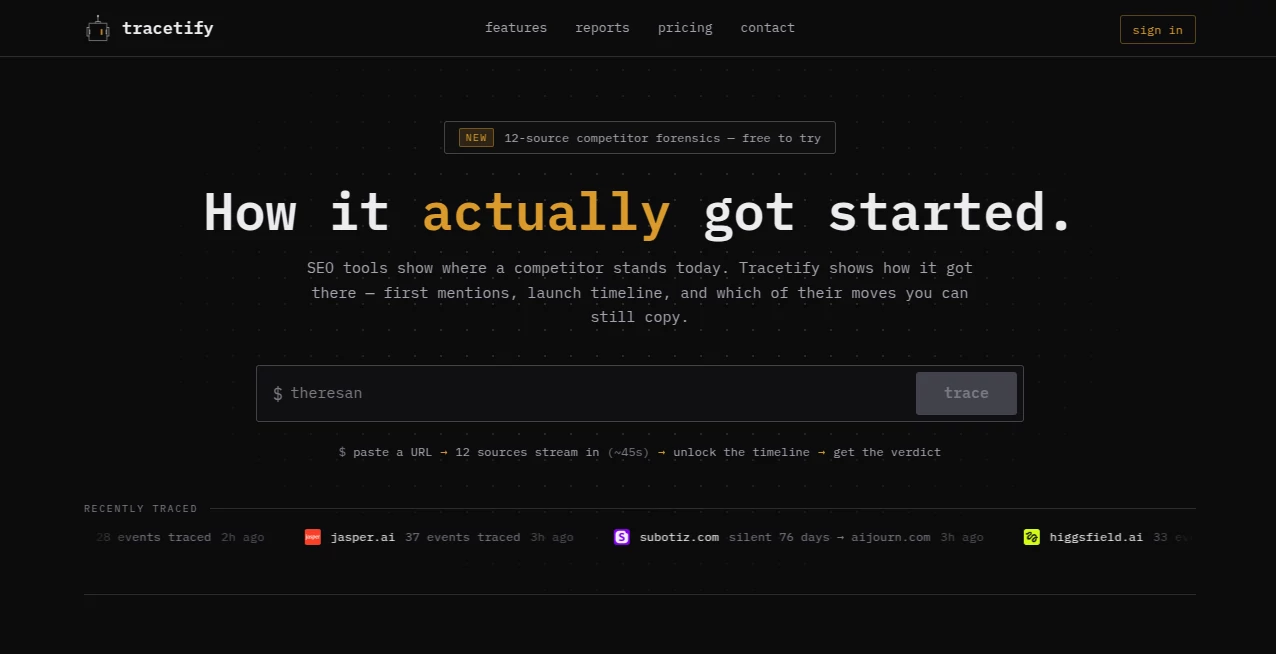
The experience is deliberately straightforward. The main workflow starts with a URL field where users enter the website they want to investigate. After submitting a domain, the system begins collecting information from its available sources and builds the research around that website.
The interface is designed around the research process rather than overwhelming users with dozens of unrelated dashboards. Reports, timelines, sources, and conclusions are presented as connected pieces of the same investigation. For someone doing competitor research regularly, this keeps the process focused and easy to follow.
Accuracy & Performance
One of the strongest aspects of the platform is its emphasis on verifiable evidence. Each trace uses 12 sources, including backlink data, traffic estimates, social and community archives, historical web pages, search results, trends, and advertising information. A typical initial trace is designed to take around 45 seconds.
More importantly, the system says it does not fill missing information with guesses. When a source cannot be verified or a website blocks access, the report identifies the limitation instead. Claims are connected to their underlying sources, allowing researchers to inspect the evidence themselves.
This approach is especially valuable when researching relatively new products. A plausible growth story is easy to create, but a dated sequence of events backed by public records is much more useful when making actual marketing decisions.
Capabilities
The platform goes beyond simply listing backlinks or estimating traffic. It attempts to reconstruct the sequence of events behind a competitor's growth. A report can reveal when a product first appeared publicly, where it was mentioned, how long it remained quiet, and which promotional or distribution events happened later.
Its research layer combines information from sources such as a large backlink index, SimilarWeb traffic estimates, Hacker News, Reddit archives, the Wayback Machine, Google Trends, SERP rankings across multiple markets, advertising libraries, and revenue information when that information has been connected by a founder.
The final analysis is designed to turn that historical information into practical ideas. Instead of stopping at a timeline, the verdict identifies several potential moves that can be learned from the competitor's earlier growth stage.
Security & Privacy
The service primarily works with publicly available information. Reports are built from external public sources, and the platform states that each claim is linked to the source from which it was obtained.
There is also a clear distinction between publicly readable research and paid report sections. Existing reports can be viewed publicly at the data level, while paid timeline and verdict sections remain behind the relevant access controls. Users should still review the platform's privacy and terms documentation before submitting information that is not intended to be public.
Use Cases
Competitor Research: Founders can investigate how established products attracted their earliest attention instead of copying their current marketing strategy.
Startup Research: Entrepreneurs can study the early stages of successful products and identify launch channels, communities, directories, or other events that appeared during their growth.
Marketing Strategy: Marketing teams can use historical evidence to find campaigns, mentions, and distribution opportunities that may be worth testing.
SEO Research: SEO professionals can investigate when competitors first appeared in search results, which sources mentioned them, and how their visibility developed over time.
Product Discovery: Product teams can examine how similar products evolved and which public milestones accompanied their development.
Investment and Market Research: Researchers can use historical public information to build a more detailed picture of a company's journey rather than relying solely on its current position.
Content and Distribution Research: Teams looking for promotional opportunities can study where competing products were first discovered and which channels became important later.
Pros and Cons
Pros
- Focuses on how competitors grew, not just where they are today
- Combines information from multiple public data sources
- Provides dated evidence for research claims
- Useful for startup and competitor research
- Includes an actionable verdict rather than only raw data
- Existing public reports can be read without paying
- Credits purchased separately do not expire
- A failed trace or incomplete verdict is automatically refunded
Cons
- The deepest analysis requires credits or a subscription
- Very large websites may have limitations in historical backlink research
- Reports represent a snapshot from the time they were created
- Fresh research consumes additional credits
- The service is more specialized than a general-purpose SEO platform
Pricing Plans
The platform uses a credit-based pricing system alongside an unlimited subscription. New users can try the service without immediately paying, with free credits available after registration.
The free option provides two free traces before signup, followed by 20 credits after creating an account. A complete analysis consists of three actions: the initial trace, unlocking the timeline, and unlocking the verdict. Each action costs 10 credits.
The one-time credit package starts at $19.90 for 150 credits. These credits do not expire and provide enough credits for five complete analyses.
For users who perform competitor research frequently, the unlimited plan costs $99 per month. It includes unlimited traces, timeline and verdict unlocks, and free verdict regeneration, subject to a fair-use limit of up to 30 fresh traces per calendar day.
How to Use the Platform
- Open the website and enter the URL of the competitor you want to research.
- Start a trace to collect information from the available public sources.
- Review the initial research and the sources connected to the collected evidence.
- Use credits to unlock the detailed timeline when deeper research is required.
- Unlock the verdict to see the main patterns and recommended actions identified from the historical evidence.
- Check the original sources before using important findings in business decisions.
Comparison with Similar Tools
Traditional SEO and competitive intelligence platforms are excellent when the goal is to understand where a company stands today. They can show rankings, traffic estimates, backlinks, keywords, and other current performance indicators.
This platform takes a different angle. Its central question is not simply “Where is this competitor now?” but “What happened before it got here?” That distinction can make the research particularly interesting for founders and growth teams studying products that started from a small audience.
For example, current traffic may tell you that a competitor is successful, while historical research can reveal that the company spent months with little public attention before appearing in a particular community, directory, publication, or launch channel. That context can be much more useful when building a strategy from an early-stage position.
It also differs from simply asking a general-purpose AI assistant to explain a competitor. Rather than relying only on previously learned information, the service works with live public records and provides dated references that can be checked independently.
Conclusion
Competitor research becomes considerably more useful when it explains the journey rather than only displaying the destination. This platform is built around that idea, combining historical web research, multiple public data sources, dated events, and evidence-backed analysis into a single workflow.
For founders and marketers, the most interesting part may be the focus on early-stage behavior. A company with hundreds of thousands of visitors today has access to resources that a new startup does not. Looking at what that same company did when it was much smaller can reveal strategies that are far easier to understand and potentially reproduce.
With its source-based reports, historical timelines, flexible credit system, and actionable conclusions, the platform offers a focused approach to competitor intelligence. It is particularly worth considering for anyone who wants to move beyond surface-level competitor metrics and understand the events that shaped a product's growth.
Frequently Asked Questions (FAQ)
What does the platform analyze?
It analyzes publicly available information about a website, including historical mentions, backlinks, traffic estimates, community activity, web archives, search visibility, trends, advertising data, and other publicly verifiable signals.
How many sources are used for each trace?
Each trace uses 12 data sources. The available sources include backlink data, traffic estimates, Reddit and Hacker News archives, the Wayback Machine, Google Trends, SERP rankings, advertising libraries, and other public datasets.
How long does a trace take?
The initial trace is designed to take approximately 45 seconds, although the exact time can vary depending on the website and available data.
Do purchased credits expire?
No. One-time credits do not expire, so they can be saved and used whenever additional competitor research is needed.
Can I research any website?
Any domain can be submitted for research. Very large websites may have limitations in historical first-mention research because backlink indexes cannot always reach equally far into the past. When this happens, the report identifies the limitation.
Are the reports based on verified information?
The platform states that it only presents information it can verify and connects report claims to their underlying sources. If information cannot be confirmed, the report indicates the limitation instead of presenting an unsupported conclusion.
Can existing reports be read for free?
Yes. Existing reports have a publicly accessible data layer, while certain detailed sections such as the full timeline and verdict require the appropriate credits to unlock.
What is a full analysis?
A full analysis consists of three steps: running the trace, unlocking the complete timeline, and unlocking the verdict. Each step costs 10 credits, making the complete analysis 30 credits.
AI Marketing Plan Generator , AI Research Tool , AI Analytics Assistant .
These classifications represent its core capabilities and areas of application. For related tools, explore the linked categories above.

Tracetify Alternatives Product

RankPeak

Candidate Sc…

Odysseus AI

Reddit Campa…
Adscriptly

Lebesgue: AI…
PatentFig AI

Grok 4
Roipad