


















TrustGrowth
What is TrustGrowth?
TrustGrowth is an SEO and AI visibility platform built for website owners who want a clearer picture of how their site performs in search and how it may be understood by modern AI systems. Instead of relying only on generic SEO scores, it connects with Google Search Console using read-only access and evaluates a website against its own search data.
The platform brings technical SEO, performance, content quality, E-E-A-T, search visibility, authority, and AI visibility into one workflow. Its approach is particularly interesting for founders and marketers who want recommendations backed by evidence rather than another dashboard filled with unexplained numbers.
One of the strongest aspects of the product is its emphasis on showing the evidence behind an issue. When an audit identifies a problem, the affected pages and supporting information are surfaced so users can investigate the finding and decide what should actually be changed.
Key Features
- GSC-verified website audits using read-only Google Search Console access
- More than 80 checks covering technical SEO, performance, content, and other website signals
- 27 E-E-A-T signals covering experience, expertise, authoritativeness, and trustworthiness
- AI visibility analysis across multiple AI engines
- Search visibility and competitor research
- Backlink, link-gap, and authority intelligence on higher plans
- Keyword opportunities and competitor analysis
- Website-specific research and strategy recommendations
- Public proof pages with dated scores and score history
- API and MCP access on supported plans
- Groundcrew, an open-source option for working with an AI coding or research agent
User Interface
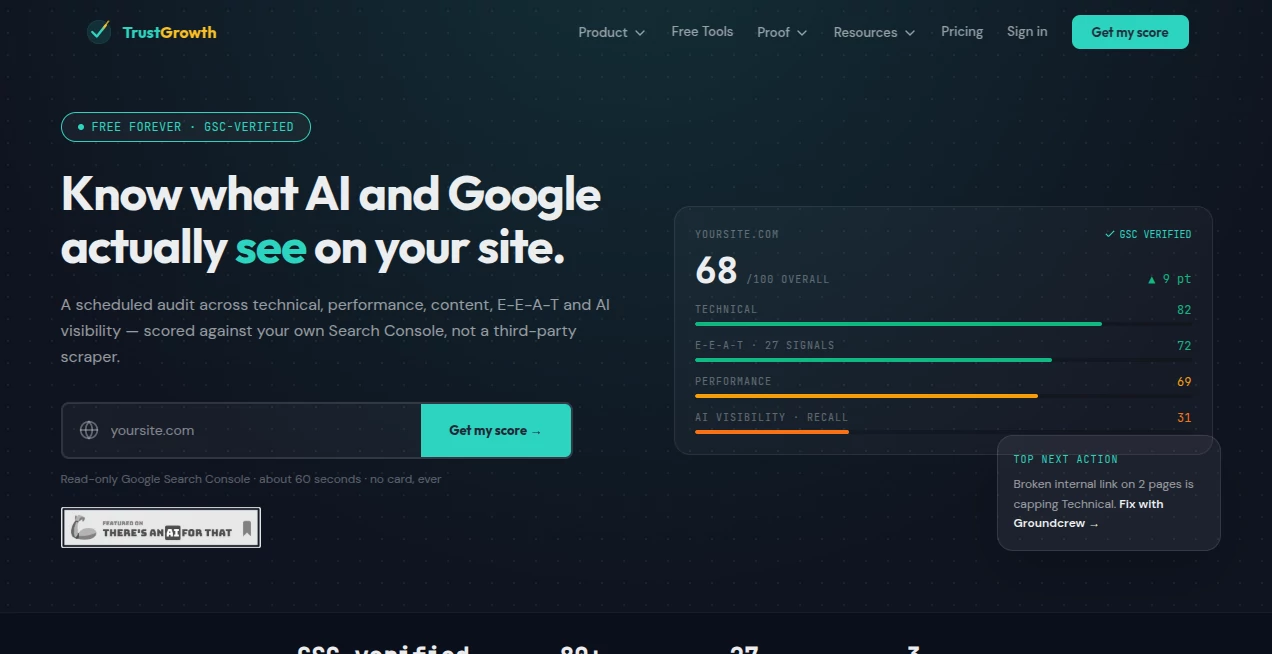
The interface is designed around a straightforward audit-and-action workflow. Rather than forcing users to move between several unrelated SEO tools, the platform organizes information around what was measured, what needs attention, and whether the situation improves after changes are made.
The scoring dashboard separates major areas such as technical performance, E-E-A-T, performance, and AI visibility. Findings can also be connected to the pages where an issue occurs, which makes the experience more practical than simply displaying a percentage or letter grade.
For website owners who prefer working from evidence, this structure makes sense. You can see the current baseline, identify the most important problems, make changes independently or with an agent, and then measure the result again.
Accuracy & Performance
A major selling point is the use of first-party Google Search Console data rather than depending entirely on third-party estimates. The platform describes its audit as GSC-verified and uses connected property data as part of its evaluation.
The audit covers more than 80 individual checks, including areas such as metadata, headings, internal and external links, structured data, Core Web Vitals, GEO readiness, and E-E-A-T signals. Findings are associated with affected pages where applicable, giving users a concrete place to investigate.
It is also refreshingly transparent about uncertainty. If a particular check cannot be performed, the system can identify it as unmeasured instead of presenting an invented pass or failure. That distinction is valuable when making SEO decisions from automated reports.
Capabilities
The platform goes beyond traditional technical SEO auditing. Its AI visibility feature looks at how a website appears across AI-driven discovery, while its search visibility tools focus on SERP presence, competitors, and share of voice.
Research capabilities can identify keyword opportunities and competitor gaps, while the strategy layer turns those findings into a site-specific plan. Higher-tier functionality also adds backlink intelligence, link-gap analysis, reclamation opportunities, SERP research, and style-guide generation.
Another notable part of the ecosystem is Groundcrew. It can work with an AI agent to help turn identified problems into actual changes. The platform keeps the distinction between diagnosis and execution clear, allowing website owners to decide what should be changed rather than automatically publishing modifications without review.
Security & Privacy
Google Search Console is connected with read-only access, which means the platform is positioned around analyzing your data rather than modifying your Search Console property. The product explicitly states that it does not modify your Search Console data.
This is an important distinction for businesses that are cautious about connecting SEO platforms to their properties. The service is primarily designed to inspect available information, produce findings, and help users decide what actions to take.
As with any service that connects to a business property, users should still review the current privacy policy, permissions, and account terms before connecting a production website, particularly when managing client properties.
Use Cases
SEO for SaaS companies: SaaS founders can use the platform to understand technical weaknesses, E-E-A-T signals, search visibility, and AI discoverability without assembling several separate reports.
Website audits: Agencies and consultants can use page-level findings and evidence when preparing technical and content audits for clients.
AI visibility research: Businesses increasingly care about whether AI systems can discover and mention their brands. The AI visibility functionality provides a dedicated way to investigate this area.
Competitor analysis: Marketers can research keyword opportunities, competitor gaps, SERP landscapes, and share-of-voice signals to find areas where their site may be losing visibility.
Ongoing SEO monitoring: Instead of treating an SEO audit as a one-time report, users can monitor changes over time and compare their current position with an earlier baseline.
Founder-led SEO: Small teams without a dedicated SEO department can use the audit and strategy workflow to turn a long list of SEO problems into a more manageable set of priorities.
Pros and Cons
- Pros: Uses Google Search Console data, provides evidence behind findings, combines technical SEO and AI visibility, tracks changes over time, includes E-E-A-T analysis, and offers a useful free entry point.
- Pros: The public proof-page concept adds an interesting layer of transparency by allowing a website's score and progress to be inspected.
- Pros: Higher plans include keyword research, competitor analysis, backlink intelligence, SERP research, and strategy tools.
- Cons: The most advanced research and authority capabilities require a paid plan.
- Cons: The platform is primarily an analysis and planning system, so users should not expect every recommendation to be automatically implemented on their website.
- Cons: Businesses looking only for a basic keyword tracker may find the broader audit and visibility approach more extensive than necessary.
Pricing Plans
The platform uses a free-to-paid model, allowing users to start with a free website audit before moving to deeper monitoring and research capabilities.
- Free: $0 per month, with one site, GSC-verified auditing, essential audit coverage, 27-signal E-E-A-T evaluation, performance and Core Web Vitals information, scoring, and a public proof page.
- Starter: $9 per month, including expanded audit coverage, proof-page refreshes, keyword research, competitor analysis, five tracked competitors, and 30-day score history.
- Pro: $49 per month, adding advanced audit coverage, more tracked competitors, SERP landscape research, backlink and authority intelligence, link-gap and reclamation features, strategy regeneration, and style-guide generation.
The pricing structure is particularly approachable for smaller websites because the free tier can be used to establish a baseline before committing to a subscription. Starter and Pro plans use credits for usage rather than simply restricting the number of websites that can be connected.
How to Use TrustGrowth
- Enter the website you want to analyze.
- Connect the relevant Google Search Console property using read-only access.
- Run or review the available audit.
- Examine the overall score and individual pillar scores.
- Open specific findings to see the affected pages and available evidence.
- Review E-E-A-T, technical, performance, search, and AI visibility signals.
- Use keyword and competitor research where available to identify additional opportunities.
- Prioritize the issues that have the clearest evidence and greatest potential value.
- Make the necessary website changes manually or use an appropriate AI-assisted workflow.
- Run another audit and compare the new results against the previous baseline.
Comparison with Similar Tools
Traditional SEO platforms often focus heavily on keyword rankings, backlinks, site crawls, or individual technical problems. TrustGrowth takes a broader approach by combining technical auditing with E-E-A-T evaluation, Google Search Console data, AI visibility, competitor research, and proof-based progress tracking.
That makes it particularly suitable for website owners who are asking a bigger question than “What keywords am I ranking for?” They may also want to know whether their site demonstrates credibility, whether AI systems can discover the brand, which technical problems are holding the site back, and whether changes actually improve the measured baseline.
It should not be viewed as a universal replacement for every specialist SEO platform. A large enterprise may still need dedicated tools for deep backlink databases, rank tracking, crawling, or advanced technical workflows. The appeal here is the combination of several important visibility signals in one evidence-focused environment.
Conclusion
For founders, marketers, agencies, and website owners who want more accountability from their SEO workflow, this platform offers a compelling approach. Its focus on first-party Search Console information, page-level evidence, E-E-A-T signals, AI visibility, and measurable progress makes the audit more actionable than a generic scorecard.
The free plan is also a sensible way to evaluate the concept without immediately committing to a subscription. Once a site needs ongoing monitoring, competitor research, SERP intelligence, or authority analysis, the paid plans provide a natural upgrade path.
Most importantly, the product does not present an SEO score as a guarantee of rankings or traffic. It treats the score as a measurement of the current evidence and encourages users to make changes and measure again. For anyone serious about improving both traditional search visibility and visibility in the growing world of AI-powered search, that is a useful philosophy.
Frequently Asked Questions (FAQ)
What does the platform audit?
It audits technical, performance, content, E-E-A-T, search visibility, and AI visibility signals. The core audit includes more than 80 checks and evaluates 27 E-E-A-T signals.
Does it use Google Search Console?
Yes. Google Search Console is connected using read-only access, allowing the platform to use property-backed information for its analysis without modifying the user's Search Console data.
Is there a free plan?
Yes. The free tier provides an audit for one site along with essential coverage, E-E-A-T evaluation, performance information, scoring, and a public proof page.
Does it automatically change my website?
No. The core product provides audits, findings, research, strategy, and verification rather than automatically publishing changes to a website. AI-assisted execution is available through the broader Groundcrew ecosystem.
What is E-E-A-T analysis?
E-E-A-T refers to experience, expertise, authoritativeness, and trustworthiness. The platform evaluates 27 signals across these areas and provides evidence for the results it can measure.
Can it help with AI search visibility?
Yes. Its AI visibility functionality is designed to examine how a website performs across AI discovery and whether AI systems can identify and mention the site.
Who is it best for?
It is a strong fit for SaaS founders, agencies, marketers, SEO professionals, and website owners who want evidence-based SEO monitoring rather than a simple collection of keyword and technical metrics.
Does a higher score guarantee better rankings?
No. The score is a diagnostic measurement of the signals the platform can verify. It should be used to understand weaknesses and track progress, not as a guarantee of rankings, traffic, or conversions.
AI SEO Assistant , AI Content Generator , AI Research Tool , AI Analytics Assistant .
These classifications represent its core capabilities and areas of application. For related tools, explore the linked categories above.
TrustGrowth details
Website unavailable — View Alternatives
Pricing
- Freemium
Apps
- Web App
Categories

TrustGrowth Alternatives Product

Touchpoint

Orchestra

Manus

WRITELO

SeoWebChecker

Lutains

Sorank

Where Is Thi…

IdeaHunter
