















IdeaHunter
What is IdeaHunter?
IdeaHunter is built for founders who want more than a random list of startup ideas. Its approach starts with something much more useful: evidence of what people actually need. The platform turns real complaints, requests, market activity, and software signals into focused app opportunities that a solo founder can realistically explore, validate, and build.
The idea is especially appealing to indie hackers, side-project builders, and entrepreneurs working with limited time or a small budget. Instead of starting with a blank AI prompt and hoping something valuable comes out, users can investigate opportunities connected to observable demand and understand why a particular product might be worth building.
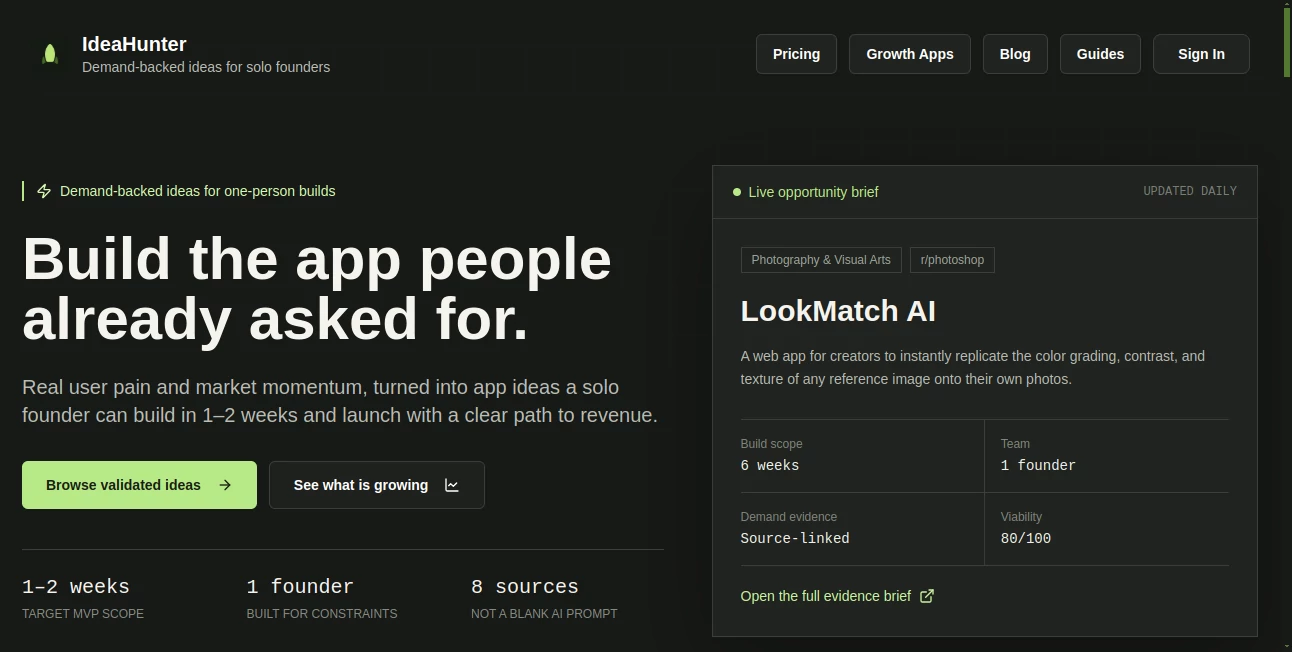
The platform focuses heavily on small, practical opportunities. Its homepage highlights concepts that can potentially be turned into an MVP within roughly one to two weeks, giving founders a much clearer starting point than a conventional startup-idea generator.
Key Features
- Demand-backed startup and app ideas based on real market signals.
- Research gathered from sources including Reddit, Hacker News, Product Hunt, GitHub, Upwork, App Store, Google Play, and Shopify.
- Daily updates designed to keep opportunity research fresh.
- Solo-founder filters that consider team size, technical complexity, and MVP scope.
- Information about the buyer, customer pain, monetization approach, competition, and validation strategy.
- Growth tracking for software products and small businesses with visible market momentum.
- Evidence that helps users investigate an opportunity before committing development time.
User Interface
The interface is centered around discovery rather than complicated configuration. Users can browse ideas, open individual opportunity briefs, and inspect the information behind each recommendation. This makes the experience feel closer to a research database than a traditional chatbot.
The structure is particularly useful when comparing several potential projects. Instead of jumping between unrelated sources, a founder can examine the buyer, problem, MVP scope, monetization possibilities, competitive landscape, and suggested validation move in one place.
Accuracy & Performance
The strength of the platform comes from its evidence-first approach. Ideas are connected to observable signals such as repeated complaints, product requests, job postings, app reviews, open-source activity, and other market indicators. This gives users something concrete to investigate instead of presenting unsupported predictions.
It is important to understand that validation does not mean guaranteed product-market fit. The platform treats its findings as research leads and also provides a next validation step, which is a sensible distinction for anyone considering a new business.
Capabilities
The platform goes beyond simply generating names for imaginary startups. Its opportunity briefs can identify who might buy a product, what painful job the product could address, how large the initial MVP should be, how difficult it may be to build, and what monetization path could make sense.
Another useful capability is the emphasis on the smallest useful product. Rather than encouraging founders to build a huge platform from day one, the research is shaped around focused product wedges that can potentially be tested quickly.
The growth-tracking side adds another layer of research by showing categories, pricing models, and small software businesses that are already showing signs of momentum. For a founder choosing between several ideas, that context can be more useful than another page of generic inspiration.
Security & Privacy
Because the service is primarily focused on product and market research, users are not required to treat it like a development environment or data-processing platform. Its public-facing material emphasizes research sources, opportunity analysis, and market evidence rather than handling sensitive business data.
As with any online research service, users should review the current privacy policy and terms before submitting confidential information or proprietary business details. For ordinary idea discovery and market research, the platform's focus remains on publicly observable signals and opportunity analysis.
Use Cases
One of the strongest use cases is finding a practical side project. A developer with only a few evenings available each week can filter opportunities around a small MVP rather than looking for a startup that requires a large team and substantial funding.
It can also help indie hackers evaluate whether a problem is worth pursuing. For example, instead of deciding to build a product simply because the concept sounds interesting, a founder can look for repeated customer complaints, existing workarounds, buyer demand, and competing products before writing the first line of code.
Another useful scenario is comparing business opportunities. Someone considering several SaaS concepts can examine the potential buyer, market evidence, complexity, monetization logic, and competitive environment for each one and then choose a smaller opportunity with a clearer path to testing.
It is also suitable for founders using AI coding tools or no-code platforms. Since many modern builders can create an MVP quickly, the harder question is often deciding what is actually worth building. Evidence-based idea discovery can help shift attention from coding speed to customer demand.
Pros and Cons
Pros
- Focuses on evidence rather than purely AI-generated startup concepts.
- Designed with solo founders and limited resources in mind.
- Provides useful context around buyers, pain points, MVP scope, and monetization.
- Uses signals from multiple communities and software marketplaces.
- Encourages founders to validate ideas before investing heavily in development.
- Includes growth-oriented research alongside individual product opportunities.
Cons
- Market evidence can indicate an opportunity but cannot guarantee commercial success.
- Founders still need to perform their own customer interviews and validation.
- Some opportunities may require more technical or industry-specific knowledge than their initial description suggests.
- The usefulness of the recommendations depends on how closely a particular opportunity matches the founder's skills and interests.
Pricing Plans
The platform allows visitors to explore its opportunity database, while a dedicated pricing section is available for users who want to investigate the available plans in more detail. The current site also emphasizes that ideas are free to explore, making it possible to inspect the concept and research approach before deciding whether a paid option is worthwhile.
For founders comparing tools in this category, the important point is not simply the subscription price. The real value comes from how much research time can be saved when an opportunity already includes supporting evidence, an estimated MVP scope, potential buyers, and a suggested validation path.
How to Use IdeaHunter
- Open the platform and browse the available opportunities.
- Choose an idea that matches your technical skills, interests, or preferred market.
- Review the evidence behind the opportunity instead of judging the title alone.
- Examine the target buyer and the specific problem being addressed.
- Check the suggested MVP scope and estimated development requirements.
- Study the monetization approach and existing competition.
- Use the recommended validation move to test whether real customers are willing to pay.
- Only after validation, decide whether the opportunity deserves full development.
Comparison with Similar Tools
Traditional startup-idea generators usually begin with a prompt such as “give me ten SaaS ideas.” That can be entertaining, but it often leaves the founder with another problem: figuring out whether any of those ideas matter to real customers.
This platform takes a different route. Instead of treating creativity as the final answer, it puts market signals at the beginning of the process. The result is closer to an opportunity research workflow, where the founder can trace an idea back to customer pain, requests, reviews, job activity, community discussions, or other observable signals.
That distinction makes it particularly interesting for practical builders. If your priority is finding something small enough to ship and meaningful enough to test commercially, an evidence-backed approach can be considerably more useful than a long list of imaginative concepts.
Conclusion
Finding a good product idea is rarely about having the most creative thought in the room. More often, it is about noticing a recurring problem and figuring out whether enough people care about solving it. IdeaHunter approaches that process from exactly that direction.
Its combination of market signals, solo-founder constraints, focused MVP thinking, buyer research, monetization context, and growth tracking gives entrepreneurs a practical way to investigate what they could build next. The platform does not promise that every opportunity will become a successful company, and that is actually part of its appeal: it gives founders evidence to investigate rather than pretending that prediction is certainty.
For indie hackers, developers, and entrepreneurs searching for a focused project with a realistic path toward validation, this can be a useful starting point. Instead of asking only “What could I build?”, the better question becomes “What are people already asking for, and can I build a small solution for them?”
Frequently Asked Questions (FAQ)
What is IdeaHunter used for?
It helps founders discover and research startup, SaaS, and app opportunities using real market signals rather than relying entirely on automatically generated ideas.
Is it suitable for solo founders?
Yes. The platform is specifically designed around one-person builds and highlights opportunities that can potentially be developed as a focused MVP within roughly one to two weeks.
Where does the market evidence come from?
The platform identifies signals across sources such as Reddit, Hacker News, Product Hunt, GitHub, Upwork, App Store, Google Play, and Shopify, along with other growth and market sources.
Does a validated idea guarantee success?
No. Validation indicates that there is observable evidence of demand, but it does not guarantee product-market fit or revenue. Founders should still conduct their own customer validation.
Can non-developers use the platform?
Yes. It is aimed at indie hackers and solo entrepreneurs, including people who use AI coding tools, no-code platforms, or traditional development workflows.
What information can I find about an opportunity?
An opportunity can include information about the buyer, customer pain, supporting evidence, MVP scope, estimated build requirements, monetization, competition, and a suggested first validation step.
Are the ideas updated?
The homepage states that opportunity briefs are updated daily, helping the platform reflect changing market signals and emerging areas of interest.