


















Turnitin0
What is Turnitin0?
Turnitin0 is built for students, researchers, and writers who want to understand how their academic work may appear in a Turnitin check before handing it in. Instead of waiting until the final submission to discover a high similarity score or an unexpected AI-writing flag, users can upload a draft and review both types of reports in advance.
The service focuses on a very practical problem: students often have access to Turnitin through their university, but they may not have a convenient way to privately check a draft before submitting it. The platform provides a pre-submission checking experience with AI detection and similarity results, helping users identify areas that deserve another look while there is still time to make legitimate revisions.
It is particularly useful for essays, research papers, dissertations, assignments, and other academic documents where originality and proper citation matter.
Key Features
- AI writing detection reports designed to show potentially AI-generated portions of a document.
- Similarity checking that identifies text matching against existing sources.
- Support for common document formats such as DOCX, PDF, and TXT for checking workflows.
- Fast report delivery, with the website stating that most checks are completed within around 5–10 minutes.
- Private pre-submission checking designed so submitted drafts are not added to an institutional repository.
- Pay-per-check pricing instead of requiring a recurring subscription.
- A separate AI humanizing feature intended to make AI-assisted writing sound more natural while preserving its meaning and formatting.
User Interface
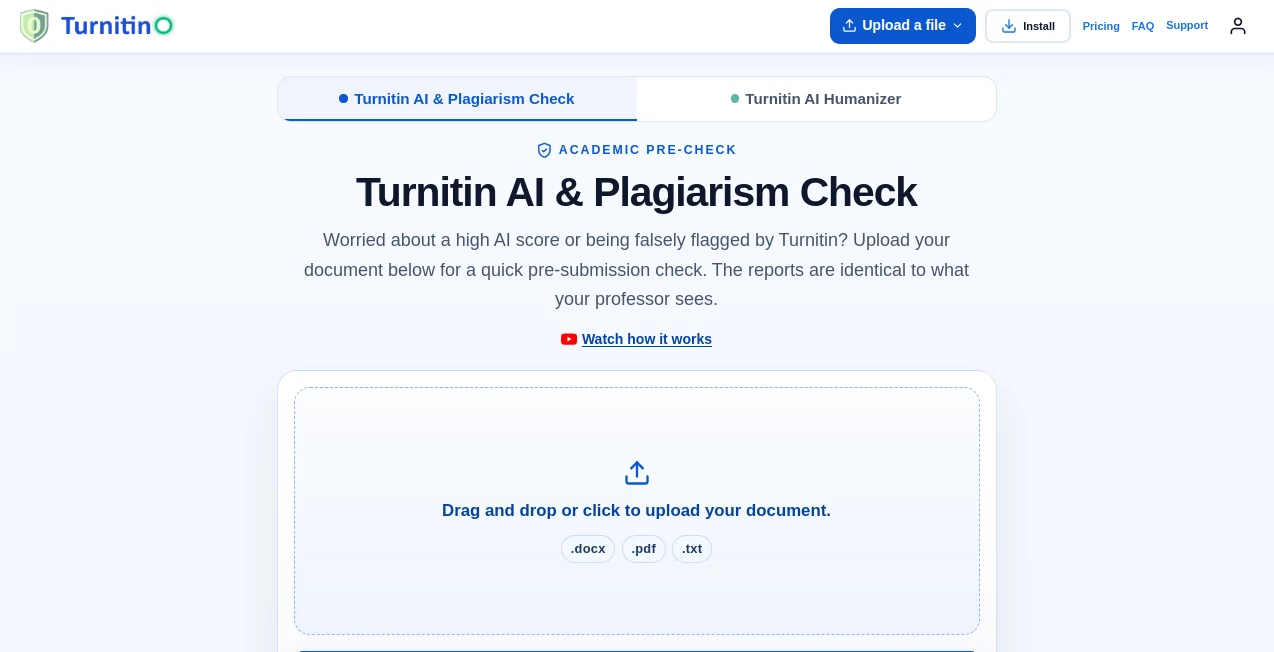
The interface keeps the main workflow straightforward. A user can upload a document through the drag-and-drop area, start a check, and wait for the resulting reports. There is no need to navigate through a complicated academic administration system just to examine a draft.
The simplicity is valuable for students working close to a deadline. Imagine finishing a 3,000-word paper late at night and wanting one last check before submitting it. A clear upload-and-check workflow removes unnecessary steps and lets the user concentrate on the actual report.
The humanizing section follows a similarly simple upload process, although the website specifies different accepted formats for that feature.
Accuracy & Performance
The main attraction is access to AI and similarity reports intended to resemble the reports students encounter in institutional Turnitin workflows. The service says its checks provide both AI detection and similarity information, allowing users to look at potential originality concerns from two different perspectives.
Results are designed to arrive quickly. The website states that 99% of checks are delivered within 5–10 minutes, with a maximum stated processing time of 30 minutes in cases requiring additional processing.
It is worth remembering that an AI detection score should not be treated as absolute proof that a person did or did not use AI. Detection systems can produce false positives, so the most sensible approach is to use the report as a review signal rather than as a substitute for academic judgment.
Capabilities
The platform combines several useful capabilities for academic writing. Its similarity report helps users locate potentially matched material, while the AI report provides an additional indication of passages that may resemble AI-generated writing.
This combination can be more useful than checking only one metric. A paper might contain legitimate quotations that increase similarity, for example, while another paper may have relatively little matching text but still contain passages that deserve closer review from an AI-detection perspective.
The service also offers an AI humanizer for users who want to revise AI-assisted text into a more natural writing style. The stated goal is to preserve the original meaning and formatting while changing the wording and flow.
Security & Privacy
Privacy is an important part of a pre-submission checking service. According to the website, documents submitted for its checking service are not archived in an institutional repository or forwarded to another institution. This is designed to prevent a student's own draft from later creating an unintended similarity match when the final version is submitted through an institution.
That makes the service particularly relevant for users who want to review an unfinished paper without treating the draft as an official academic submission. Even so, students should always read the current service terms and privacy information before uploading sensitive or confidential documents.
Use Cases
Students preparing assignments: A student can check an essay before submitting it and investigate potentially problematic matches while there is still time to revise citations or quotations.
University researchers: Researchers working on papers, conference submissions, or dissertation chapters can use a pre-submission review as one part of their editing process.
Graduate students: Long academic projects often go through multiple revisions. Running checks at important stages can make it easier to spot recurring citation or originality issues.
Writers using AI during drafting: Writers who use AI as a brainstorming or drafting assistant can review their text before submitting academic work and make sure the final document reflects their own ideas, sources, and writing standards.
Last-minute reviewers: When a deadline is approaching, fast report delivery can provide useful feedback without requiring a long-term subscription.
Pros and Cons
Pros
- Provides both AI detection and similarity information.
- Designed specifically around pre-submission academic checking.
- Pay-per-use pricing is convenient for occasional users.
- Reports are generally delivered within minutes.
- The website states that drafts are not archived in an institutional repository.
- Useful for essays, research papers, and other academic documents.
Cons
- It is not a free unlimited checking service.
- AI detection results should not be interpreted as definitive proof of AI authorship.
- Students who already have full access through their institution may have less reason to purchase an independent check.
- Users should verify current privacy and service policies before uploading confidential academic material.
Pricing Plans
The service uses a pay-per-check model rather than a conventional monthly subscription. The website currently advertises individual and multi-check packages, making the pricing more suitable for students who only need occasional reports.
Listed options include a single check for $2.50, two checks for $4.50, five checks for $10, and ten checks for $17.50. The website states that these checking packages remain valid for 100 days.
The humanizing service uses a separate word-based pricing model, with pricing beginning at $0.80 per 500 words according to the site's published information.
How to Use It
- Create or access an account on the service.
- Choose the academic pre-check option.
- Upload the document you want to review.
- Select the appropriate checking option and complete the purchase if required.
- Wait for the AI and similarity reports to be processed.
- Review the highlighted matches and AI-related indicators.
- Return to your document and make legitimate improvements where necessary, especially around citations, quotations, and unclear wording.
- Run another check when you have made substantial revisions and want to compare the new result.
The most important point is to treat the report as a revision tool. A similarity match is not automatically plagiarism, and an AI indicator is not automatically evidence of misconduct. Context, sources, citations, and institutional policies still matter.
Comparison with Similar Tools
Many online plagiarism checkers provide a similarity percentage, while a separate group of AI detectors focuses primarily on predicting whether text was generated by an AI system. This service takes a more academic-oriented approach by putting AI detection and similarity checking together in the same pre-submission workflow.
Another difference is the pricing model. Traditional subscription-based writing tools can make sense for users who check documents every day, but occasional academic users may prefer paying only when they actually need a report.
For someone preparing a thesis chapter, essay, dissertation, or research paper, the combination of similarity analysis, AI-related detection, quick processing, and pre-submission privacy makes the service more specialized than a basic generic grammar or plagiarism checker.
Conclusion
For students and researchers who want a clearer picture of their academic document before submission, this service offers a focused and practical workflow. Its biggest advantage is the combination of similarity checking and AI-writing analysis, giving users more information than a simple plagiarism percentage alone.
The pay-per-check approach is also appealing for people who only need an occasional review rather than another monthly software subscription. Fast processing, straightforward document uploads, and the stated non-repository approach make it particularly suited to pre-submission checking.
Used responsibly, it is best viewed as an editing and quality-control step rather than a way to manipulate academic evaluation. The strongest final paper is still one built around original thinking, properly cited sources, transparent research practices, and the writer's own understanding of the subject.
Frequently Asked Questions (FAQ)
What does the service check?
It provides an AI-writing detection report and a similarity report, allowing users to review potential AI-related indicators and text matches before submitting an academic document.
How quickly are reports delivered?
The website states that 99% of reports are delivered within 5–10 minutes, while unusual cases may take up to 30 minutes.
Does checking a draft submit it to a university?
The service states that pre-submission documents are not archived in an institutional repository or forwarded to another institution. Users should nevertheless review the current privacy policy before uploading confidential material.
Can I use it for a research paper?
Yes. Research papers are one of the intended use cases, along with essays, assignments, dissertations, and other academic documents.
Is the AI detection score always accurate?
No AI detector should be considered infallible. Detection results are best treated as indicators that may warrant further review rather than conclusive proof about how a document was written.
Does it require a monthly subscription?
No. The checking service is presented as a pay-per-check system, with individual checks and discounted multi-check packages.
What file formats can be checked?
The main checking workflow supports common formats including DOCX, PDF, and TXT according to the website.
Who can benefit most from it?
Students, graduate students, researchers, and academic writers who want to review a document before an official submission can benefit most from the service.
AI Detector , AI Papers , AI Plagiarism Checker , AI Content Detector .
These classifications represent its core capabilities and areas of application. For related tools, explore the linked categories above.

Turnitin0 Alternatives Product

AI ATS Check…

Reverse Vide…

ieltswriting…

IntoTheBlock
Copyleaks

AI Bypass Hub

SciSpace

Ryne AI

SuperAI
