Wavoiq
What is Wavoiq?
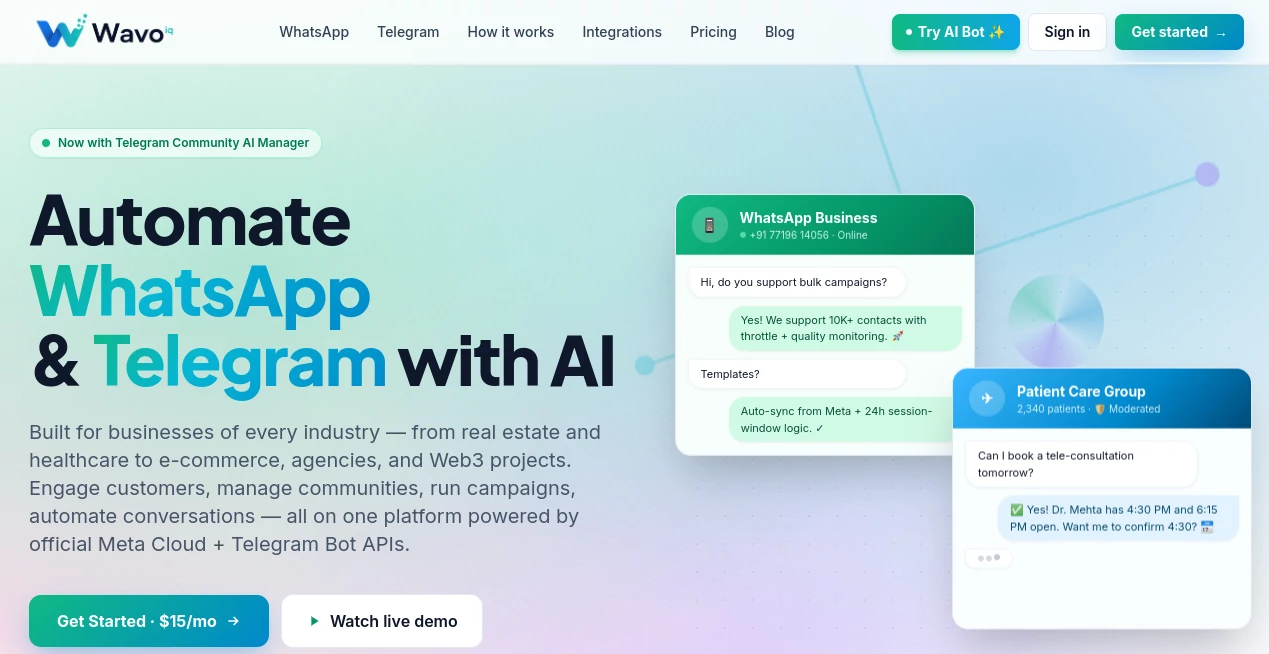
Wavoiq is an AI-powered automation platform built for businesses that want to manage customer conversations and online communities without spending the entire day answering messages manually. It brings WhatsApp and Telegram automation together in one workspace, covering customer support, lead generation, campaigns, follow-ups, and community engagement.
The platform is designed for a wide range of businesses, including real estate companies, healthcare providers, e-commerce brands, educational organizations, agencies, SaaS companies, and Web3 projects. Rather than forcing every business into the same conversation style, it can adapt its AI to an industry's vocabulary, workflows, and communication approach.
One particularly useful aspect is the combination of customer-facing automation and community management. A business can use WhatsApp for sales conversations and follow-ups while using Telegram for community engagement and moderation, all from the same platform.
Key Features
- AI-powered WhatsApp conversations available around the clock
- Telegram community management and automated engagement
- AI sales agents for lead qualification and follow-ups
- Bulk campaigns supporting more than 10,000 contacts
- Lead capture and automatic conversation tagging
- Appointment and meeting booking workflows
- Multi-step follow-up automation
- AI-powered Telegram moderation for spam, abuse, and scam patterns
- Broadcast campaigns for WhatsApp and Telegram
- Community analytics and engagement monitoring
- Cross-channel monitoring through a Master AI Agent
- REST API and webhooks for custom integrations
- Integration support for popular business applications and automation platforms
User Interface
The interface is built around the idea of keeping business communication in one place. Instead of jumping between separate systems for campaigns, conversations, community activity, and analytics, users can manage these functions through a unified workspace.
Setup is intentionally straightforward. After creating an account, users connect their Meta credentials and Telegram bot, define their business niche and communication style, and then launch their automations. The website states that the initial setup can take around five minutes, making the platform approachable even for teams without dedicated developers.
The workflow also feels practical for agencies and businesses managing multiple operations. A team can configure different industry-specific behaviors rather than relying on one generic chatbot personality.
Accuracy & Performance
There is no independent accuracy benchmark published on the product site, so it would be misleading to assign a numerical accuracy score. Instead, performance is presented through practical automation features such as lead qualification, contextual replies, follow-up timing, campaign monitoring, and live handoff to human agents.
The AI can be trained around a company's niche, project information, tone, and preferred communication style. This matters in real conversations because a property agency, medical clinic, and e-commerce store naturally need very different questions and responses.
The cross-channel monitoring system is another interesting performance feature. It can watch WhatsApp quality, Telegram engagement, campaign activity, and moderation events, then flag unusual changes and suggest adjustments.
Capabilities
The WhatsApp side focuses heavily on customer communication and sales automation. Businesses can qualify prospects, capture leads, answer frequently asked questions, send brochures, arrange meetings, and automate follow-ups. Campaign management supports large contact lists while incorporating throttling and quality monitoring.
Telegram automation takes a different approach. Bots can welcome new members, answer relevant questions, publish engagement posts, send broadcasts, and moderate communities. Spam, abuse, and scam patterns can be detected automatically, which can be especially useful for large or active groups.
The Master AI Agent adds another layer by monitoring activity across channels. It can identify drops in reply rates, quality issues, unusual activity, and campaign performance changes, while also recommending optimization opportunities.
For technical teams, REST API and webhook support makes it possible to connect the platform to custom applications, internal tools, CRMs, analytics systems, and other workflows.
Security & Privacy
The platform states that customer data and messages are encrypted in transit and that tenant data is isolated between workspaces. It lists TLS 1.3 for transport encryption, per-tenant isolation, audit logging, daily backups, and GDPR compliance with EU data residency.
The website also describes the infrastructure as SOC 2 ready, with Type II mentioned for 2026. Businesses handling customer conversations should still review the provider's privacy policy, terms, data-processing practices, and their own regulatory requirements before deploying automation for sensitive information.
Use Cases
Real Estate: Property teams can use automated conversations to answer inquiries, qualify buyers, send property information, and arrange site visits. A lead asking for a brochure can be guided through budget questions before being passed to a sales representative.
Healthcare: Clinics can automate appointment inquiries, scheduling, reminders, and basic patient questions while allowing staff to take over conversations that require human attention.
E-commerce: Online stores can use the system for order-related questions, product assistance, cart recovery, promotional campaigns, and restock notifications.
Education: Schools and education businesses can automate course inquiries, admission questions, scholarship information, batch reminders, and student community communication.
Marketing Agencies: Agencies managing several clients can create separate workflows, lead funnels, campaigns, and communication strategies for different businesses from a centralized environment.
Web3 Communities: Telegram automation can help blockchain communities welcome members, answer questions, publish engagement content, moderate spam, and support announcements around launches or events.
Customer Support: Businesses can handle repetitive questions automatically while escalating conversations to human representatives when the situation calls for personal assistance.
Pros and Cons
- Pros: Combines WhatsApp and Telegram automation in one platform.
- Pros: Supports AI conversations, lead capture, campaigns, follow-ups, and community management.
- Pros: Industry-specific AI personas can make automated conversations more relevant.
- Pros: Supports campaigns for 10,000+ contacts with throttling and quality monitoring.
- Pros: Includes REST API, webhooks, and integrations for more advanced workflows.
- Pros: Human handoff is available when automation should not continue.
- Pros: A relatively low monthly entry price makes it accessible to smaller teams.
- Cons: Usage is credit-based, so the total cost can increase as message and automation volume grows.
- Cons: Some advanced capabilities may require businesses to understand Meta and Telegram configuration.
- Cons: Businesses with very simple messaging needs may not require the full set of automation features.
Pricing Plans
The main subscription is priced at $15 per month and includes access to WhatsApp integration, Telegram integration, the AI assistant, campaign management, community management, and analytics. New subscribers receive 1,000 free credits during their first month.
Additional usage is handled through credit packs. The Starter option costs $25 for 10,000 credits, Growth costs $50 for 30,000 credits, and Business costs $100 for 100,000 credits. An Enterprise option is available with custom volume, billing, and SLA arrangements.
Credits are used for activities such as messages, AI replies, campaigns, Telegram interactions, and automated follow-ups. The exact amount consumed depends on the action, and the service states that unused credits do not expire.
How to Use It
- Create an account: Start by signing up and selecting the monthly plan.
- Connect your channels: Add the required Meta credentials for WhatsApp and the bot token for Telegram.
- Define your business: Choose your industry and provide information about your business, audience, tone, and workflows.
- Configure automation: Set up customer conversations, lead qualification, campaigns, follow-ups, or community rules.
- Train the AI: Give the assistant the context it needs to communicate using your preferred vocabulary and style.
- Test your workflows: Check common customer questions, unexpected messages, lead qualification, and escalation scenarios before going live.
- Monitor results: Use analytics and cross-channel monitoring to review engagement, campaign quality, and conversation performance.
Comparison with Similar Tools
The platform occupies an interesting position compared with conventional WhatsApp automation services. Tools such as WATI and Interakt focus strongly on WhatsApp business communication, while this solution extends the workflow into Telegram community management as well.
Its broader approach includes AI moderation, niche-aware community engagement, automated Telegram posts, cross-channel monitoring, and a Master AI Agent. This makes it more relevant to businesses that need both customer messaging and community operations rather than a WhatsApp-only campaign system.
For a small company that only needs basic WhatsApp broadcasts, a simpler service may be enough. For a business, agency, or community that wants sales conversations, campaigns, Telegram management, moderation, and analytics under one roof, the wider feature set can be much more compelling.
Conclusion
AI automation is becoming particularly useful in channels where customers already prefer to communicate, and WhatsApp and Telegram are a strong combination for businesses that rely heavily on messaging. This platform brings sales conversations, customer support, campaigns, lead management, follow-ups, and community engagement into a single system.
Its strongest point is the breadth of automation rather than one isolated AI feature. A real estate company can qualify a lead and arrange a viewing, an online store can handle customer questions and promotional messages, and a Telegram community can be moderated and kept active without requiring constant manual attention.
The $15 monthly starting price also makes experimentation relatively easy, while the credit model gives larger teams a way to scale usage as their messaging volume increases. For businesses looking to turn WhatsApp and Telegram into active, automated communication channels, it is a platform worth considering.
Frequently Asked Questions (FAQ)
Can businesses automate WhatsApp conversations?
Yes. The platform uses the official Meta Cloud API and can automate customer conversations, lead qualification, follow-ups, campaigns, and other WhatsApp workflows.
Can it manage Telegram communities?
Yes. Telegram features include automatic member welcomes, smart replies, daily engagement posts, broadcasts, analytics, and AI moderation.
Does it support lead generation?
Yes. AI sales agents can qualify prospects, collect information from conversations, tag leads, follow up with potential customers, and help move qualified prospects toward appointments or sales conversations.
Can a human take over an AI conversation?
Yes. Live handoff allows conversations to be escalated to human team members when an automated response is no longer appropriate.
Does it require coding?
The core setup is designed to be no-code. Users can connect their channels, configure their business information and workflows, and launch the automation without building the system from scratch.
How much does the service cost?
The main subscription costs $15 per month. It includes 1,000 free credits during the first month, while additional credits can be purchased separately when needed.
Does it provide API access?
Yes. REST API and webhooks are available for businesses and developers that want to connect the platform with custom software, internal systems, CRMs, analytics tools, or other workflows.
Is it suitable for agencies?
Yes. Agencies can use separate workspaces and industry-specific workflows to manage conversations, lead funnels, campaigns, and customer engagement across multiple clients.
What languages does Telegram AI moderation support?
The website currently lists English and Hinglish, including Hindi, Punjabi, and Urdu written in Roman script. It also states that support for additional languages and scripts is planned for Q3 2026.
AI Lead Generation , AI Social Media Assistant , AI Customer Service Assistant , AI Workflow Management .
These classifications represent its core capabilities and areas of application. For related tools, explore the linked categories above.

Wavoiq Alternatives Product

Blipix

Lessie AI

AthenaChat

Schedpilot

Quso AI

LinkedIn Spe…

Simplified

Somnio

Needle