
What Brandon Thinks
What is What Brandon Thinks?
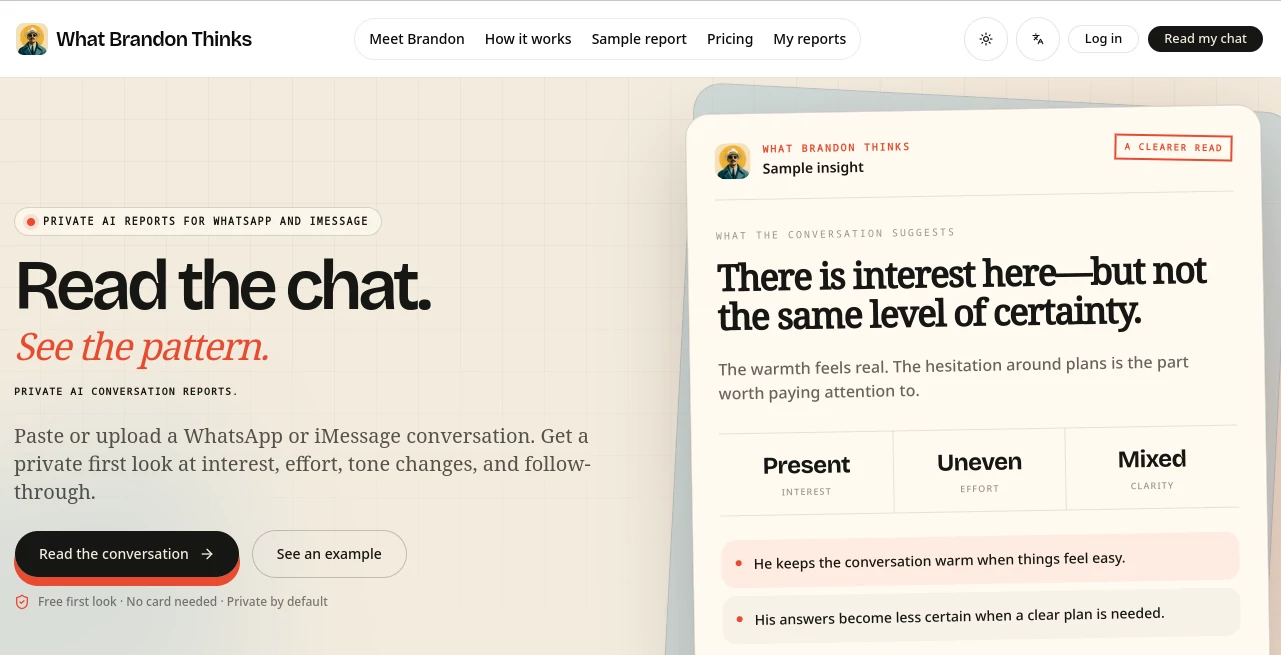
What Brandon Thinks is a private AI-powered conversation analysis tool designed to help people understand the patterns hiding inside their WhatsApp and iMessage conversations. Instead of focusing on one message or trying to guess what someone is thinking, it looks across the conversation for recurring signals involving interest, effort, tone changes, reciprocity, mixed signals, and follow-through.
The idea is refreshingly simple: sometimes a conversation is difficult to understand because there is too much information, not too little. A single late reply can mean almost anything, while repeated behavior across dozens of messages can tell a much clearer story. The platform turns that larger picture into a readable report that separates observable evidence from interpretation.
It is particularly useful for relationship conversations, situationships, friendships, family chats, and other personal exchanges where tone and consistency can be difficult to judge objectively. The service also makes an important distinction: it does not claim to read minds or prove someone's private feelings.
Key Features
- AI analysis of WhatsApp and iMessage conversations
- Support for pasted conversations and compatible TXT exports
- Analysis of interest, effort, consistency, tone changes, and mixed signals
- Reports based on patterns across the conversation rather than isolated messages
- Evidence-first interpretation with room for alternative explanations
- Personalized reflection prompts and suggestions for what to discuss next
- Private reports that remain under the user's control
- Free first-look preview without requiring a payment card
User Interface
The experience is built around a straightforward three-step process. Users add their conversation, confirm who is who, and then review the resulting report. This approach removes much of the friction that can make conversation-analysis tools feel complicated.
The workflow is also adapted to the type of conversation being analyzed. Dedicated guides cover WhatsApp chats, iMessage conversations, and relationship-focused conversations, making it easier to prepare the right material before starting an analysis.
The report itself is designed to be readable rather than overly technical. Instead of presenting a wall of statistics, it organizes the results around practical questions such as who initiates conversations, whether effort is consistent, where the tone changes, and what might be worth asking directly.
Accuracy & Performance
The strongest part of the approach is its emphasis on patterns rather than dramatic individual messages. The system considers observable behavior across the conversation, including initiation, follow-through, response effort, tone, and changes in communication.
That distinction matters. A message can be interpreted in several ways when viewed alone. Looking at repeated behavior provides more context and can produce a more useful assessment. The reports also acknowledge uncertainty and include alternative explanations rather than presenting every interpretation as an established fact.
Users should still treat the results as reflection and entertainment rather than definitive psychological conclusions. A conversation can provide clues about communication patterns, but it cannot prove exactly what another person feels or intends.
Capabilities
The platform can analyze exported or pasted conversations and turn them into a structured report. Its analysis covers several practical areas, including overall conversational tone, interest signals, effort and consistency, mixed signals, and possible next steps.
For relationship conversations, this can be especially helpful when someone has spent too much time rereading a chat and trying to interpret every individual response. Rather than encouraging endless speculation, the report aims to highlight recurring behavior and suggest a better question or conversation to have.
There are also different working modes, including Classic Roast, Deep Read, and The Mirror. This gives users different ways to approach the same underlying conversation, depending on whether they want something more playful, detailed, or reflective.
Security & Privacy
Privacy is a central part of the product experience because the conversations being analyzed can contain highly personal information. Reports are private by default, and they are not automatically made public.
Users can choose whether to share a report, and the service states that sharing can be stopped and reports can be deleted. The platform also does not require access to a user's WhatsApp or iMessage account. Instead, the conversation is supplied by the user through pasted text or a compatible export.
This approach gives users more control over what they submit and keeps the analysis separate from their messaging accounts.
Use Cases
The most obvious use case is relationship communication. Someone wondering whether a conversation feels reciprocal can use the report to look at patterns of initiation, effort, plans, and tone rather than relying on one particularly encouraging or disappointing message.
It can also be useful for situationships, dating conversations, friendships, conversations with an ex, and family or group chats. For example, a person might notice that someone is consistently warm during casual conversation but becomes uncertain whenever plans need to be made. That pattern can be more meaningful than any single sentence.
Another interesting use case is simply gaining distance from a conversation. When people are emotionally involved, it is easy to reread the same messages repeatedly. An outside, evidence-focused summary can provide another perspective and help turn vague uncertainty into a more specific question.
Pros and Cons
- Pros: Private by default, simple conversation import, supports WhatsApp and iMessage, focuses on patterns, explains evidence behind interpretations, provides useful reflection prompts, and offers a free first look.
- Pros: The service avoids claiming that AI can literally determine another person's private thoughts or feelings.
- Cons: The quality of an analysis naturally depends on the conversation provided and the context available within it.
- Cons: Results should not be treated as psychological diagnosis or definitive proof of someone's intentions.
- Cons: The complete report requires a one-time payment after the free preview.
Pricing Plans
The service uses a straightforward free-preview and one-time-purchase model rather than a recurring subscription. Users can generate a free first-look preview without entering card details, giving them an opportunity to see the type of insight the system provides before paying.
A complete private report is available as an optional one-time unlock starting at $19.99. This is a useful pricing structure for people who only need conversation analysis occasionally and do not want another monthly subscription.
How to Use It
Start by preparing the conversation you want to understand. You can paste the relevant chat text or upload a compatible TXT export, depending on the messaging platform you are using.
Next, confirm the participants so the analysis understands who is speaking and can interpret the conversation from the correct point of view. This step is particularly important for conversations involving several people or relationship dynamics.
Once the conversation has been processed, review the report. Pay attention to recurring patterns involving interest, effort, consistency, tone changes, and follow-through rather than treating one sentence as the final answer. The report can then help you identify a more useful question or next step.
Comparison with Similar Tools
Many AI chat tools are built around generating replies, rewriting messages, or acting as a conversational assistant. This product takes a different direction by concentrating on analysis of an existing conversation.
Its focus is also narrower than a general-purpose AI assistant. Rather than asking a chatbot to interpret a few screenshots or individual messages, users can provide a broader conversation and receive an analysis organized around recurring behavioral patterns.
Another distinction is the emphasis on evidence and uncertainty. The system explicitly separates what happened in the conversation from what those events might mean. That makes the experience more useful for reflection and less likely to turn an ambiguous message into an overly confident conclusion.
Conclusion
For anyone who has ever reread a conversation several times and still wondered what was actually going on, this tool offers a practical alternative to endless speculation. Its value comes from looking at the conversation as a whole and identifying patterns that are easy to miss when emotions are involved.
The combination of WhatsApp and iMessage support, private reporting, pattern-based analysis, and a free first look makes it an interesting option for people dealing with complicated personal conversations. It is not a mind reader, and it does not pretend to be one. Instead, it provides another perspective grounded in the words and behaviors visible in the chat.
Frequently Asked Questions (FAQ)
What does the AI conversation analyzer do?
It reviews a conversation across multiple messages and identifies observable patterns such as initiation, effort, reciprocity, tone changes, consistency, and follow-through. The results are presented as a private conversation report.
Can I analyze a WhatsApp conversation?
Yes. Users can prepare a WhatsApp conversation as text or use a compatible TXT export, then provide it for analysis and confirm the participants before generating a report.
Can I analyze an iMessage conversation?
Yes. iMessage conversations can be prepared as text and analyzed through the dedicated workflow. The service does not require direct access to the user's messaging account.
Can the report tell me exactly what someone feels?
No. Conversations can reveal patterns in language, timing, effort, tone, and plans, but they cannot prove a person's private feelings or intentions. The analysis distinguishes observable evidence from interpretation.
Are conversation reports private?
Yes. Reports are private by default. Users decide whether they want to share a report, and the service states that sharing can be revoked and reports can be deleted.
Is there a free version?
Yes. A free first-look preview is available without requiring a card. A complete private report is available through an optional one-time purchase starting at $19.99.
Is this a psychological or professional diagnosis tool?
No. The service is intended for entertainment and personal reflection, not diagnosis or professional advice.
Does it require access to WhatsApp or iMessage?
No. Users provide the conversation themselves by pasting text or uploading a compatible export. The service does not claim direct access to messaging accounts.
AI Life Assistant , AI Fun Tools , AI Dating Assistant .
These classifications represent its core capabilities and areas of application. For related tools, explore the linked categories above.
What Brandon Thinks details
Website unavailable — View Alternatives
Pricing
- Free
Apps
- Web App
Categories

What Brandon Thinks Alternatives Product

TriviaFlow

FortuneTelle…

MBTI Compati…

Romantic AI

bratgenerator

QuickPick

AI Baby Dance

Play Queens …

Project Genie