What Is My Chinese Name
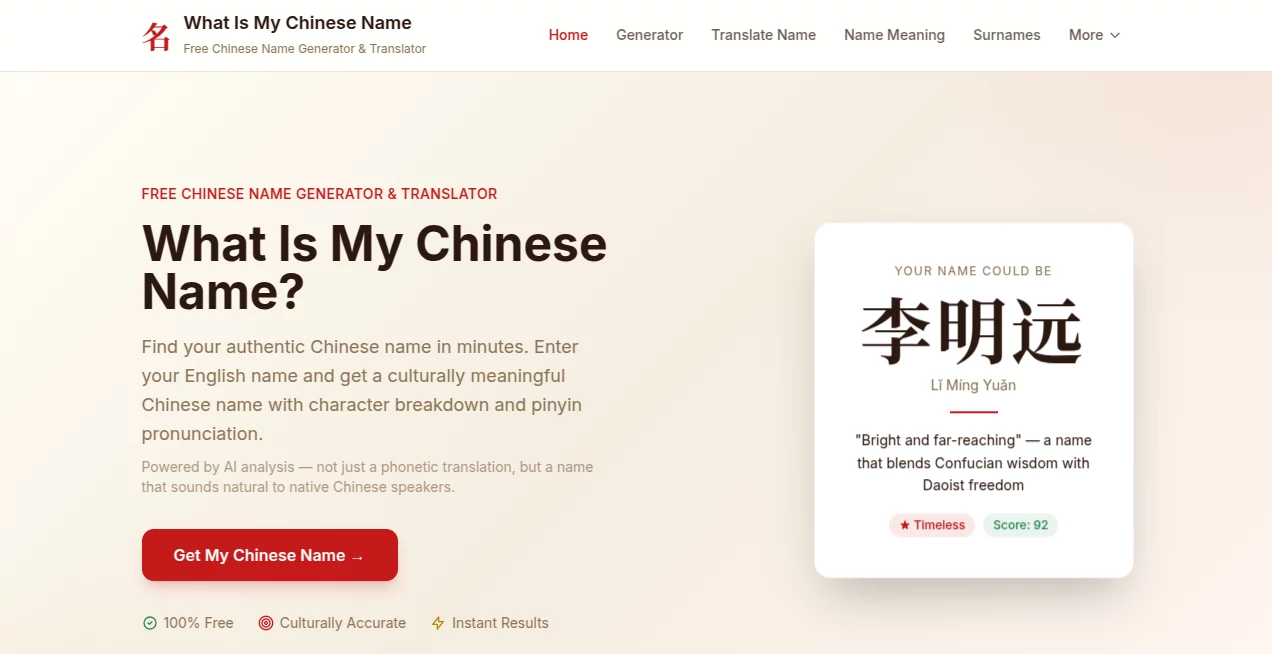
What is What Is My Chinese Name?
Finding a meaningful Chinese name can be both exciting and challenging, especially when you want it to reflect your personality, sound natural to native speakers, and carry a positive cultural meaning. This tool is designed to bridge that gap in a simple and enjoyable way.
Instead of guessing or relying on random translations, it helps users generate authentic Chinese names that feel natural, culturally appropriate, and thoughtfully crafted. Whether you're learning Chinese, creating a social identity, or simply curious about what your name would be in another language, the experience feels surprisingly personal.
Key Features
User Interface
The interface is clean and minimal, allowing users to focus only on entering their name and receiving meaningful results. There are no distractions, making the experience fast and intuitive even for first-time users.
Accuracy & Performance
The system focuses on generating names that follow real Chinese naming conventions. Instead of literal translations, it prioritizes phonetic similarity and cultural meaning, which makes the output feel more authentic and usable in real-life contexts.
Capabilities
- Generates culturally appropriate Chinese names based on input
- Provides multiple variations with different meanings
- Balances phonetic similarity with meaningful character selection
- Offers male, female, and neutral name options
- Works instantly without requiring registration
Security & Privacy
User input is handled in a lightweight and straightforward way, with no unnecessary data collection. This makes it suitable for casual users who value privacy while exploring name ideas.
Use Cases
- Students learning Chinese language and culture
- Travelers preparing for trips to Chinese-speaking regions
- Content creators building multicultural identities
- Professionals interacting with Chinese clients or partners
- Anyone curious about how their name translates culturally
Pros and Cons
Pros
- Fast and easy to use
- Provides culturally meaningful names
- No registration required
- Multiple name suggestions available
Cons
- Limited customization compared to advanced naming services
- Focuses mainly on general naming patterns rather than deep personalization
Pricing Plans
The tool is generally accessible without complicated pricing tiers. Users can generate names freely, making it ideal for quick exploration without financial commitment.
How to Use This Tool
Using the platform is straightforward. You simply enter your name into the input field and let the system process it. Within seconds, you receive one or more Chinese name suggestions along with their meanings and character explanations.
If you want more variety, you can refresh or adjust your input slightly to explore different naming styles and tones.
Comparison with Similar Tools
Unlike generic translation tools that simply convert names phonetically, this platform focuses on cultural accuracy and meaningful interpretation. Many alternatives either produce awkward literal translations or ignore naming conventions altogether, while this approach feels more natural and human-like.
Conclusion
For anyone interested in discovering a Chinese version of their name, this tool offers a simple yet thoughtful experience. It goes beyond direct translation and tries to capture meaning, sound, and cultural relevance in a balanced way. The result feels more like a real identity rather than just a translated label, making it useful for both casual curiosity and practical use.
Frequently Asked Questions (FAQ)
Is the generated name a real Chinese name?
Yes, the names follow real naming conventions and are designed to sound natural to native speakers.
Can I use the name officially?
While many people use these names socially or online, official use depends on local legal requirements.
Does it translate my name directly?
No, it focuses more on meaning and sound rather than literal translation, making the result more natural.
Is it free to use?
Yes, users can generate names without any payment or subscription.
Can I generate multiple names?
Yes, you can generate different variations until you find one that feels right.
AI Content Generator , Text & Writing .
These classifications represent its core capabilities and areas of application. For related tools, explore the linked categories above.
What Is My Chinese Name details
Website unavailable — View Alternatives
Pricing
- Free
Apps
- Web App
Categories

What Is My Chinese Name Alternatives Product
GPT Image 2

SonicPost

QuotaWake

Quso AI

VideoSnap

Z-Image

SocialRails

Analyse

Nanobanana 2