












What's Trending
What is What's Trending?
What’s Trending is a customer conversation research and social listening platform built for teams that want to understand what people are actually discussing before deciding what to publish. Instead of relying only on assumptions, marketers, founders, agencies, and content teams can monitor public conversations around a market, product, or competitor and turn those signals into practical content ideas.
The platform focuses on evidence. It collects relevant public posts from sources such as Reddit, Facebook, Instagram, and X, keeps the original source information, and organizes conversations around topics, activity, and engagement. This makes it easier to move from a vague feeling that something is becoming popular to a clearer picture of why people are paying attention.
A particularly useful part of the workflow is that the first complete market scan is available at no cost and does not require a credit card. Users can enter a website, review suggested market terms and competitors, and then decide what deserves deeper attention.
Key Features
User Interface
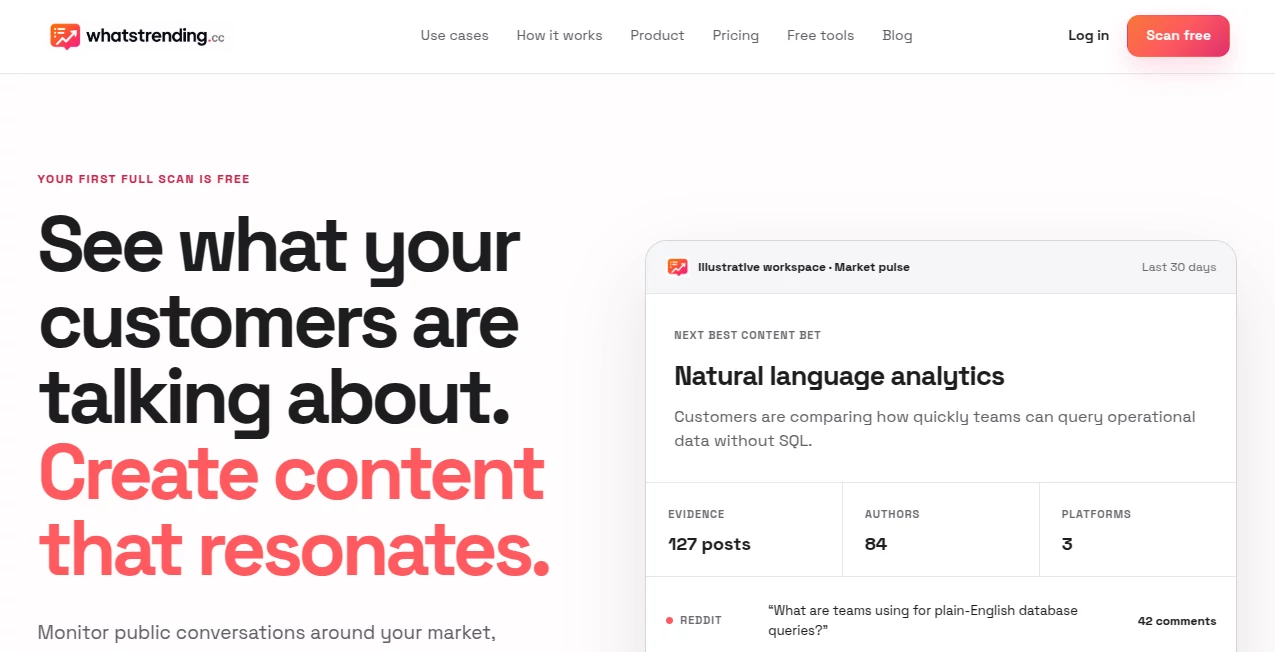
The workspace is designed around a straightforward research process rather than a complicated collection of dashboards. Users start by defining their market, reviewing suggested topics and competitor profiles, and then collecting public evidence that matches those selections.
Results are presented as a market pulse, with information such as the number of relevant posts, authors, platforms, and available engagement signals. This makes the interface useful for someone who needs to answer a practical question quickly: what are customers discussing right now, and which conversations are worth investigating?
The source-focused approach is also helpful when several people are involved in content decisions. A marketer can open the underlying conversation instead of simply presenting an unexplained trend score to the rest of the team.
Accuracy & Performance
The platform takes an evidence-first approach to trend research. Topics can be traced back to public posts, while engagement information such as likes, comments, replies, shares, views, and other platform-specific signals can be inspected when publicly available.
This does not mean every conversation represents the entire market. Social platforms naturally contain incomplete and uneven signals. The advantage is that users can see the evidence behind a topic and decide for themselves whether it is meaningful.
Historical views add another useful layer. Depending on the available data, users can examine recent activity over periods such as seven or thirty days, compare longer periods ranging from several months to a year, or review stored evidence. That makes it easier to distinguish a short-lived spike from a topic that keeps appearing over time.
Capabilities
The main capability is turning public customer conversations into research that can influence content decisions. Users can define their market, review suggested terms and competitors, collect matching posts, and rank topics according to activity and momentum.
Each evidence item can retain details such as the original source URL, post text, author, publication time, and publicly available engagement metrics. This is particularly valuable when a team wants to understand the language customers are using rather than relying on generic keyword research.
The platform can also support recurring monitoring. Weekly reports provide a way to keep an eye on customer interests without restarting the entire research process from scratch every time.
Another practical advantage is its focus on content direction rather than pretending to replace the content team. It can help identify promising conversations and angles, while the final decision about what to create and where to publish remains with the user.
Security & Privacy
The service is designed around publicly available social content. Its documentation explains that monitoring covers public posts matching selected market terms and competitor profiles, subject to the availability and limitations of each platform's public data.
Because the product works with source-linked public evidence, users can inspect where a signal came from instead of treating the collected information as an unexplained black box. Source URLs and available engagement information remain connected to the research results.
Users should still consider the privacy and data policies of the individual social platforms involved, particularly when using social listening for sensitive markets or customer research.
Use Cases
For content marketers, the platform can help identify subjects that are already generating real conversations. Instead of choosing the next article or social post entirely from an editorial calendar, a team can look at current customer discussions and find a more relevant angle.
For founders and product teams, monitoring conversations around competitors can reveal recurring customer concerns, questions, and comparisons. A competitor may claim that a particular feature is important, while public conversations reveal that users are actually struggling with something completely different.
Agencies can use the research workflow when preparing content strategies for clients. Source-linked evidence gives recommendations more substance because the team can show examples of the conversations that influenced a proposed topic.
Social media managers can also benefit from the engagement-focused view. Rather than simply collecting mentions, they can examine which discussions are attracting attention and look for patterns worth following.
A simple example would be a software company preparing next month's content calendar. Instead of publishing another broad article about its product category, the team could discover that customers are repeatedly asking about a specific problem. Those conversations could become the basis for an educational article, comparison, social post, or video.
Pros and Cons
- Pros: The first complete market scan is available without payment or a credit card.
- Pros: Public conversations can be traced back to their original sources.
- Pros: Supports research across Reddit, Facebook, Instagram, and X where public data is available.
- Pros: Engagement signals help separate active conversations from weaker signals.
- Pros: Historical evidence makes it easier to compare recent activity with longer-term patterns.
- Pros: Useful for marketers, founders, agencies, and content teams.
- Cons: Results depend on the availability and quality of public social data.
- Cons: Social listening signals should not be treated as a complete representation of an entire customer base.
- Cons: The platform provides research and content direction rather than automatically publishing content for the user.
Pricing Plans
The pricing structure is easy to understand, with an entry point designed to let users evaluate the product before committing to a recurring subscription.
- Free: $0 for one complete market scan, including real public-source collection, a trend and engagement dashboard, source-backed content opportunities, and access to free research tools and templates.
- Weekly: $20 per month, with a seven-day free trial, one complete scan each week, the trend and engagement dashboard, and recurring customer-interest reports.
- Pro: $50 per month, with unlimited scans, hourly or daily scheduling, REST API access, MCP tools, and workspace-scoped agent keys.
The free scan is particularly useful for evaluating whether the available conversation signals are relevant to a specific market before paying for recurring monitoring.
How to Use It
- Start by providing your website and defining the market you want to research.
- Review the suggested market terms, phrases, and competitor profiles.
- Adjust the suggestions by adding or removing topics and competitors that are not relevant to your business.
- Run a scan to collect matching public conversations.
- Review the evidence and inspect the original source posts when a topic looks interesting.
- Compare engagement signals and activity to identify conversations that deserve attention.
- Use the strongest findings to develop content ideas, topics, or publishing angles.
- For ongoing research, choose a recurring plan that matches how frequently your team needs updated market signals.
Comparison with Similar Tools
Traditional social listening platforms often concentrate on monitoring mentions, keywords, or brand activity. This product takes a more content-oriented approach by connecting public conversations with topic discovery and publishing decisions.
Another difference is the emphasis on evidence. Rather than simply telling a user that a subject is trending, the platform allows users to inspect the underlying posts and available engagement information. That can be valuable when a content team needs to justify why a particular subject deserves attention.
It is also different from AI content generators. A content generator can help write an article or social post, but it may not tell you whether the underlying topic reflects a meaningful customer conversation. This platform sits earlier in the workflow: research first, decide what is worth creating, and then let the content team handle production.
For teams that already have writing, design, and publishing tools, this makes the service a useful research layer rather than an attempt to replace an entire marketing stack.
Conclusion
What’s Trending offers a practical way to bring real public customer conversations into the content planning process. Its strongest feature is not simply finding popular subjects; it is connecting those subjects to source evidence that users can inspect themselves.
The combination of market discovery, competitor research, engagement signals, historical evidence, and recurring monitoring makes the platform particularly relevant for marketers and teams that want their content decisions to be based on what people are actually discussing.
The free first scan also lowers the barrier to testing the workflow. For someone who regularly asks “What should we publish next?”, having a structured view of current customer conversations can turn that question into a much more informed decision.
Frequently Asked Questions (FAQ)
What does the platform monitor?
It monitors public posts that match selected market terms and competitor profiles across Reddit, Facebook, Instagram, and X, subject to the public-data availability of each platform.
Can I inspect the original conversations?
Yes. Evidence items can retain the original public source URL along with information such as the post text, author, publication time, and available engagement metrics.
Does it automatically create and publish content?
No. The service focuses on listening, evidence, research, and content direction. The user remains responsible for deciding what to create and where to publish it.
Can I try it before paying?
Yes. The first complete market scan is available for free without requiring a credit card.
How much does the paid version cost?
The Weekly plan costs $20 per month, while the Pro plan costs $50 per month. Pro includes unlimited scans, scheduling options, REST API access, MCP tools, and agent keys.
Can I monitor competitors?
Yes. During the setup process, users can review suggested competitor profiles and adjust them before running a scan.
How far back can I review conversations?
The platform supports recent views such as seven or thirty days, longer comparisons covering several months, and access to stored evidence depending on the selected view.
AI Social Media Assistant , AI Research Tool , AI Analytics Assistant .
These classifications represent its core capabilities and areas of application. For related tools, explore the linked categories above.
What's Trending details
Pricing
- Freemium
Apps
- Web App
Categories

What's Trending Alternatives Product

Marketbetter…

Arobis AI Vi…

Jasper

CitedSpy

SearchSpot

CheckAEO

Geoleaper

DemoDash

RankPeak