
Adaption | Auto Scientist
What is Adaption | Auto Scientist?
Most teams still treat model training like a slow, hand-tuned craft. You adjust data, tweak recipes, run experiments, and hope the next round is better than the last. It takes weeks, costs real money, and usually requires someone who already knows the dark arts of fine-tuning. This system flips that script. You describe the outcome you want. It co-optimizes your data and training recipes in a closed loop until the model actually converges on that goal. What used to take a research team now feels closer to an afternoon of focused work.
Introduction
The gap between “I have a dataset and a clear goal” and “I have a model that delivers on that goal” has always been painful. Traditional fine-tuning is sequential, manual, and full of trial and error. This platform runs the full research loop automatically: it searches training recipes, optimizes the data, trains, evaluates, and cycles until performance stabilizes around the behavior you defined. It is designed for real production needs across medical, technology, finance, and enterprise use cases. No domain-specific workflows to rebuild. No requirement for specialized expertise. One system that adapts to what you are actually building.
Internal evaluations showed it outperforming human-configured training by an average of 35% relative improvement, lifting win rates from 48% to 64% across multiple model sizes and domains. That kind of consistent lift is what makes the difference between a model that almost works and one you can ship with confidence.
Key Features
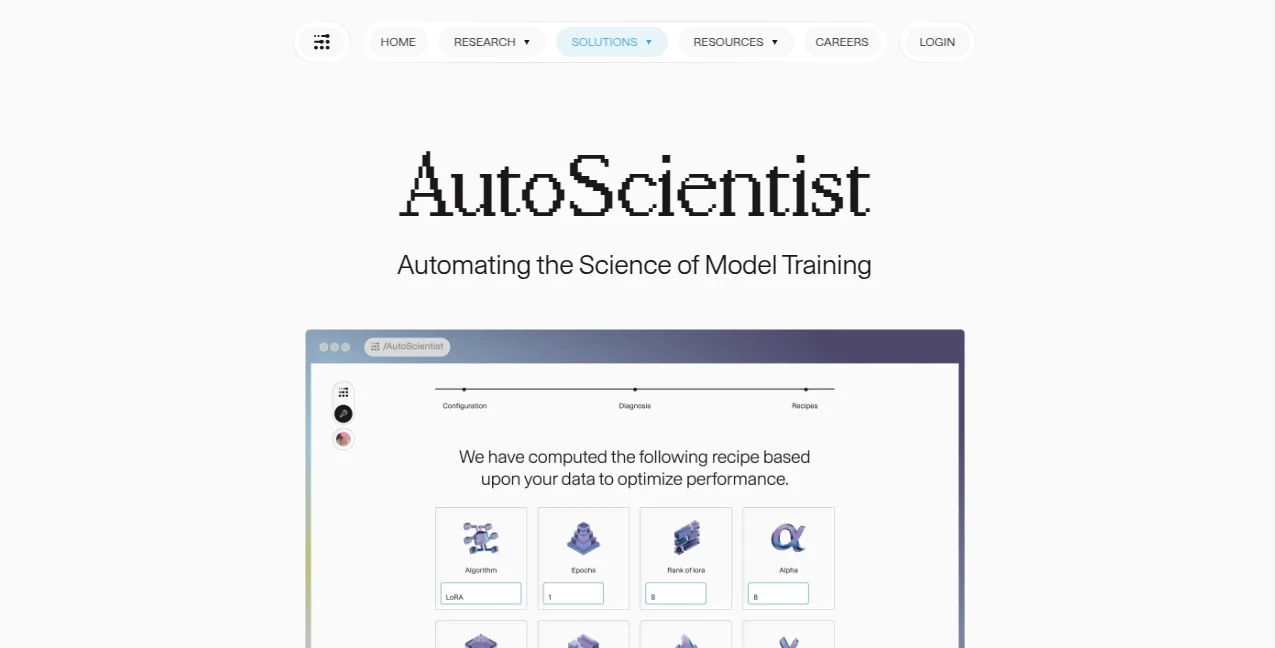
User Interface
The experience stays focused. You set the desired outcome, point the system at your data, and let the loop run. Progress and intermediate results stay visible without drowning you in every experimental detail. For developers there is also a full API and SDK, so the same research loop can be triggered from notebooks or production pipelines with a few lines of code. The interface never pretends you need to be an expert in hyperparameter search or data selection theory.
Accuracy & Performance
Because data and training recipes are optimized together rather than in isolation, the system avoids many of the usual dead ends. Gains held across dataset sizes from a few thousand to a hundred thousand samples and across different model architectures. The closed loop keeps iterating until quality converges on the objective you set, which is why the reported relative improvements stay consistent instead of looking like one-off lucky runs.
Capabilities
It handles the full research cycle: data optimization, recipe search, training, and evaluation. There is support for smaller production models (the Tiny version targets the sub-10B range that most real systems actually deploy) as well as larger ones. Multimodal training has been added so the same approach works across text and images. Once the model converges you can deploy the adapted weights. The API lets you integrate the entire process into existing pipelines instead of treating training as a separate, manual project.
Security & Privacy
Your data stays under your control during the optimization process. Enterprise-oriented features support centralized management and detailed tracking so teams can keep sensitive material inside their own workflows. The system is built for organizations that cannot simply throw proprietary data into a public fine-tuning service and hope for the best.
Use Cases
A medical document review team used the system and cut review time significantly by training a model that actually understood their specific document types. Finance teams adapt models to domain language and risk signals without rebuilding the entire training stack for every new product. Technology and enterprise groups turn proprietary datasets into specialized models that outperform generic baselines on their actual tasks. Developers can go from idea to an owned, adapted model in a single focused session instead of weeks of experiment tracking. Even non-technical builders can shape model behavior by defining outcomes rather than writing training code.
Pros and Cons
Pros:
- Co-optimizes data and training recipes in one automated loop instead of sequential hand-tuning.
- Consistent relative gains across domains and model sizes in internal benchmarks.
- Works for both technical teams and non-experts who simply define the desired outcome.
- API and SDK make it practical to embed inside real production pipelines.
- Supports smaller models that fit actual deployment constraints as well as larger ones.
Cons:
- Best results still depend on having a clear outcome and usable starting data.
- Reported performance numbers come primarily from internal evaluations.
- Full enterprise features and higher volume usage sit behind paid access after the initial trial period.
Pricing Plans
A free trial period is available so teams can run real experiments and see the quality of the adapted models before committing. After that, usage is based on credits and volume. Enterprise plans add centralized credit management, priority support, detailed analytics, and custom integrations. The model is designed so the cost of running the research loop is far lower than the traditional approach of keeping specialized researchers and infrastructure online for weeks of manual iteration.
How to Use AutoScientist
Define the outcome you want the model to achieve. Upload or connect your dataset. Launch the run and let the system co-optimize data and training recipes until performance converges. Review the resulting model and deploy the adapted weights. Developers can do the same flow programmatically through the API: upload data, trigger Adaptive Data processing if needed, create an AutoScientist run, and retrieve the trained model. The process is intentionally short on ceremony so you spend time evaluating results rather than configuring every experimental detail.
Comparison with Similar Tools
Most fine-tuning platforms still treat data preparation and hyperparameter search as separate, mostly manual stages. This system collapses them into a single self-improving loop. Generic auto-ML tools often optimize only the recipe while leaving data quality untouched. Here both move together until the model actually hits the behavior you described. The practical result is faster convergence and higher final quality without requiring a full-time research engineer to babysit every experiment.
Conclusion
Model training does not have to remain a specialized craft available only to a few labs and highly experienced teams. By automating the full research loop and co-optimizing data with training recipes, this platform turns a multi-week process into something closer to a directed experiment you can actually finish. For teams that need models shaped to their own data and goals rather than average internet behavior, that shift is substantial. Intelligence should not stay limited to those who already know how to build it. This is one of the clearer steps toward making that statement real.
Frequently Asked Questions (FAQ)
What does co-optimization actually mean?
The system adjusts both the training data and the training recipe in lockstep, iterating until the model converges on the outcome you defined.
Do I need deep machine learning expertise?
No. You set the desired outcome and provide data. The research loop runs automatically.
How much better is it than manual configuration?
Internal evaluations showed roughly 35% relative improvement and win-rate gains from 48% to 64% against configurations chosen by the company’s own research staff.
Can developers use it programmatically?
Yes. There is a full API and SDK so the same loop can be triggered from code and integrated into pipelines.
Does it work for smaller models?
Yes. There is a version focused on models under 10B parameters, which is the range most production systems actually deploy.
AI Code Assistant , AI Research Tool , AI Developer Tools , Other .
These classifications represent its core capabilities and areas of application. For related tools, explore the linked categories above.
Adaption | Auto Scientist details
Website unavailable — View Alternatives
Pricing
- Freemium
Apps
- Web App
Categories

Adaption | Auto Scientist Alternatives Product

Rank++

globalize.now

GLM 5

PatentFig AI

Blackbox AI

ChatterSift

Hirescope.te…
Clean Paste
Dedoctive