


















Adaptive Engine
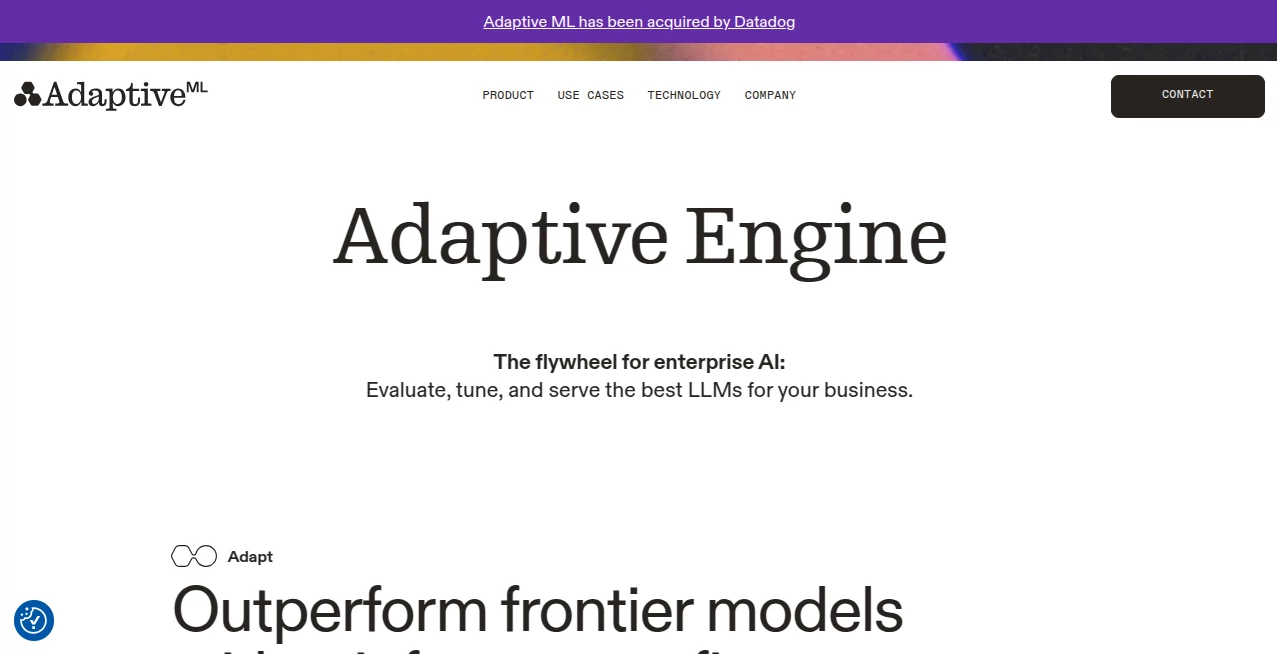
What is Adaptive Engine?
Adaptive Engine is an enterprise AI platform designed to help teams evaluate, tune, and serve language models around the outcomes that matter to their business. Instead of treating an LLM as a finished product, it provides an environment where models can be trained, tested, deployed, monitored, and improved as real-world requirements change.
The platform is particularly interesting for organizations building specialized AI agents. A general-purpose model may perform well across many tasks, but enterprise workflows often need something more specific: better retrieval accuracy, fewer hallucinations, stronger reasoning, consistent tone, or reliable performance against internal business rules. Adaptive Engine brings these requirements into the model development cycle.
Its workflow connects model adaptation, evaluation, and inference rather than forcing teams to manage each stage through separate systems. That makes it a practical option for companies moving beyond AI prototypes and looking for a more controlled production environment.
Key Features
- Reinforcement fine-tuning with PPO, GRPO, DPO, and other optimization approaches.
- Full-model and adapter-based tuning for different deployment requirements.
- Synthetic data generation and pre-built recipes for efficient model training.
- AI and human feedback for improving model behavior.
- Automated reasoning optimization and test-time search.
- Production feedback and business-metric optimization.
- Custom Python recipes and configurable training jobs.
- Automated evaluation for proprietary APIs and open models.
- Custom AI judges based on business-specific evaluation criteria.
- A/B testing with online users and offline annotator feedback.
- Production observability with model interaction tracking and custom metrics dashboards.
- Inference optimization using techniques such as prefix caching and quantization.
User Interface
The platform is built around the practical workflow of developing and operating specialized AI systems. Models, datasets, training runs, evaluations, and deployments can be managed as connected parts of the same process rather than isolated experiments.
This approach is useful for technical teams that need visibility across the complete model lifecycle. Instead of jumping between a training environment, evaluation scripts, inference infrastructure, and monitoring tools, teams can work around a unified AI development workflow.
Accuracy & Performance
Performance is one of the strongest reasons to consider this type of platform. Rather than relying only on generic benchmark scores, teams can evaluate models against metrics that reflect their actual business requirements. Custom AI judges, RAG evaluators, business rules, human feedback, and production signals can all become part of the evaluation process.
The inference layer is also designed with efficiency in mind. The platform states that its proprietary inference engine can be up to 30% faster than vLLM, while features such as prefix caching and quantization are used to reduce latency and GPU costs.
For example, a company running a customer-support agent could evaluate not only whether an answer sounds fluent, but also whether it follows company policies, retrieves the correct information, and satisfies a defined quality threshold.
Capabilities
The platform covers three important stages of enterprise model development. During adaptation, teams can fine-tune models with reinforcement learning, synthetic data, expert feedback, and customized recipes. During evaluation, different models can be compared using automated judges, custom guidelines, A/B testing, and production-oriented metrics. During serving, models and fine-tuned adapters can be deployed for scalable inference.
Another useful capability is adapter serving. Multiple specialized adapters can share the same underlying model, allowing organizations to personalize AI agents without necessarily maintaining a completely separate model infrastructure for every workflow.
The system can also work with external inference providers, giving teams a centralized way to manage inference across providers and models.
Security & Privacy
Enterprise deployment often comes with strict requirements around data location and infrastructure control. The platform supports managed environments as well as private cloud and on-premise deployments, allowing organizations to keep their data within infrastructure that matches their operational or regulatory requirements.
This flexibility can be especially valuable for companies handling sensitive enterprise information. Control over model updates and deployment environments also gives technical teams more influence over how their AI systems evolve.
Use Cases
Adaptive Engine is aimed at specialized enterprise AI rather than casual consumer experimentation. One strong use case is enterprise search, where organizations can optimize retrieval and response quality around their own knowledge and evaluation criteria.
Another application is business intelligence. Specialized agents can connect natural-language requests with databases and help users interact with business data without requiring every request to be translated manually into database queries.
Customer support is another natural fit. A support agent can be tuned around company policies, preferred communication styles, escalation rules, and other business-specific requirements. Production feedback can then become part of the improvement loop.
The platform can also be useful for workflows involving RAG, text-to-SQL, document processing, reasoning tasks, content moderation, and other applications where generic model performance is not enough.
Pros and Cons
Pros:
- Combines model tuning, evaluation, deployment, and monitoring in one workflow.
- Supports multiple reinforcement learning approaches.
- Allows businesses to optimize models around their own metrics.
- Supports synthetic data and human feedback.
- Provides options for private cloud and on-premise deployments.
- Supports open models as well as external inference providers.
- Useful for organizations building specialized AI agents at production scale.
- Adapter serving can reduce infrastructure requirements for multiple specialized workflows.
Cons:
- The platform is primarily aimed at enterprise and technical teams rather than casual users.
- Understanding fine-tuning, evaluation, inference, and reinforcement learning can require engineering expertise.
- Public pricing information is not prominently provided, so organizations need to contact the company for commercial details.
- The breadth of its capabilities may be more than a small team needs for a simple AI application.
Pricing Plans
No standard public pricing plans are listed for the platform. The official website directs interested organizations toward booking a demo and discussing their requirements with the team.
This approach is consistent with an enterprise-oriented product where infrastructure, deployment model, compute requirements, security requirements, and the number of AI workloads can significantly affect the final setup and cost.
How to Use the Platform
Getting started typically begins by defining a use case and selecting a model suitable for the task. Teams can then deploy the model, upload or prepare relevant datasets, and run a training or fine-tuning workflow.
After tuning, the model can be evaluated against custom criteria. Teams can compare different models, use AI judges or human feedback, and perform A/B tests before exposing a model to a wider production audience.
Once deployed, production interactions and business metrics can provide additional feedback. This creates a continuous improvement cycle where the model can be refined as users and business requirements evolve.
Comparison with Similar Tools
Many AI development platforms concentrate on a single part of the workflow. Some focus mainly on model training, others specialize in inference, while separate products may handle evaluation or observability.
The main distinction here is the attempt to connect these stages. A team can start with an existing model, adapt it to a particular task, evaluate it against business-specific requirements, deploy it, and then use production feedback to guide future improvements.
This makes the platform more suitable for organizations that view AI as an evolving production system rather than a one-time model selection exercise.
Conclusion
For organizations serious about building specialized enterprise AI, the biggest attraction is the complete feedback loop. Models are not simply selected and deployed; they can be evaluated against business requirements, adapted with reinforcement learning, tested with real users, and improved using production signals.
The combination of model tuning, evaluation, scalable inference, and deployment flexibility makes the platform particularly compelling for companies operating AI agents in demanding environments. It is a technical product, but its core idea is straightforward: build an AI system around the results your business actually needs, then keep improving it as those results become measurable.
Frequently Asked Questions (FAQ)
What is this platform designed for?
It is designed for enterprises that need to fine-tune, evaluate, deploy, and continuously improve specialized language models and AI agents.
Does it support reinforcement learning?
Yes. The platform supports reinforcement learning approaches including PPO, GRPO, and DPO, along with other tuning workflows.
Can businesses use their own data?
Yes. Teams can use their own datasets, written guidelines, expert feedback, and production signals to improve models for specific workflows.
Can models be evaluated before production?
Yes. The platform provides automated evaluations, customizable AI judges, RAG evaluators, A/B testing, and offline feedback mechanisms.
Does it support open-source models?
Yes. The platform supports open models as well as proprietary model APIs, allowing teams to compare different approaches within the same evaluation workflow.
Can it be deployed on private infrastructure?
Yes. Private cloud and on-premise deployment options are available for organizations that need greater control over data location and infrastructure.
Is there a public pricing plan?
No standard public pricing table is provided. Organizations interested in using the platform are directed toward a demo and a discussion of their requirements.
Who would benefit most from using it?
It is best suited to enterprise AI teams, machine learning engineers, researchers, and organizations developing specialized AI agents that need measurable performance improvements and production-level control.
AI Testing & QA , AI Research Tool , Large Language Models (LLMs) , AI Developer Tools .
These classifications represent its core capabilities and areas of application. For related tools, explore the linked categories above.
Adaptive Engine details
Website unavailable — View Alternatives
Pricing
- Freemium
Apps
- Web App
Categories

Adaptive Engine Alternatives Product

Standard Com…

globalize.now

Toflow AI

Discord Time…

HY Motion

ForexCoupons

AlphaTax

TokenCalcula…

AyeWatch AI
