
aelívra
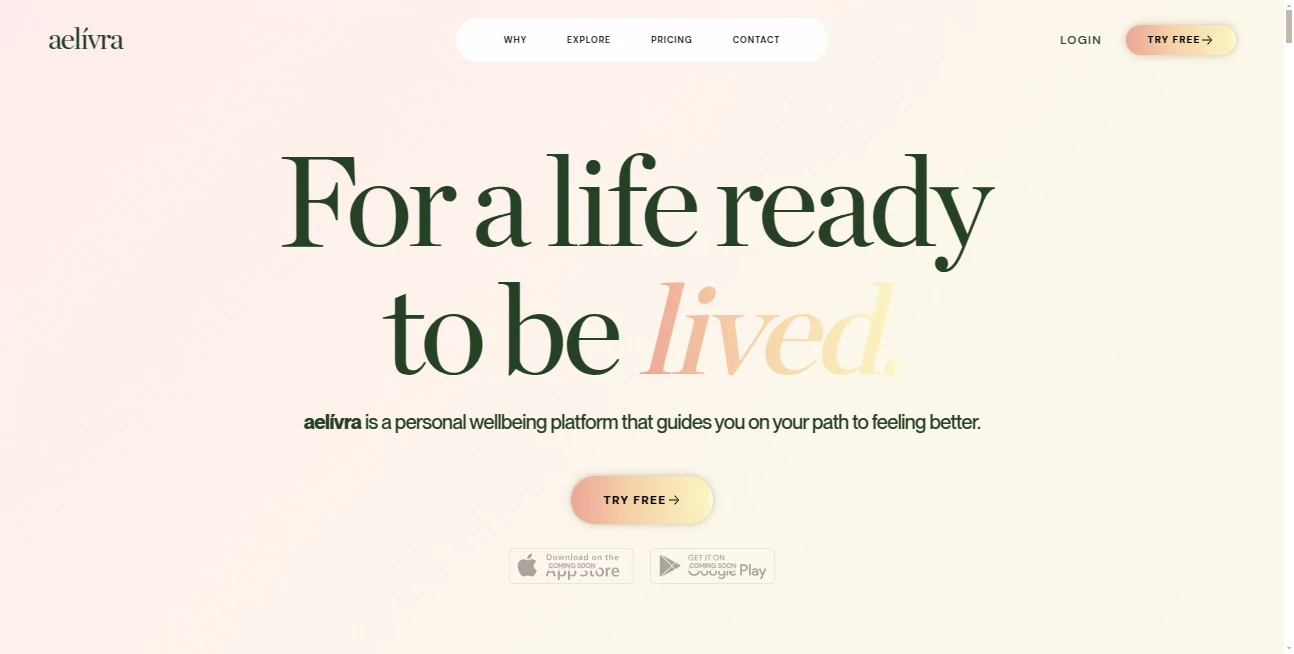
What is aelívra?
aelívra is a personal wellbeing platform designed to help people make sense of their health, lifestyle, symptoms, habits, and everyday wellbeing in one place. Rather than treating health tracking as a collection of disconnected numbers, the platform takes a broader view by bringing together information such as symptoms, biomarkers, health records, wearable data, triggers, nourishment, movement, and mindfulness.
The idea is refreshingly practical: instead of simply collecting information, the platform is built around helping users explore questions about their wellbeing and turn what they discover into personalized, manageable steps. It can be particularly appealing to people who feel that conventional health trackers show plenty of data but do not always explain what that data means in the context of their everyday lives.
The experience follows a five-stage journey: exploration, connection, personalization, insights, and adventure. Users can begin with a wellness goal or question, connect relevant information and devices, and then work through a plan that adapts as their circumstances change.
Key Features
- Personalized wellbeing plans: The platform creates plans around individual goals rather than forcing every user into the same routine.
- Whole-health view: Symptoms, biomarkers, records, triggers, habits, and other information can be considered together.
- Health record exploration: Users can explore areas including cardiovascular health, hematology, inflammation, liver health, metabolic health, hormones, sleep and recovery, gut health, immune health, thyroid health, and more.
- Wearable data: Connected wearable information can contribute to the broader picture of a person's wellbeing.
- Symptom tracking: The platform covers different types of symptoms, including neurological, cardiorespiratory, digestive, hormonal, mental health, musculoskeletal, and dermatological symptoms.
- Wellness goals: Users can start with a specific question or personal objective and use the platform to explore it over time.
- AI-supported insights: Its structured AI-support engine is intended to help users organize and interpret health-related information while keeping the experience focused on self-guided exploration.
User Interface
The overall experience is built around a guided journey rather than a traditional dashboard overloaded with charts. The progression from exploration to connection, personalization, insights, and finally an ongoing wellness journey gives the product a clear sense of direction.
This approach should feel comfortable for someone who does not enjoy spending time analyzing spreadsheets of health measurements. Instead of asking users to become experts in every metric, the platform attempts to put information into a more understandable personal context.
The interface also separates different parts of wellbeing, such as nourishment, symptoms, movement, biomarkers, mindfulness, wearables, triggers, and records. That makes the broad scope of the service easier to navigate.
Accuracy & Performance
Health information requires a higher level of care than ordinary productivity or lifestyle software. The platform is transparent about this point. Its website states that the AI-support engine uses structured approaches to scientific reasoning but can make mistakes.
It is therefore best viewed as a tool for organizing information, exploring patterns, preparing questions, and supporting personal wellbeing—not as a replacement for a doctor, diagnosis, or professional treatment.
One of its strongest qualities is the attempt to connect different types of information rather than interpreting a single metric in isolation. For example, sleep, symptoms, wearable information, lifestyle habits, and health records may provide more useful context together than any one of them alone.
Capabilities
The breadth of the platform is one of its most interesting characteristics. It covers much more than basic step counting or calorie tracking. Users can work with health records, symptoms, biomarkers, wearable information, triggers, nourishment, movement, and mindfulness as parts of a single wellbeing journey.
The platform also supports exploration across a wide range of health areas. Its available record categories include cardiovascular, hematology, inflammation, liver, performance, tumour markers, coagulation, hormones, iron studies, metabolic health, sleep and recovery, gut health, immune health, kidney health, nutrients, and thyroid information.
For someone trying to understand why certain patterns keep appearing in their daily life, this broader approach can be useful. A person might begin with a question about sleep, for example, and then look at related symptoms, habits, wearable information, or other health records instead of treating sleep as an isolated number.
Security & Privacy
Privacy is especially important for a service that handles personal health information, and the platform puts considerable emphasis on it. Its website states that health data is encrypted, users control who can access their information, and personal data is not sold.
The service also states that it is GDPR compliant and HIPAA aligned, alongside encrypted security measures. These commitments are important for users who may want to bring sensitive health information into a digital wellbeing environment.
As with any health platform, users should still review the current privacy policy and terms before uploading particularly sensitive records or connecting external services.
Use Cases
Understanding recurring symptoms: People dealing with recurring but difficult-to-explain symptoms can use the platform to organize information and look for connections between different aspects of their wellbeing.
Preparing for healthcare conversations: Instead of trying to remember months of symptoms and lifestyle changes before an appointment, users can use a structured record of their experiences to prepare more useful questions for a healthcare professional.
Improving sleep and recovery: Sleep-related goals can be explored alongside lifestyle information, symptoms, wearable data, and other relevant signals.
Supporting lifestyle changes: Someone working on nutrition, movement, mindfulness, or daily habits can use personalized goals rather than following a generic checklist.
Managing a complex health journey: Users with several areas they want to monitor may appreciate having records, symptoms, biomarkers, and lifestyle information considered within one broader framework.
Pros and Cons
- Pros: Broad approach to personal wellbeing
- Pros: Personalized plans instead of a one-size-fits-all routine
- Pros: Combines symptoms, biomarkers, records, wearables, and lifestyle information
- Pros: Strong focus on privacy and encrypted health data
- Pros: Useful for organizing information before discussions with healthcare professionals
- Pros: Free early-access trial without requiring a credit card
- Cons: The service is still in its early-access stage
- Cons: AI-generated health insights can contain mistakes
- Cons: It should not be used as a substitute for professional medical advice
- Cons: Some future features and integrations may not yet be available
Pricing Plans
The platform currently offers an Early Access Trial that provides 14 days of free access. No credit card is required, and users can cancel at any time. The early-access plan also includes access to priority feedback channels.
The regular Membership is listed at $19 USD per month and includes ongoing platform access, priority customer support, and current platform features. The website also notes a founding price that will increase to $35 after launch.
A Lifetime Partner option is planned as a one-time payment, although its final price is currently listed as to be announced. The planned package includes lifetime platform access, personalized customer support, and future features at no additional cost.
How to Use the Platform
Getting started is designed around a simple five-step journey. First, choose a wellness goal or a question you want to explore. This gives the experience a clear starting point rather than asking you to configure everything before seeing any value.
Next, connect compatible devices and share relevant health history. The more useful information you provide, the broader the personal context becomes.
The next stage is personalization, where the platform builds a wellbeing plan around your situation. From there, you can review insights and respond to what your body and daily habits may be telling you.
The final stage is an ongoing wellness journey. Rather than treating the experience as a one-time assessment, the concept is built around making progress gradually and adjusting the plan as circumstances change.
Comparison with Similar Tools
Traditional fitness trackers are excellent at recording individual measurements such as steps, workouts, sleep, or heart-rate data, but they often leave users to interpret the information themselves. Generic wellness apps may offer routines and reminders, yet they can still feel disconnected from a person's broader health history.
This platform takes a different direction by attempting to bring multiple sources of information into one personal context. Symptoms, biomarkers, health records, wearable information, triggers, movement, nourishment, and mindfulness can all contribute to the overall picture.
That makes it particularly interesting for people who want more than a simple dashboard. The trade-off is that a broader health platform also requires users to be thoughtful about data privacy and to remember that AI-supported information is not the same thing as clinical diagnosis.
Conclusion
aelívra presents a thoughtful alternative to the usual health-tracking experience. Its strongest idea is not simply collecting more data, but trying to connect different pieces of a person's wellbeing into something easier to understand and act upon.
The combination of personalized goals, health records, symptoms, biomarkers, wearable data, lifestyle factors, and AI-supported exploration gives the platform considerable scope. The emphasis on privacy is another welcome feature, particularly for a product dealing with sensitive personal information.
It is still an early-stage service, so users should expect the product to evolve. For anyone interested in taking a more holistic approach to wellbeing and organizing their health journey in one place, however, it is a promising option worth exploring.
Frequently Asked Questions (FAQ)
What is this platform used for?
It is a personal wellbeing platform designed to help users explore health goals, symptoms, biomarkers, lifestyle factors, wearable information, and health records in a more connected way.
Does it provide medical advice?
No. The platform states that its AI-support engine can make mistakes and that the service does not provide medical advice, diagnosis, or treatment. It is intended for self-guided exploration and discussion with qualified healthcare professionals.
Can I track symptoms?
Yes. The platform supports a broad range of symptom areas, including sleep and energy, digestive, hormonal, mental health, neurological, cardiorespiratory, musculoskeletal, and dermatological symptoms.
Can I connect wearable devices?
Wearable data is one of the information sources supported by the platform and can contribute to the broader view of a user's wellbeing.
Is there a free plan?
There is currently a 14-day Early Access Trial. The trial does not require a credit card and can be cancelled at any time.
How much does the membership cost?
The Membership is currently listed at $19 USD per month. The website states that the founding price will increase to $35 after launch.
Is health data protected?
The platform states that health data is encrypted, will not be sold, and that users control who can access it. It also lists GDPR compliance and HIPAA alignment among its privacy and security commitments.
Can it replace a doctor?
No. It should be considered a wellbeing and information-support platform rather than a replacement for a qualified healthcare professional, medical diagnosis, or treatment.
AI Fitness , AI Mental Health , AI Healthcare .
These classifications represent its core capabilities and areas of application. For related tools, explore the linked categories above.

aelívra Alternatives Product

Pontefuerte …
AI Face Anal…

TDEE Calcula…

HealCycle

ZenMako

AI Meal Plan…

MyJournalPal

Romantic AI

GetFIT App