
AI HaoYisheng
What is AI HaoYisheng?
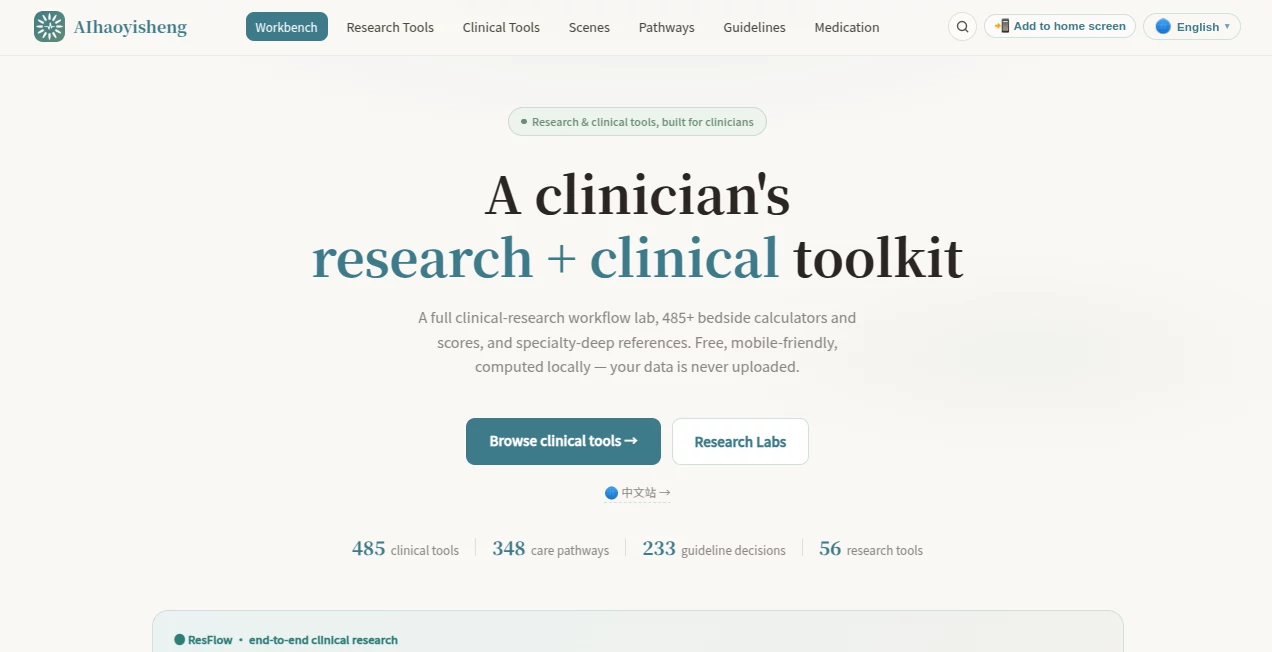
AI HaoYisheng is a clinician-focused platform that brings everyday medical calculations, clinical decision support, care pathways, and research utilities into one convenient workspace. Instead of jumping between scattered calculators, reference pages, and statistical tools, doctors can access a broad collection of resources from a single place.
The platform currently brings together hundreds of clinical tools, care pathways, guideline-based decisions, and research utilities. It is designed with a clear practical goal: make commonly needed clinical and research tasks easier to perform without adding unnecessary complexity to the workflow.
One particularly useful aspect is its focus on local computation. According to the platform, calculations are performed locally in the browser and patient data is not uploaded. That approach can make the service especially appealing when working with sensitive clinical information.
Key Features
- Hundreds of clinical calculators and scoring tools covering a wide range of medical specialties.
- Guideline-based decision support with risk stratification, thresholds, recommendations, and evidence information.
- Structured clinical care pathways that guide users through decision trees.
- Research tools for diagnostic accuracy, survival analysis, statistical modelling, agreement analysis, and other common research tasks.
- A dedicated research workflow environment covering stages from research questions through statistical analysis and publication-oriented outputs.
- Mobile-friendly access for doctors who need quick calculations at the bedside or during clinical work.
- Local browser-based computation for many of the available tools.
User Interface
The interface is built around practical access rather than visual decoration. Clinical calculators, guideline decisions, care pathways, and research resources are separated into clear sections, making it easier to find the type of tool needed for a particular task.
The mobile-friendly design is another useful detail. A physician working between wards, outpatient rooms, or emergency settings can open a calculator without needing a desktop workstation. The bedside workflow pages are also organized around clinical scenarios, which can be more intuitive than searching through a large unstructured database.
Accuracy & Performance
For medical calculators, accuracy depends heavily on the underlying formula, criteria, guideline, and the quality of the information entered by the user. The platform places considerable emphasis on evidence-based decision support, with guideline decisions displaying recommendation categories, evidence levels, and their supporting guidelines.
The research section also goes beyond simple arithmetic. Available tools include diagnostic 2×2 table analysis, normality and variance checks, Fagan nomograms, Fleiss' Kappa, restricted cubic splines, Bayesian proportion inference, and other statistical methods. This makes the platform useful not only for quick bedside calculations but also for more demanding academic work.
At the same time, medical software should be treated as decision support rather than an independent clinical authority. The website itself states that its tools and content are intended for licensed medical professionals and do not replace clinical judgment.
Capabilities
The breadth of the platform is one of its strongest points. Clinical resources cover areas such as cardiology, nephrology, respiratory medicine, neurology, infectious disease, gastroenterology, thrombosis, critical care, imaging, and gynecologic oncology.
Examples include tools for CHA₂DS₂-VASc assessment, Wells scores, NIHSS, FIB-4, Mentzer Index, Khorana score, GOLD classification, and several other established clinical calculations. The care-pathway section takes this a step further by turning clinical guidance into structured decision trees.
For researchers, the dedicated laboratory section provides tools that can support statistical analysis without requiring every task to be handled manually in a separate statistical package. Some outputs can also be accompanied by reproducible R code, which is particularly useful for researchers who want to verify or extend their analysis.
Security & Privacy
Privacy is an important consideration for any clinical utility. The platform states that its calculations are performed locally and that data is not uploaded or stored. This is a meaningful advantage when a calculator requires clinical values that users may not want to send to a remote service.
Doctors should still follow their institution's privacy policies and avoid entering personally identifiable patient information into any online service unless explicitly permitted. Local computation reduces exposure during calculation, but it does not replace proper clinical data-handling practices.
Use Cases
The platform can fit several parts of a doctor's daily workflow. In a busy clinical environment, a physician may need to calculate a risk score, estimate a clinical value, or quickly review a decision pathway. Having these resources grouped together can save time compared with repeatedly searching the web for individual calculators.
It can also be useful for residents and medical trainees who want to understand how established scores and clinical criteria are applied. Rather than simply displaying a final number, many tools are structured around the variables and thresholds that lead to the result.
For academic researchers, the research tools provide another layer of value. Tasks such as diagnostic test evaluation, survival modelling, agreement analysis, and regression-related work can be explored directly in the browser. A researcher preparing a paper could use the tools for an initial analysis and then reproduce the methodology in a dedicated statistical environment when required.
Pros and Cons
Pros
- Large collection of clinical calculators and medical decision-support resources.
- Useful combination of bedside tools and research utilities.
- Guideline-oriented clinical decision pathways.
- Local computation with no data upload stated for the platform's tools.
- Mobile-friendly and convenient for quick clinical reference.
- Free access makes the collection easy to explore.
Cons
- The platform is primarily designed for medical professionals rather than general users.
- Users still need appropriate medical knowledge to interpret scores and recommendations correctly.
- A web-based decision-support tool cannot replace professional judgment or institution-specific protocols.
- The large number of available resources may initially feel overwhelming to new users.
Pricing Plans
The platform currently presents its clinical and research resources as free to use. There is no conventional premium pricing structure highlighted on the main English site, making it possible for clinicians and researchers to explore the available calculators, decision tools, pathways, and research utilities without committing to a subscription.
This free-access approach is particularly attractive for students, residents, researchers, and independent clinicians who need occasional access to specialized medical calculators without maintaining several separate subscriptions.
How to Use It
Start by choosing the type of resource you need. For a quick clinical calculation, open the clinical tools section and select the relevant score or calculator. Enter the requested clinical values and review the resulting assessment.
If the task involves a more complex clinical situation, a care pathway or guideline decision may be more appropriate. These resources organize the process into sequential steps, helping users move from patient information and risk assessment toward the relevant recommendation.
For academic work, open the research tools area and select the statistical method that matches the question being investigated. Enter the required dataset or values, review the generated results, and use the available methodological information to understand what the output means before incorporating it into a research project.
Comparison with Similar Tools
Many medical websites specialize in a single category, such as clinical calculators, drug references, medical guidelines, or statistical analysis. This platform takes a broader approach by combining several of these functions in one environment.
Its main advantage over a standalone calculator website is the combination of bedside scoring, guideline decisions, care pathways, and research analysis. A physician can move from a simple risk calculation to a structured clinical pathway, while a researcher can use a separate set of statistical tools for academic work.
The platform is therefore better viewed as a general clinical and research toolkit rather than a replacement for a comprehensive medical reference database, electronic health record, or professional statistical application.
Conclusion
For clinicians and medical researchers looking for a practical collection of calculators, clinical pathways, guideline-based decision tools, and research utilities, this platform offers a compelling combination of breadth and accessibility. Its emphasis on local computation, mobile access, and free availability makes it particularly convenient for quick tasks during clinical or academic work.
The strongest part of the service is arguably its range. It does not stop at basic medical scores; it connects bedside calculations with structured decision-making and a growing collection of research methods. Used appropriately and alongside professional judgment and current clinical guidance, it can become a useful addition to a doctor's everyday digital toolkit.
Frequently Asked Questions (FAQ)
Who is this platform designed for?
It is primarily designed for doctors, licensed healthcare professionals, medical researchers, residents, and others working with clinical or medical research tasks.
Is the platform free?
Yes. The main website currently presents its clinical and research tools as free resources.
Does it include clinical calculators?
Yes. The platform provides hundreds of clinical calculators and scoring tools covering numerous specialties and medical scenarios.
Does it provide medical decision support?
Yes. Its guideline decision section converts clinical information into risk stratification, thresholds, and guideline-based recommendations, while its care pathways organize clinical situations into step-by-step decision trees.
Is patient data uploaded?
The platform states that its calculations are performed locally and that data is not uploaded or stored. Users should nevertheless follow their organization's privacy requirements when handling clinical information.
Can it be used for medical research?
Yes. The research section includes tools for statistical analysis and methodology, including diagnostic accuracy, survival analysis, agreement statistics, Bayesian analysis, and regression-related methods.
Can it replace a doctor or clinical judgment?
No. The platform is intended as a support resource for licensed medical professionals. Its results should be interpreted in context and should not replace professional clinical judgment or applicable medical guidelines.
AI Knowledge Management , AI Productivity Tools , AI Research Tool , AI Healthcare .
These classifications represent its core capabilities and areas of application. For related tools, explore the linked categories above.

AI HaoYisheng Alternatives Product

Keepmind

PurityRadar

DocReplacer

TruthSpine

Discord Time…

Ultralytics

Graph Maker

ttanonviewer

Weekly Brief