


















Ansarada
What is Ansarada?
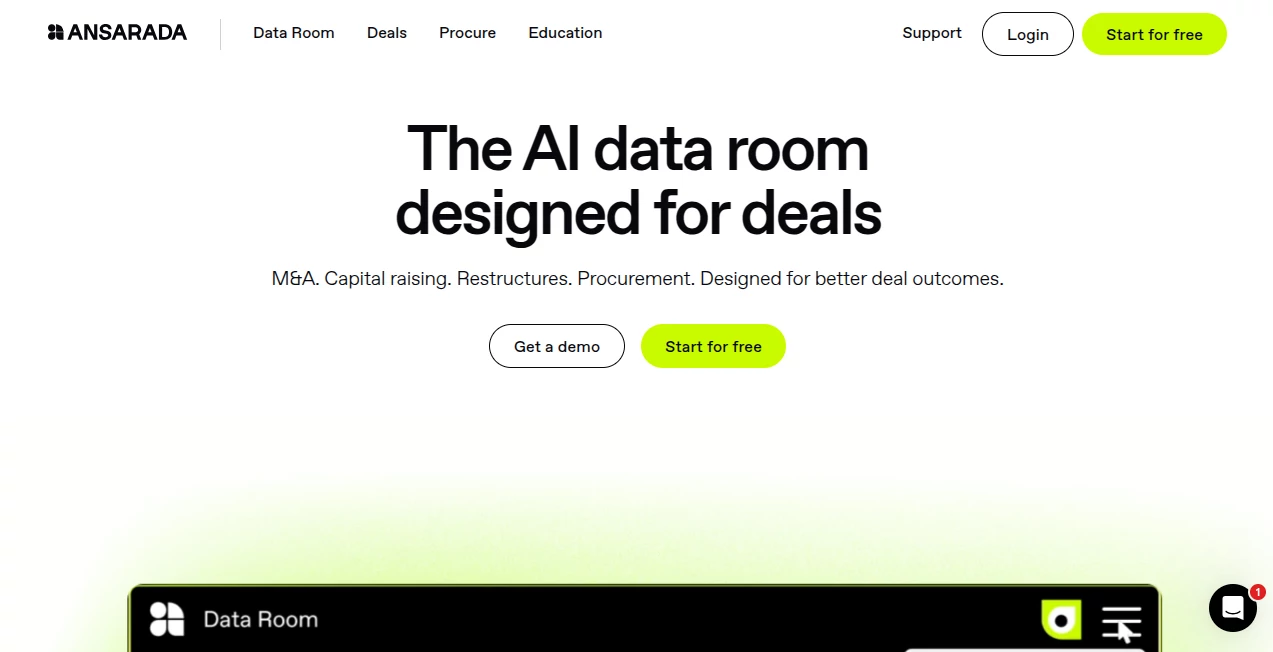
Ansarada is an AI-powered deal management platform built for organisations handling high-stakes transactions and sensitive business information. Its main focus is helping teams manage M&A transactions, capital raising, restructures, procurement, due diligence, and other complex projects from one secure environment.
Rather than treating a data room as nothing more than a place to upload files, the platform connects document management, collaboration, workflow, reporting, security, and artificial intelligence. This makes it particularly useful for investment bankers, M&A advisors, legal teams, private equity firms, corporate teams, governments, and organisations working through major transactions.
The platform has been operating since 2005 and is currently used across more than 170 countries. Its approach is straightforward: keep critical information organised, give the right people the right access, and use automation to reduce the amount of manual work involved in a transaction.
Key Features
- AI-powered data room: A secure virtual data room designed specifically around transactions and sensitive business information.
- Ask AiDA: An AI assistant that can search documents, summarise information, answer questions, and surface useful insights from a document collection.
- AI-Sort: Helps organise and reorder documents within a data room, reducing the manual effort involved in preparing large document collections.
- AI-Redact: Provides intelligent redaction capabilities for removing sensitive information from documents at scale.
- AI-Translate: Translates deal-critical documents directly within the data room.
- AI-Predict: Analyses bidder behaviour and provides predictions that can help deal teams understand which bidders are more likely to make an offer.
- Automated Q&A: Streamlines the question-and-answer process during due diligence with AI-supported workflows, approvals, comments, and similar-question alerts.
- Centralised task management: Keeps transaction tasks, requests, responsibilities, and progress in one workspace.
- Secure file sharing: Gives teams detailed control over access to confidential documents and information.
- Advanced reporting: Provides visibility into activity and user behaviour so deal teams can make better-informed decisions.
User Interface
The interface is designed with simplicity in mind. Drag-and-drop functionality makes it easier to prepare a data room, while centralised dashboards help users keep track of documents, tasks, requests, and deal activity without constantly switching between different systems.
This is particularly valuable for first-time data room users. A transaction can already involve enough complexity, so having a workspace that feels closer to a modern business application than an old-fashioned document repository is a practical advantage.
For larger teams, the centralised structure also creates a clearer view of who is responsible for each task and what still needs attention.
Accuracy & Performance
Performance is especially important in transaction software because teams may need to review thousands of documents under tight deadlines. The platform includes bulk document processing, smart sorting, indexing, watermarking, AI-assisted redaction, and automated Q&A features to reduce repetitive work.
One particularly interesting capability is its bidder analysis. The platform states that its AI can compare bidder activity against data from more than 60,000 deals and identify likely offer behaviour, with reported accuracy of up to 97 percent. This type of analysis can give deal teams another useful signal when evaluating buyer engagement.
AI is not positioned as a replacement for professional judgement. Instead, it works in the background to find information, organise documents, highlight patterns, and reduce administrative work so professionals can spend more time making decisions.
Capabilities
The platform covers a broad part of the transaction lifecycle. Teams can prepare marketing materials, organise NDAs and information memorandums, manage deal preparation, coordinate due diligence, handle bidder questions, support post-merger integration, and retain documentation after a transaction has finished.
Its Deal Workflow functionality is particularly useful for teams that rely heavily on checklists and requests. Users can centralise tasks, collaborate with colleagues and advisors, track progress, and maintain an auditable record of activity.
The system also supports infrastructure procurement and complex tender processes, making its use cases broader than conventional M&A data rooms.
Security & Privacy
Security is one of the most important parts of the platform because it is designed to handle confidential financial, legal, corporate, and transaction information. Users can control document access, printing, saving, and other permissions while monitoring activity within the environment.
Additional protections include watermarking, detailed reporting, document controls, and the ability to self-destruct files regardless of where saved copies may exist. The platform also provides granular access management so sensitive information can be restricted according to roles and responsibilities.
For organisations involved in regulated or high-value transactions, this combination of controlled access, auditing, reporting, and secure collaboration can be considerably more useful than relying on ordinary cloud storage and separate project-management applications.
Use Cases
- M&A transactions: Manage preparation, marketing, due diligence, bidder communication, and transaction documentation in one environment.
- Capital raising: Organise confidential documents and securely share information with potential investors.
- Private equity: Support deal teams throughout acquisition and investment processes.
- Investment banking: Coordinate transaction workflows, documents, buyer activity, and due diligence requirements.
- Legal teams: Securely manage sensitive documents and support disclosure and review processes.
- Restructuring and insolvency: Keep critical information organised while multiple parties collaborate on sensitive projects.
- Infrastructure procurement: Manage complex tenders, bidder interactions, submissions, evaluation, and reporting.
- Post-merger integration: Continue using the same environment for integration checklists, responsibilities, and documentation after a deal closes.
- Secure document repositories: Keep important transaction records available after completion instead of moving them to another system.
Pros and Cons
Pros
- Combines virtual data rooms with broader transaction management capabilities.
- Strong selection of AI features for document-heavy workflows.
- Secure collaboration for highly sensitive business information.
- Supports the full transaction lifecycle rather than only due diligence.
- Unlimited internal and external users are included in the published data plans.
- Free deal preparation is available before a deal goes live.
- Online pricing makes it easier to estimate costs without immediately contacting sales.
- 24/7 customer support is available across global time zones.
Cons
- The platform is primarily designed for professional transaction and procurement workflows, so it may be excessive for simple everyday file sharing.
- Pricing can become significant for large data rooms or long-running transactions.
- Some advanced functionality is most valuable to experienced deal teams rather than casual users.
- Organisations looking only for a basic document repository may not need its broader transaction-management features.
Pricing Plans
The pricing model is based primarily on data room size and subscription term rather than the number of users. Published plans include unlimited internal and external users, while smaller Essentials plans have limits on internal users.
A notable advantage is that teams can prepare a deal room for free before the transaction goes live. Payment begins when the room goes live, meaning an external guest is invited, or after 90 days from room creation, whichever happens first.
- 50 MB Essentials: Starts at $99 per month, with lower monthly pricing available for longer commitments.
- 100 MB Essentials: Starts at $189 per month.
- 250 MB: Starts at $479 per month.
- 1 GB: Starts at $1,479 per month.
- 2 GB: Starts at $2,044 per month.
- 5 GB: Starts at $3,069 per month.
- 10 GB: Starts at $4,348 per month.
- 20 GB: Starts at $8,579 per month.
Longer commitments can substantially reduce the effective monthly cost. For example, the published 50 MB Essentials plan falls from $99 per month on monthly billing to $69 per month when a 12-month term is selected. Prices may vary by location, taxes, plan configuration, and current pricing updates, so users should check the live quote before purchasing.
How to Use the Platform
- Start by creating a new data room or transaction workspace.
- Upload and organise the documents required for the transaction.
- Use automated sorting and document-management features to reduce preparation time.
- Configure user roles and permissions according to each participant's responsibilities.
- Invite internal team members, advisors, bidders, investors, or other external users when appropriate.
- Use AI tools to search documents, summarise information, translate files, redact sensitive content, and answer questions.
- Manage requests and due diligence questions through the central workflow.
- Monitor user activity, bidder engagement, and transaction progress through reporting tools.
- Continue using the workspace for integration or secure archival after the transaction is completed.
Comparison with Similar Tools
Traditional virtual data rooms generally focus on securely storing and sharing documents during due diligence. That remains an important function here, but the broader approach is what makes this platform stand out.
Instead of treating the data room, project checklist, Q&A process, reporting dashboard, and transaction workflow as separate products, the platform brings them together. This can reduce the need for teams to maintain parallel spreadsheets, email threads, document repositories, and task-management systems.
The AI layer also adds another dimension. Document sorting, redaction, translation, document search, question answering, and bidder analysis can remove some of the repetitive work that traditionally falls on analysts, advisors, and deal administrators.
For a small business that only needs to share a handful of files, a simpler cloud-storage solution may be more appropriate. For a complex transaction involving confidential information, multiple stakeholders, strict permissions, and substantial due diligence, the broader feature set becomes much easier to justify.
Conclusion
For organisations managing high-value transactions, the biggest challenge is rarely just storing documents. The real challenge is keeping hundreds of moving parts organised while maintaining security, accountability, and momentum.
This platform addresses that problem by combining a secure data room with workflow management, collaboration, reporting, and a growing set of AI capabilities. Features such as AI-powered document search, smart sorting, automated redaction, translation, Q&A, and bidder analysis can save meaningful amounts of time during demanding transaction processes.
Its strongest fit is therefore with M&A teams, investment professionals, legal advisors, private equity firms, corporations, governments, and procurement teams that need more than ordinary file storage. The free preparation model and transparent online pricing also make it relatively easy to explore before committing to a live transaction.
If your work involves sensitive documents, multiple stakeholders, strict access controls, and a transaction that needs to stay organised from preparation through completion, this is a compelling platform to consider.
Frequently Asked Questions (FAQ)
What is this platform used for?
It is primarily used for secure deal management, virtual data rooms, M&A transactions, capital raising, due diligence, restructuring, procurement, tenders, and other high-stakes projects involving sensitive information.
Does it include AI features?
Yes. Its AI capabilities include document search and question answering, smart document sorting, intelligent redaction, translation, bidder prediction, and AI-supported due diligence workflows.
Can I prepare a data room for free?
Yes. Deal preparation is free until the room goes live. According to the published pricing model, payment begins when an external guest is invited or 90 days after the room is created, whichever occurs first.
Does pricing depend on the number of users?
The published data-room plans use a storage-based pricing model rather than charging primarily by user count. Plans include unlimited external users, while some Essentials plans have limits on internal users.
Is it suitable for M&A?
Yes. M&A is one of its core use cases, with functionality covering deal marketing, preparation, due diligence, bidder management, transaction workflows, integration, and post-deal archiving.
Can it be used for procurement and tenders?
Yes. A dedicated procurement solution supports large and complex infrastructure procurement projects, including bidder management, RFI and Q&A processes, submissions, evaluation, and reporting.
Does it provide document security controls?
Yes. The platform provides granular permissions and controls around document access, saving, printing, sharing, and monitoring. It also supports watermarking, activity tracking, and intelligent redaction.
Who is the platform best suited for?
It is best suited to investment banks, M&A advisors, private equity firms, legal teams, corporate development departments, governments, procurement teams, and other organisations handling complex, confidential transactions.
Can documents remain available after a transaction?
Yes. Its archival capabilities allow organisations to retain transaction documentation in the same environment after completing a deal, reducing the need to move important records into another system.
AI Workflow Management , AI Project Management , AI Documents Assistant , AI Contract Management .
These classifications represent its core capabilities and areas of application. For related tools, explore the linked categories above.

Ansarada Alternatives Product

Referent

Chatzy AI

LaunchBoard

ResumeFreePro

LLaMaRush

Jujutsu Zero…

PDF to Video

JFIF to JPG …

GLM-OCR Onli…
