
Aripsy
What is Aripsy?
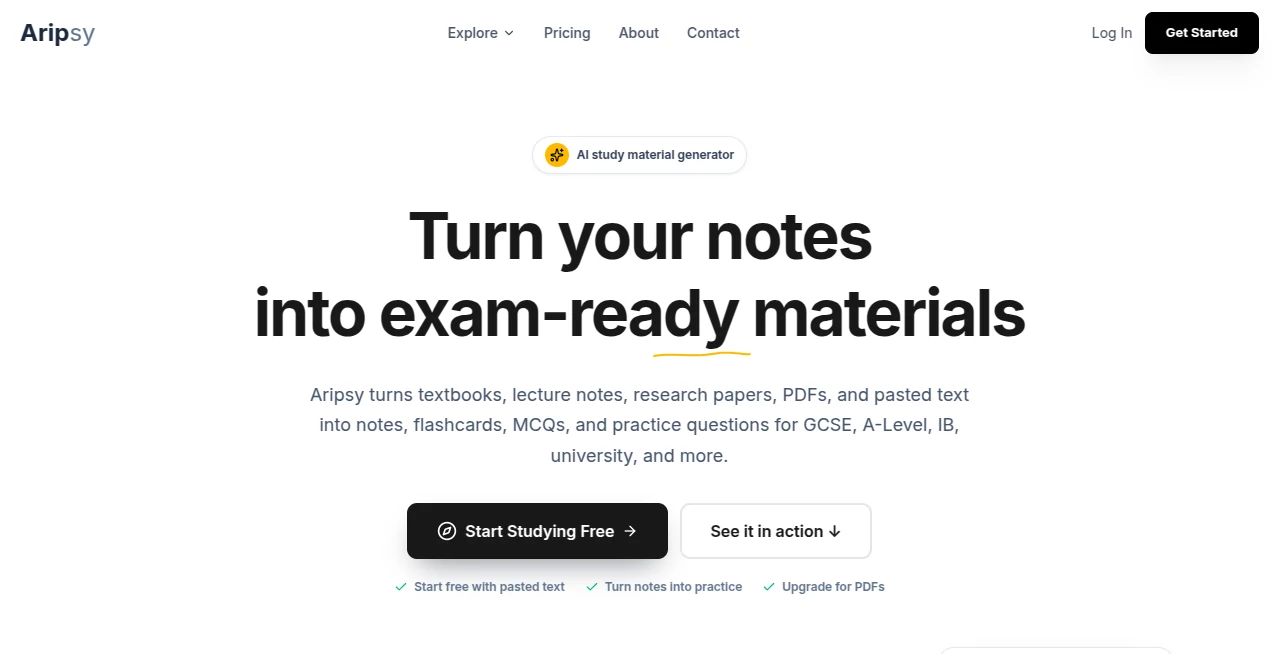
Studying often becomes difficult long before the actual exam. A textbook chapter can be hundreds of pages, lecture notes can be messy, and turning all that material into something useful for revision takes valuable time. Aripsy is designed to make that part of studying easier by turning textbooks, lecture notes, research papers, PDFs, and pasted text into structured study materials.
The platform focuses specifically on students rather than trying to be a general-purpose chatbot. Its workflow brings notes, flashcards, multiple-choice questions, practice questions, and other revision formats into one place. It supports learners preparing for GCSE, A-Level, IB, AP, SAT, university exams, and other academic subjects.
What makes the approach particularly practical is the emphasis on active recall. Instead of simply producing a summary and leaving the student with another document to read, the platform can turn study material into flashcards and practice questions that encourage students to test what they actually remember.
Key Features
- AI-generated structured study notes from pasted text and study material
- PDF processing for Pro users, including large study documents
- Automatic flashcard generation for active recall
- Multiple-choice question generation for targeted revision
- Practice questions for checking understanding
- Fill-in-the-blank exercises on the Pro plan
- Support for multiple subjects and academic levels
- Exam-focused study workflows for different curricula and exam boards
- Export options including PDF, Markdown, and Anki on the Pro plan
- Collections and sharing features for organizing study materials
User Interface
The interface is built around a straightforward study workflow. Students can provide their material, select relevant options such as subject or academic level, and then generate the type of revision material they need. The study tool also provides settings for subjects, levels, exam boards, output length, and focus.
This setup is useful when the goal is to get from raw material to something practical without jumping between several websites. A student preparing for an A-Level biology exam, for example, can start with a chapter or lecture note, create structured notes, and then use those notes to build flashcards or practice questions.
Accuracy & Performance
The platform is designed to extract important concepts, definitions, processes, and examples from supplied study material and organize them into revision-friendly formats. Its website also demonstrates processing long PDF-based study material and generating structured summaries.
Still, AI-generated educational content should not be treated as an unquestionable source. Important definitions, formulas, dates, case details, and scientific information should be checked against the original textbook, lecture material, or official curriculum. This is especially important before using generated content as the sole source for exam preparation.
Performance is most useful when the input is focused. Providing a specific chapter, lecture section, or topic can make the resulting material easier to review than feeding an entire subject into the system at once.
Capabilities
The strongest part of the platform is the way several study formats connect together. A student can begin with ordinary notes and turn them into a structured summary, then move toward flashcards and practice questions. This creates a more complete revision workflow instead of relying only on summarization.
PDF processing is another useful capability for students who work primarily with digital textbooks, lecture slides, research papers, or course handouts. Pro users can upload PDFs of up to 15MB, while the platform also promotes its ability to search and analyze very large study documents.
The system covers a broad selection of academic subjects, including biology, chemistry, physics, mathematics, history, geography, economics, business, psychology, computer science, and English literature. Its curriculum options also make it suitable for students following different educational systems.
Security & Privacy
Study materials can sometimes contain personal notes, unpublished academic work, or course documents, so privacy matters. The platform states that user content may be processed through AI providers required to deliver the service and that submitted content is not sold or used to train its own models.
Students should still avoid uploading sensitive information that is unrelated to studying and should review the service's privacy terms before using the platform with confidential academic or personal material.
Use Cases
One of the clearest uses is exam revision. A student can take a dense chapter and turn it into a shorter set of structured notes, making it easier to identify the concepts that deserve another review.
Flashcards are particularly useful for subjects containing terminology, definitions, formulas, processes, and key facts. Instead of manually creating every card, students can use their existing material as the starting point and then edit or verify the generated cards.
Practice questions are another practical option. Students can generate questions from their own material, answer them without looking at the source, and then return to the areas where their understanding is weaker.
The platform can also help university students organize lecture notes after class. For example, a psychology student could turn rough lecture notes into a cleaner revision summary before comparing the result with the original slides.
For subjects such as law, medicine, science, and business, the generated material can serve as a first revision layer. The original source should remain the authority for precise academic details.
Pros and Cons
Pros
- Designed specifically around student revision rather than general chat
- Combines notes, flashcards, quizzes, and practice materials in one workflow
- Supports multiple academic levels and examination systems
- Useful for turning long or messy study material into a clearer structure
- Free plan available without requiring a credit card to get started
- Pro plan includes PDF uploads and additional study formats
- Export options include Anki, PDF, and Markdown
- Can help students move from passive reading toward active recall
Cons
- AI-generated answers and study notes can contain mistakes
- PDF uploads are restricted to the Pro plan
- The free plan has a monthly generation limit
- Students still need to verify important information against their original sources
- Generated material works best as a study aid rather than a replacement for textbooks or teachers
Pricing Plans
The platform offers a free plan for students who want to try its study workflow without paying upfront. The Free plan provides 50 AI generations per month, supports notes, questions, and flashcards, and allows inputs of up to 5,000 words when logged in. PDF uploads, MCQs, and fill-in-the-blank exercises are not included in this tier.
The Pro plan costs $4.99 per month and is aimed at students who need more capacity and a broader set of revision tools. It includes 300 AI generations per month, PDF uploads up to 15MB, MCQs, fill-in-the-blanks, practice questions, and export options for Anki, PDF, and Markdown. It also includes unlimited collections and sharing.
For students who regularly work with PDFs or need more extensive practice material, the Pro plan provides considerably more flexibility than the free option.
How to Use the Tool
- Open the study tool and prepare the material you want to revise.
- Paste your study text or, with a Pro account, upload a suitable PDF.
- Select the subject and academic level when needed.
- Choose the relevant exam board or curriculum if applicable.
- Generate structured study notes from your material.
- Review the generated notes and compare important details with the original source.
- Turn the saved material into flashcards or practice questions.
- Use MCQs and other exercises to identify topics that need additional revision.
- Export your materials when you want to continue studying elsewhere.
Comparison with Similar Tools
Many AI study products concentrate on a single feature, such as summarization, flashcards, or question generation. This platform takes a broader approach by connecting these activities into one revision workflow.
Its biggest advantage is therefore not necessarily that it performs one task that no other tool can perform. Instead, it reduces the amount of switching between different study applications. A student can begin with a lecture note, create a structured version, generate recall material, and continue with practice questions from the same study workflow.
It is also more focused than a general AI assistant. Rather than starting with an open-ended conversation, the experience is organized around academic material, revision, exam preparation, and active recall. That specialization can make it a better fit for students who want a dedicated study environment.
Conclusion
For students who spend too much time organizing material instead of actually studying it, this platform offers a practical way to shorten that preparation stage. Its combination of AI notes, flashcards, quizzes, practice questions, and PDF processing creates a useful bridge between raw course material and active revision.
The strongest results are likely to come from using it as part of a larger study routine: generate a first set of materials, check important information against the original source, and then use flashcards and questions to test genuine understanding.
With a free entry point and an inexpensive Pro tier, it is also relatively easy for students to test whether an AI-assisted revision workflow fits their learning style. It does not replace textbooks, teachers, or careful study, but it can make the repetitive work of organizing revision material considerably easier.
Frequently Asked Questions (FAQ)
What is this tool used for?
It is an AI-powered study platform that helps students turn study material into structured notes, flashcards, quizzes, MCQs, and practice questions for exam preparation.
Is there a free plan?
Yes. The Free plan provides 50 AI generations per month and includes notes, questions, and flashcards. It does not include PDF uploads, MCQs, or fill-in-the-blank exercises.
Can students upload PDFs?
Yes, but PDF uploads are available on the Pro plan. Pro users can upload PDFs up to 15MB and use them to create structured study materials.
Which exams and curricula are supported?
The platform is designed for a wide range of academic levels and mentions GCSE, A-Level, IB, AP, SAT, university study, and multiple examination boards including AQA, Edexcel, Cambridge, OCR, and IGCSE.
Can it create flashcards?
Yes. Students can generate flashcards from their study material and use them for active recall and memorization.
Can it generate multiple-choice questions?
Yes. MCQ generation is included with the Pro plan and is designed to help students identify weaker areas and practise before an exam.
Is the AI output always accurate?
No AI-generated study material should be assumed to be perfect. Important information should be checked against the original textbook, lecture notes, syllabus, or another authoritative source.
How much does the Pro plan cost?
The Pro plan is listed at $4.99 per month and includes 300 AI generations per month, PDF uploads up to 15MB, additional practice formats, and export features.
Can generated materials be exported?
Yes. Pro users can export study materials to Anki, PDF, and Markdown, making it easier to continue studying outside the platform.
Who can benefit most from it?
It is particularly useful for GCSE, A-Level, IB, AP, SAT, university, and other students who regularly work with lecture notes, textbooks, PDFs, and exam-focused study material.
AI Summarizer , AI Education Assistant , Education , AI Quizzes .
These classifications represent its core capabilities and areas of application. For related tools, explore the linked categories above.

Aripsy Alternatives Product

Lexi4

Keepmind

Fillout.com

ieltswriting…

Twee

SkipBait

Image Descri…

Sovi.AI

Manus