Devisia s.r.l.
What is Devisia s.r.l.?
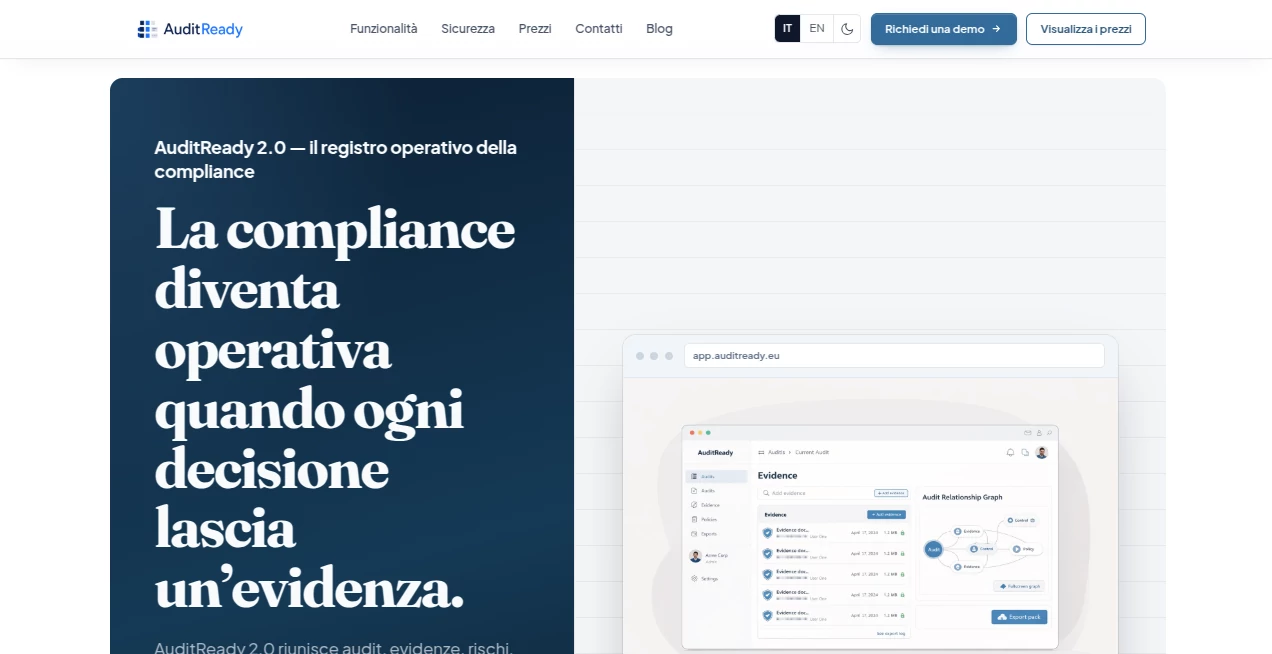
AuditReady is an operational compliance platform designed for teams that need to keep audits, controls, evidence, risks, incidents, privacy records, and governance activities connected in one place. Instead of treating compliance as a collection of folders, spreadsheets, emails, and disconnected documents, the platform creates a working record where responsibilities, deadlines, controls, and supporting evidence stay linked.
It is built for organizations working with frameworks such as GDPR, NIS2, DORA, the EU AI Act, and Italy's Modello 231. The approach is practical: teams can define their audit scope, assign ownership, collect evidence, track findings, manage risks, and prepare material for reviewers without rebuilding the entire picture every time an audit arrives.
That distinction matters. Compliance teams rarely struggle because they cannot create another document. The harder problem is knowing which evidence supports which control, who owns it, whether it is current, and what still needs attention. This platform addresses that operational gap.
Key Features
- Centralized audit and control management
- Structured evidence collection with references and status
- Supplier evidence requests through controlled upload links
- Risk registers with treatment and acceptance workflows
- Incident and findings management
- GDPR registers including RoPA, DPIA, DSAR, and privacy breaches
- Governance records, attestations, and ownership management
- Audit Day Pack and structured export capabilities
- Support for GDPR, NIS2, DORA, EU AI Act, and Modello 231 workflows
- Operational AI-system inventory and monitoring information
User Interface
The interface is organized around the operational context of compliance work rather than simply presenting a document repository. Audits, controls, evidence, owners, deadlines, findings, and related activity can be viewed as connected parts of the same record.
This is particularly useful for teams where several people contribute to the same compliance process. A compliance manager can see ownership and outstanding work, while IT, security, privacy, or operational teams can work against the controls and evidence relevant to them.
The supplier workflow is another practical touch. External parties can receive controlled upload links with expiration and status tracking, allowing evidence to be requested without giving every supplier access to the internal workspace.
Accuracy & Performance
For compliance software, useful performance is less about producing an impressive score and more about preserving accurate relationships between controls, evidence, responsibilities, and decisions. The platform takes this approach by keeping evidence tied to its context rather than treating uploaded files as isolated attachments.
Teams can identify missing or incomplete proof, connect evidence to controls, assign responsibility, and maintain status information as work progresses. Exports can then reflect the current state of the workspace instead of relying on manually assembled audit folders.
It is also important to understand what the platform does not claim to do. It does not certify an organization as compliant and does not replace legal advice or specialist consulting. Its value is in organizing the operational work that supports compliance and making that work easier to review.
Capabilities
The platform covers a broad range of compliance operations. Audit teams can connect scope, controls, assets, evidence, and ownership, while risk teams can maintain risk records, treatment plans, and residual risk information.
Incident workflows support real operational incidents as well as related compliance requirements, with classification, deadlines, owners, and remediation activities. Findings can be centralized so that severity, responsible people, action plans, and closure evidence remain visible together.
Privacy teams have dedicated workflows for records of processing activities, data protection impact assessments, data subject requests, and privacy breaches. Supplier management can also include ICT-related information such as audit rights, exit planning, subcontractors, and data location.
For organizations preparing for the EU AI Act, the platform can maintain an operational inventory of AI systems, including purpose, ownership, risk classification, requirements, monitoring, and supplier dependencies. That makes it more useful than a generic document folder when AI governance becomes an ongoing responsibility.
Security & Privacy
Security is closely tied to the way compliance evidence is handled. The platform uses tenant separation, protected documents, controlled access, and traceability for critical actions. Evidence can be managed with metadata, status, validation information, control relationships, and controlled downloads.
For organizations dealing with sensitive compliance material, this structure can make a meaningful difference. Instead of distributing important documents through email attachments and shared folders, teams can keep access and evidence relationships inside a controlled operational environment.
The platform also supports secure, expiring links for supplier evidence collection, reducing the need to provide external parties with broader access than they actually need.
Use Cases
GDPR compliance: Privacy teams can manage RoPA, DPIA, DSAR, breach records, evidence, controls, and related deadlines from a connected workspace.
NIS2 readiness: Security and compliance teams can organize controls, evidence, findings, incidents, risk information, and NIS2-related categorization while keeping the supporting records connected.
DORA preparation: Financial organizations can bring ICT risks, incidents, critical functions, resilience tests, suppliers, and supporting evidence into a common operational structure.
EU AI Act governance: Organizations developing or deploying AI systems can maintain an inventory and connect system information with ownership, risk classification, requirements, monitoring, and evidence.
Internal audits: Audit teams can define scope, assign controls and owners, collect supporting evidence, record findings, and prepare structured material for reviewers.
Consultancies and compliance partners: Organizations managing compliance work for multiple clients can use the multi-tenant partner configuration to maintain separate client environments while working from a centralized administration layer.
Modello 231 and OdV workflows: Italian organizations can manage 231-related compliance work and Supervisory Body activities within the same environment used for other frameworks.
Pros and Cons
Pros
- Connects audits, controls, evidence, owners, and deadlines instead of treating them as separate records.
- Supports several major European compliance frameworks.
- Useful evidence collection workflow for internal teams and suppliers.
- Includes structured exports and an Audit Day Pack for review preparation.
- Provides dedicated operational registers for risk, privacy, incidents, and findings.
- Can support organizations that need multiple frameworks in the same workspace.
- Offers an on-premise enterprise deployment option.
Cons
- The platform is focused on compliance operations, so organizations looking for a general-purpose project management system may find its scope more specialized.
- Pricing can become substantial when several full regulatory modules are combined.
- Organizations with complex existing compliance processes may need onboarding or data migration assistance.
- It supports compliance work but does not replace legal advice, consultants, or formal certification.
Pricing Plans
The pricing model is modular, allowing organizations to select the regulatory frameworks they actually need. GDPR Light starts at €99 per month, while the full GDPR module is €290 per month. NIS2 is €590 per month, the EU AI Act module is €490 per month, DORA is €690 per month, and Modello 231 with OdV workflows is €690 per month.
Additional frameworks can be added at a lower monthly add-on rate. The most expensive selected framework is charged at its standalone price, while additional modules use the corresponding add-on price. Annual billing provides 12 months of access for the price of 10 months.
GDPR Light includes five users and 5 GB of evidence storage, while full standalone modules include 15 users and 25 GB of evidence storage. Additional storage, user packs, assisted onboarding, data migration, and a multi-tenant partner platform are available for organizations with larger requirements.
Enterprise customers can also choose an on-premise deployment, with identity integration and professional services scoped according to the project.
How to Use the Platform
- Choose the compliance framework or combination of frameworks that matches your organization's obligations.
- Define the relevant audit scope and establish the controls that need to be monitored.
- Assign owners and responsibilities so every important control has a clear point of accountability.
- Collect evidence from internal teams and external suppliers using the appropriate evidence workflows.
- Review missing, incomplete, or outdated evidence and connect supporting files to the relevant controls.
- Record risks, incidents, findings, and remediation activities as they arise.
- Maintain the relevant operational registers for privacy, ICT risk, AI systems, or other framework-specific requirements.
- Use the available exports and Audit Day Pack when preparing material for auditors, stakeholders, or internal reviews.
Comparison with Similar Tools
Traditional compliance workflows often rely heavily on spreadsheets, shared drives, email threads, and manually assembled evidence folders. Those methods can work for small audits, but they become increasingly difficult to maintain when several frameworks, departments, suppliers, and deadlines are involved.
General project management software can organize tasks and deadlines, but it is not necessarily designed to preserve relationships between regulatory controls, evidence, findings, risk records, and audit outputs.
On the other hand, broad GRC platforms may cover a much wider governance landscape and can be appropriate for large enterprises with extensive governance programs. This platform takes a more focused operational approach, putting evidence, controls, audits, registers, and review-ready outputs at the center of the workflow.
A useful way to think about the difference is simple: if the recurring headache is finding the right evidence and explaining how it connects to a control, this approach is more directly aligned with that problem than a generic document management or task-tracking system.
Conclusion
Compliance becomes considerably easier to manage when the evidence behind every decision is connected to the people, controls, risks, and obligations that give it meaning. That is the strongest idea behind this platform.
Rather than promising an automatic compliance score or claiming to replace professional advice, it focuses on the operational side of the job: organizing evidence, managing controls, assigning ownership, tracking risks and findings, maintaining regulatory registers, and producing material that is easier to review.
For organizations dealing with GDPR, NIS2, DORA, the EU AI Act, or Modello 231, this can provide a much cleaner alternative to scattered spreadsheets, folders, and email attachments. The modular pricing also makes it possible to start with one framework and expand as regulatory requirements grow.
Frequently Asked Questions (FAQ)
What is this platform designed for?
It is designed for operational compliance work, including audits, controls, evidence collection, risk management, incidents, findings, privacy records, governance, and regulatory framework management.
Which compliance frameworks are supported?
The available modules cover GDPR, NIS2, DORA, the EU AI Act, and Modello 231 with OdV workflows.
Can suppliers submit evidence?
Yes. Suppliers and other external parties can receive controlled upload links with expiration and status tracking, allowing them to submit evidence without requiring a full internal account.
Does it certify compliance?
No. The platform does not certify compliance and does not replace legal advice or specialist consulting. It provides structure and traceability for the operational work behind compliance.
Can multiple frameworks be managed together?
Yes. Organizations can combine modules, and the shared platform model allows evidence and controls to support more than one regulatory obligation where appropriate.
Is there an enterprise deployment option?
Yes. An on-premise enterprise option is available for organizations that want deployment in their own data center or hosting environment, with identity integration and professional services scoped as part of the project.
Is annual billing available?
Yes. Annual billing provides 12 months of access for the price of 10 months, effectively including two months within the annual plan.
Who can benefit from using it?
Compliance, privacy, IT, security, operations, internal audit teams, and consultants can use the platform to coordinate evidence and compliance activities across departments and regulatory frameworks.
AI Workflow Management , AI Knowledge Management , AI Documents Assistant , AI Legal Assistant .
These classifications represent its core capabilities and areas of application. For related tools, explore the linked categories above.

Devisia s.r.l. Alternatives Product

The #1 Compa…

MacroMicro
TuCanChat

Plainpaper
LongTerMemory

onuml

Claude and C…

jpg to excel

Ryne AI