

















Plainpaper
Verified Blue CheckMark
Verified Blue CheckMark products are featured above free or unverified listings.
This badge indicates authenticity and builds trust, giving your product higher visibility across the platform.
Upgrade to get verified
Verified Blue CheckMark products are featured above free or unverified listings. This badge indicates authenticity and builds trust, giving your product higher visibility across the platform.
Upgrade to get verified
What is Plainpaper?
Marketing work often gets scattered across too many places. A campaign brief may live in a document, customer research in another tab, email drafts inside an AI chat, creative assets in a design tool, and performance results somewhere else entirely. This makes even a straightforward campaign harder to manage than it should be.
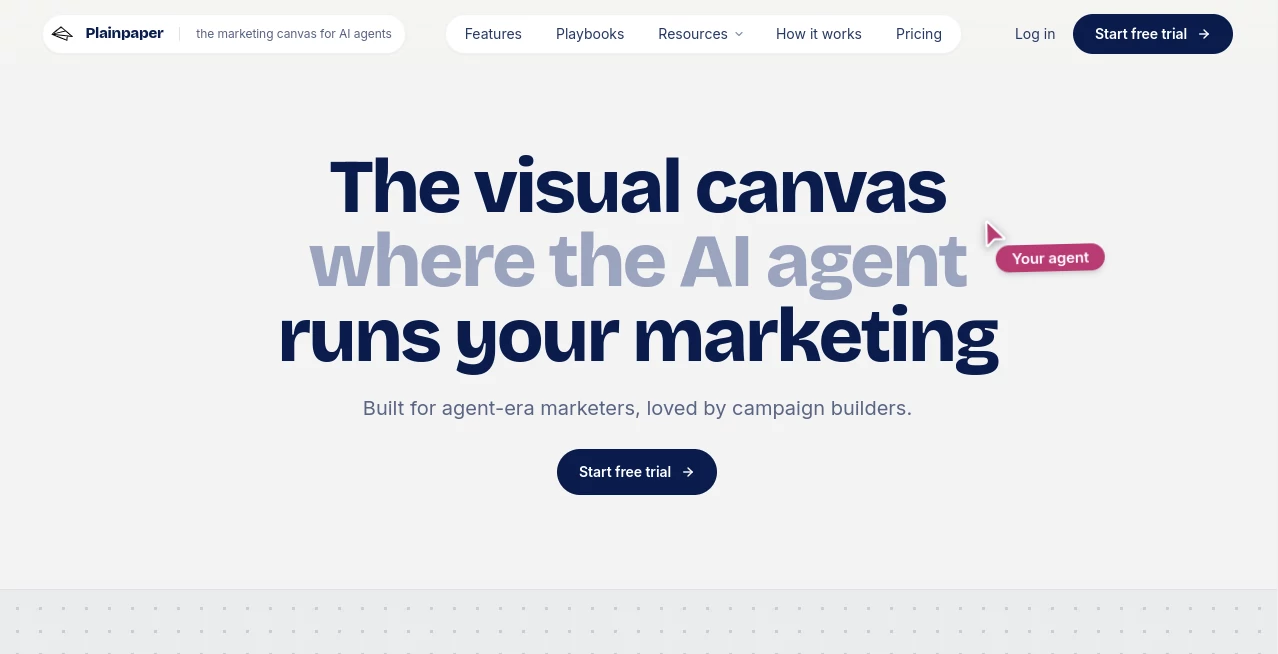
Plainpaper takes a different approach by putting the strategy, research, creative work, campaign assets, and results onto a visual canvas that can also be read and updated by AI agents. Instead of treating AI as a separate writing window, the platform gives the agent a structured workspace to work inside.
The platform is designed for marketers who already use tools such as Claude, ChatGPT, Cursor, Cowork, and other MCP-compatible clients. The AI agent can create research, briefs, emails, advertising concepts, and other campaign materials directly on the board while the marketer remains in control of what gets approved and published.
That combination makes the product particularly interesting for people running recurring campaigns. You can leave a project, return days later, and continue from the same board rather than reconstructing the entire context from an old conversation.
Key Features
- Visual marketing canvas for organizing campaign strategy and execution.
- Integration with Claude, ChatGPT, Cursor, Cowork, and other MCP clients.
- Structured cards for briefs, audiences, insights, plans, emails, creative assets, and results.
- Ready-made marketing playbooks for common campaign workflows.
- Approval workflow for emails and advertising creative before publication.
- Persistent campaign context outside an individual AI conversation.
- Support for HTML emails, images, video, and advertising creative.
- Brand voice, tone, and language rules for more consistent content.
- A built-in preset designed to reduce unwanted AI-style language.
- Campaign results can be connected back to the strategies that produced them.
- Unlimited sharing links and cards across plans.
- Version history and access to a playbook and template library.
User Interface
The interface is built around a visual board rather than a conventional text editor. Different pieces of campaign information appear as cards, making it easier to see how an audience, insight, strategy, and final asset relate to one another.
This structure is useful when a campaign becomes complicated. Instead of scrolling through a long conversation trying to remember why a particular email was written, the reasoning and deliverable can remain connected on the same board.
The experience also supports real-time activity from connected agents. Research, drafts, and other outputs can appear on the canvas as the agent works, giving the marketer a much clearer view of what is happening.
Accuracy & Performance
The platform does not position itself as a replacement for the underlying language model. Instead, it provides the workspace, structure, instructions, and campaign context around an AI agent. This distinction is important because the quality of generated material still depends on the connected model and the information supplied to it.
Where the platform can make a practical difference is in consistency. A campaign board can contain audience information, brand instructions, deliverable requirements, and previous decisions, giving the agent considerably more context than an isolated prompt.
For marketers working on multi-step campaigns, this can reduce repetitive prompting and make the workflow easier to continue from one session to another.
Capabilities
The platform goes beyond generating individual pieces of copy. It can support a complete campaign workflow, from research and positioning through content creation, approval, launch, and measurement.
Available playbooks cover areas such as ecommerce campaigns, email marketing, content calendars, lead generation, product launches, retention campaigns, competitor analysis, paid social testing, and content repurposing.
It also supports connections with marketing and creative ecosystems. Examples include workflows involving Shopify and Klaviyo, Brevo, ActiveCampaign, Mailchimp, Meta Ads, and Canva. The idea is to let the agent work with the tools already used by the marketing team rather than forcing the team into a completely separate stack.
Security & Privacy
One notable part of the architecture is that the platform states that it does not hold users' credentials for the external marketing tools. Instead, approved assets can be sent through the destination platforms' own tools.
It also does not wrap, resell, or proxy the underlying AI model. Users can bring their preferred AI agent and connect it through the supported MCP approach. This makes the service more of a campaign workspace and coordination layer than another closed AI model.
As with any service connected to business information and marketing systems, users should still review the provider's current privacy and security documentation before adding confidential campaign or customer information.
Use Cases
Email Marketing: Marketing teams can use a board to plan audiences, messaging, subject lines, email content, and campaign sequences before approving the finished material for their email platform.
Paid Advertising: Advertising teams can keep campaign strategy, audience insights, creative concepts, and finished ad assets together. This is especially useful when testing multiple creative variations.
Ecommerce Campaigns: Teams working with online stores can connect product and customer information to an agent-driven workflow and build campaigns around the available data.
Content Planning: A content team can establish monthly pillars, assign content ideas to individual slots, create the posts, and measure their results from the same campaign workspace.
Lead Generation: Marketers can build structured lead-generation campaigns, including giveaway campaigns and quiz funnels, while keeping the planning and resulting assets connected.
Marketing Agencies: Agencies can benefit from multiple workspaces and users, especially when each client needs a separate campaign environment.
Product Launches: Teams can move from positioning and proof to launch sequencing, creative production, and measurement without rebuilding the campaign context in several applications.
Pros and Cons
- Pros: Visual approach makes complex campaigns easier to understand.
- Pros: Works with several popular AI agents and MCP clients.
- Pros: Campaign context remains available outside an individual chat.
- Pros: Strong collection of ready-made marketing playbooks.
- Pros: Approval steps help keep humans involved before creative is published.
- Pros: Supports multiple types of marketing assets in one workspace.
- Cons: The service is primarily aimed at marketers rather than general-purpose users.
- Cons: Users still need a compatible AI agent to get the full benefit of the workflow.
- Cons: Higher plans are more relevant to teams and agencies than individual users.
Pricing Plans
Every plan includes the full feature set, and each plan begins with a 7-day free trial. The main differences are the number of workspaces, users, and boards available.
- Starter: €29 per month or €290 per year. Includes 1 workspace, 1 user, and up to 20 boards.
- Scale: €79 per month or €790 per year. Includes 5 workspaces, 10 users, and up to 30 boards per workspace.
- Business: €149 per month or €1,490 per year. Includes 15 workspaces, 25 users, and unlimited boards.
Annual billing provides a two-month saving compared with monthly pricing. All plans include features such as unlimited sharing links, unlimited cards, version history, the playbook and template library, agent access, deliverable types, and available tools. Prices exclude VAT, with applicable tax calculated at checkout.
How to Use the Platform
Getting started is relatively straightforward. First, connect your preferred AI agent. Depending on the environment, this can be done through an OAuth connection or by creating a workspace token and adding it to the relevant client.
Next, select a playbook or create a blank board. Give the agent direction about the campaign, and it can begin adding research, audience information, strategy, emails, and creative work to the board.
The final stage is review and approval. Finished assets can be inspected on the canvas before they are sent through the relevant marketing or creative tools. This keeps the marketer involved instead of allowing generated content to move directly from an AI prompt to publication.
Comparison with Similar Tools
Traditional whiteboards are excellent for brainstorming, but they often stop once the ideas have been organized. Conventional AI writing tools are useful for producing individual pieces of content, but they may not provide a persistent visual environment for an entire campaign.
This platform sits between those two approaches. Its canvas is designed specifically around marketing work, while its MCP connections allow an external AI agent to participate directly in the workflow.
The difference becomes clearer during a larger campaign. Instead of keeping strategy in one application, copy in an AI chat, creative in a design platform, and results in a reporting dashboard, the campaign board can act as the central layer connecting those pieces.
That does not necessarily make it a replacement for every marketing application. Rather, its strength is coordinating the work between them while preserving the context that explains how each deliverable was created.
Conclusion
For marketers experimenting with AI agents, the biggest challenge is often not generating another piece of content. It is giving the agent enough context to understand the campaign, keeping its work organized, and making sure a human can review the result before anything goes live.
This visual campaign workspace addresses that problem with a practical combination of structured boards, marketing playbooks, MCP connections, persistent context, and approval workflows. The result feels closer to a marketing operating environment than a standard AI writing assistant.
It is particularly compelling for marketers, agencies, and teams running repeated campaigns across email, advertising, ecommerce, content, and social channels. If your current workflow involves jumping between AI chats, documents, creative tools, and marketing platforms, bringing those pieces into one campaign-focused canvas can make the process considerably easier to follow.
Frequently Asked Questions (FAQ)
What is the main purpose of this platform?
Its main purpose is to give AI agents a structured visual workspace for planning, creating, reviewing, and measuring marketing campaigns.
Which AI agents can be connected?
The platform supports Claude, ChatGPT, Cursor, Cowork, and other MCP-compatible clients.
Does it generate marketing content?
Yes. A connected AI agent can create campaign research, briefs, emails, advertising creative, and other deliverables directly on the visual board.
Can marketers approve content before publication?
Yes. Emails and advertising creative can be reviewed and approved on the board before the connected agent publishes them through the appropriate external tools.
Is there a free trial?
Yes. All listed plans include a 7-day free trial, and the current signup flow states that no credit card is required at the start of the trial.