
Awesome Indie
What is Awesome Indie?
Awesome Indie is a curated launch board and discovery platform built around indie makers, solo founders, and small teams. Instead of browsing a huge marketplace where new products can easily disappear, visitors can explore products launching today and see which ones are getting attention from the community.
The platform gives independent creators a straightforward place to introduce what they have built, while giving curious users a practical way to discover new software, startups, developer tools, AI products, and side projects. Products can be explored through daily, weekly, monthly, and yearly rankings, making it useful both for finding something new and keeping track of products that continue to gain traction.
For an independent founder preparing a launch, the appeal is particularly clear: getting listed is free, accepted products receive a launch day, and the listing can continue to provide visibility beyond the initial launch.
Key Features
- Daily launch board for newly submitted indie products
- Community-driven upvotes, comments, and rankings
- Daily, weekly, monthly, and yearly product views
- Dedicated product pages for accepted submissions
- Maker profiles for independent founders and creators
- Categories covering areas such as AI, productivity, marketing, development, design, video, education, and more
- Leaderboard and community discovery features
- Weekly newsletter highlighting products that performed well
- RSS and sitemap exposure for listed products
- Optional paid features for choosing a launch date or promotional placement
User Interface
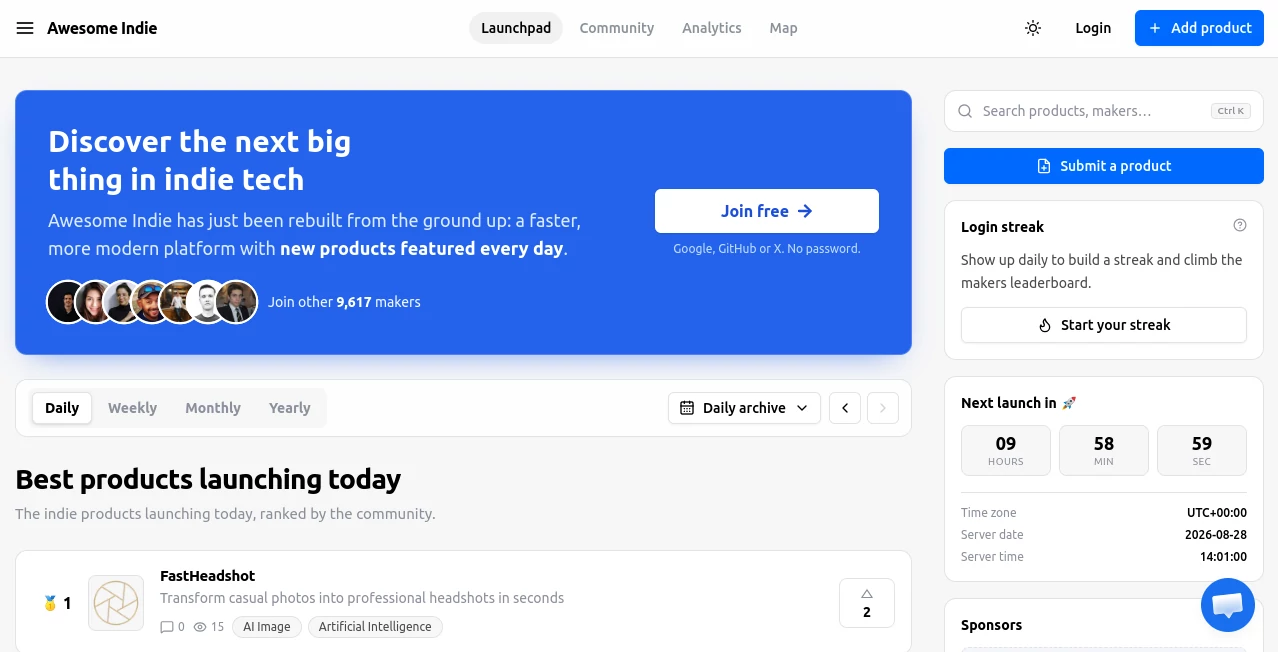
The interface is intentionally focused on discovery rather than complicated dashboards. The homepage puts newly launched products front and center, showing their position, short description, category, and community activity. Visitors can move between daily, weekly, monthly, and yearly views without having to learn a complicated navigation system.
Category browsing is another useful part of the experience. Someone looking specifically for AI products, developer tools, productivity software, or design projects can narrow the discovery process instead of scrolling through unrelated launches.
Accuracy & Performance
The platform is designed around a relatively simple principle: products are submitted, reviewed, published when accepted, and then ranked according to community engagement and the site's ranking system. The service states that submissions are checked to ensure the product was actually built by the submitter, that the product link works, and that the listing accurately describes what is being submitted.
This approach creates a useful balance between an open launch platform and a curated directory. It does not claim to independently verify every product or every marketing statement, so visitors should still evaluate a product themselves before purchasing or installing it.
Capabilities
The platform covers more than simple product listings. Makers can maintain profiles, collect upvotes, receive comments, participate in rankings, and build a public history around the products they create.
For visitors, the combination of categories, rankings, product pages, community activity, and the weekly roundup makes product discovery easier. A founder can also use the platform as a lightweight launch campaign rather than treating it as just another directory submission.
Security & Privacy
Account access is handled through third-party sign-in providers rather than a traditional password system. The privacy policy explains that information such as email addresses and session details are handled separately from publicly visible profile and product information.
Because submitted products and maker profiles are public by design, creators should avoid publishing information they do not want exposed. The service also uses technical measures such as session information, request logs, and device identifiers for security, moderation, and usage measurement.
Use Cases
One of the strongest use cases is launching a new indie product. A solo founder can submit a web application, mobile application, SaaS product, developer tool, API, browser extension, or another genuinely usable software project and use the launch day to attract early visitors.
It is also useful for product discovery. Developers looking for small tools, founders researching competitors, investors watching emerging projects, and early adopters searching for unusual software can browse the rankings and categories to find products that may not yet have mainstream visibility.
Another practical use is launch preparation. A maker can use an initial launch to see which description, screenshot, or positioning attracts attention, then apply those lessons to other launch channels. This makes the platform more interesting than a static directory where a submission simply disappears after publication.
Pros and Cons
- Pros: Free product submissions, focused indie community, daily launch visibility, community voting, multiple ranking periods, maker profiles, category discovery, and a weekly product newsletter.
- Pros: Accepted products receive a defined launch day, which makes it easier for founders to plan announcements and outreach.
- Pros: The platform is particularly suitable for solo founders and small teams rather than large corporate product launches.
- Cons: The audience is considerably smaller than the largest mainstream product-launch platforms.
- Cons: Being listed does not guarantee traffic, conversions, sales, or positive community engagement.
- Cons: The directory does not independently verify every product claim, so users still need to do their own research.
Pricing Plans
Submitting a product and receiving a launch listing are available for free. The platform also offers optional paid extras for makers who want additional control over promotion. One option allows a founder to choose a specific launch date, while another provides sponsored sidebar exposure.
The free option is particularly attractive for small teams because there is no requirement to purchase a package simply to get listed. Paid features are better viewed as optional promotional tools rather than requirements for participating in the launch system.
How to Use Awesome Indie
Start by creating an account and preparing the product you want to submit. The product should have a working public page that clearly explains what it does. During submission, information such as the product name, tagline, description, categories, screenshots, and maker details can be provided.
The platform can use information from the product page to help prepare the initial listing, while the maker can edit the submitted information before it becomes public. Once the submission passes review, the product receives its launch placement and becomes available for community interaction.
After launch, the most useful step is to actively share the listing with people who may genuinely care about the product. Upvotes and engagement influence visibility, while comments can provide useful feedback from people seeing the product for the first time.
Comparison with Similar Tools
Compared with larger launch communities, this platform takes a more focused approach to indie products. Its main strength is predictability: accepted products receive a launch day rather than depending on a second editorial decision about whether they deserve homepage exposure.
Compared with a traditional software directory, it is also more community-oriented. Products are not simply stored in a database; they can receive votes, comments, rankings, and ongoing visibility across different time periods.
For founders, the best strategy may not be choosing one launch platform exclusively. A smaller indie-focused launch can serve as an early test of messaging and audience response before pursuing a larger launch elsewhere.
Conclusion
For independent makers and small teams, Awesome Indie offers a practical way to put a new product in front of people who actively enjoy discovering what other builders are creating. Its combination of launch listings, community engagement, rankings, categories, maker profiles, and newsletter exposure gives a new project several opportunities to be discovered.
It is not a replacement for a complete marketing strategy, and a listing alone will not guarantee meaningful traffic. Its real value comes when a founder treats the launch as part of a wider campaign: prepare the product page carefully, bring an interested audience to the launch, listen to feedback, and continue improving the product after launch day.
For anyone building independently, that is a useful combination. The barrier to entry is low, the free launch option removes much of the risk, and the community-driven format can give smaller products a chance to compete for attention alongside other indie projects.
Frequently Asked Questions (FAQ)
Is submitting a product free?
Yes. Product submission, accepted launch listings, maker profiles, and several standard launch features are available without a submission fee. Optional paid features are available for additional promotional control.
What type of products can be submitted?
The platform focuses on software created by independent makers, solo founders, and small teams. Web apps, mobile apps, developer tools, extensions, APIs, SaaS products, and genuinely usable side projects can qualify.
Can founders choose their launch date?
The standard launch process provides an assigned date. An optional paid feature is available for makers who need to choose a specific launch date for their campaign.
How are products ranked?
Community engagement plays an important role in rankings. Products can be viewed through daily, weekly, monthly, and yearly rankings, giving successful launches opportunities to remain discoverable after their initial day.
Does getting listed guarantee traffic?
No. A listing creates an opportunity for discovery, but traffic and conversions depend on the product, its presentation, the audience brought to the launch, and the amount of community engagement it receives.
Can a product be edited after submission?
Yes. Makers can edit their product information during the submission process and after acceptance. The platform allows creators to keep their listing information up to date.
Is it useful for AI products?
Yes. AI is one of the categories available for browsing, alongside areas such as AI Image, AI Writing, AI Video, developer tools, productivity, marketing, and other software categories.
These classifications represent its core capabilities and areas of application. For related tools, explore the linked categories above.

Awesome Indie Alternatives Product

saasgrow.ai

Digitool

SubmitMap

Geekflare AI

Yes No Oracle

FavTool

ToolPilot AI

TonesMatch

JustHunt