
BioSkepsis
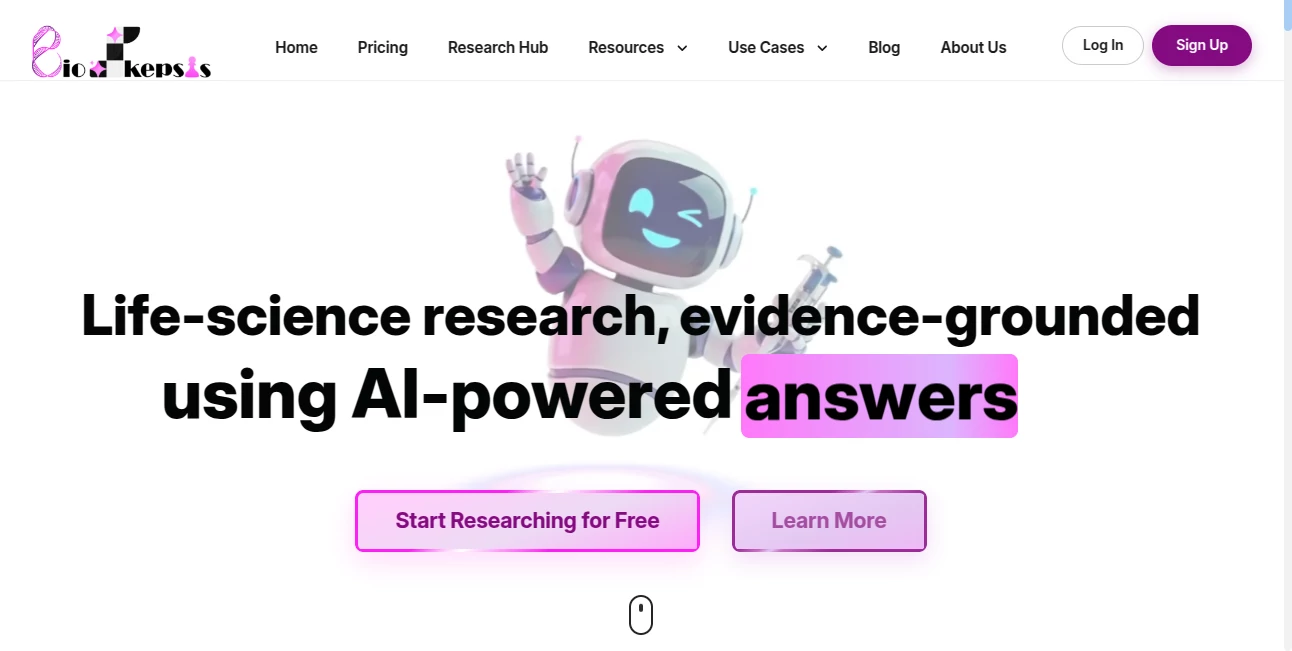
What is BioSkepsis?
BioSkepsis is an AI-powered research assistant designed for scientists, researchers, students, and professionals working in biology, medicine, biotechnology, and related life-science fields. It helps users discover, understand, and analyze scientific literature by combining semantic search, knowledge graphs, and evidence-based AI reasoning.
Instead of providing simple summaries based only on keywords, this platform focuses on connecting biological concepts, research papers, experimental results, and scientific evidence. It is built to support workflows such as literature reviews, hypothesis development, grant preparation, and research planning by transforming millions of scientific publications into practical insights.
With access to a large collection of curated biomedical papers and a system designed around biological context, researchers can spend less time manually searching through publications and more time focusing on meaningful discoveries.
Key Features
User Interface
The interface is designed around a research-focused workflow rather than a traditional search engine experience. Users can ask scientific questions in natural language and receive structured answers supported by relevant literature. The guided research approach makes it accessible for newcomers while still offering advanced controls for experienced researchers.
The clean workspace allows users to explore papers, follow evidence trails, organize findings, and continue conversations around specific research topics. Researchers can move from a broad question to detailed scientific analysis without constantly switching between multiple databases and tools.
Accuracy & Performance
Accuracy is a core focus of the platform. The system uses biology-specific knowledge connections to identify relevant studies based on scientific meaning rather than simple text matching. This allows researchers to discover relationships between genes, pathways, diseases, mechanisms, and experimental findings.
The platform analyzes full-text research materials instead of relying only on abstracts, helping preserve important details such as methods, controls, limitations, and experimental context. Each answer is designed to remain connected to traceable scientific evidence.
Capabilities
- AI-powered biomedical literature search across millions of scientific papers
- Evidence-grounded answers with citation support
- Research question refinement and guided discovery
- Full-text paper analysis beyond abstract-level summaries
- Biology-native knowledge graph connections
- Literature review assistance
- Scientific hypothesis and methodology generation
- Research trend detection and personalized feeds
- Integration with personal research collections through reference management workflows
- Laboratory result interpretation using published evidence
Security & Privacy
Scientific research often involves sensitive workflows and valuable intellectual information. The platform is designed with research privacy in mind, allowing users to work with their scientific materials while maintaining control over their research sessions and resources.
Researchers can securely manage their collections, organize findings, and share research sessions with collaborators when needed. The focus remains on providing reliable scientific assistance without compromising the integrity of research processes.
Use Cases
This tool can support a wide range of professional and academic activities across life sciences. Researchers can use it to accelerate literature reviews, identify important papers, explore mechanisms, and prepare stronger scientific arguments.
- Academic Research: Students and researchers can quickly understand complex topics and build structured knowledge around new fields.
- Drug Discovery: Scientists can explore biological mechanisms, therapeutic targets, and emerging research directions.
- Grant Writing: Research teams can collect supporting evidence and strengthen proposals with relevant scientific findings.
- Biotechnology: Companies can analyze scientific landscapes and identify opportunities in developing technologies.
- Healthcare Research: Professionals can review evidence and compare findings across medical studies.
- Thesis Preparation: Graduate students can organize information and discover important connections between publications.
Pros and Cons
Pros
- Designed specifically for biology and biomedical research
- Provides evidence-supported scientific answers
- Analyzes full research papers instead of only abstracts
- Helps reduce time spent on manual literature searches
- Useful for both beginners and experienced researchers
- Supports complex scientific questions and follow-up analysis
Cons
- Best suited for life-science fields rather than general research topics
- Advanced features may require a paid subscription
- Users still need scientific expertise to interpret complex findings
Pricing Plans
The platform offers multiple pricing options designed for different types of users. A free plan is available for students and curious researchers who want to explore AI-assisted biomedical research workflows.
- Basic: Free plan with access to scientific search, research exploration features, knowledge graphs, and limited monthly research usage.
- Plus: Designed for Master's and PhD students who need higher usage limits and additional research capabilities.
- Pro: Built for PhD candidates, postdoctoral researchers, principal investigators, and healthcare professionals requiring deeper analysis.
- Team: Suitable for research groups and organizations that need collaborative workflows.
- Organization: Enterprise solutions for institutions requiring advanced deployment options.
How to Use BioSkepsis
Getting started is simple. Users can enter a research question using everyday scientific language, and the system helps refine the query before searching through relevant literature.
- Create a research session and enter a scientific question.
- Allow the AI system to identify relevant concepts and research directions.
- Review connected papers, evidence, and scientific explanations.
- Ask follow-up questions to explore mechanisms or compare findings.
- Save useful discoveries and organize research insights for future work.
Comparison with Similar Tools
Many AI research assistants focus on general academic searching, but this platform is specifically optimized for biological and biomedical research. Its advantage comes from combining literature discovery with biological context, allowing researchers to explore relationships between scientific concepts rather than simply matching keywords.
Compared with traditional academic search methods, it reduces the manual effort required to find, filter, and interpret relevant studies. Compared with general AI chat assistants, it provides a more research-focused experience with stronger emphasis on evidence tracking and scientific relevance.
Conclusion
For researchers working in biology, medicine, and biotechnology, having access to reliable scientific information is essential. This AI research assistant provides a practical way to explore complex topics, analyze publications, and connect scientific evidence faster.
By combining advanced AI reasoning with biomedical knowledge structures, it helps researchers move from questions to insights more efficiently. Whether preparing a thesis, exploring a new research area, or supporting professional scientific decisions, it offers a powerful companion for modern life-science workflows.
Frequently Asked Questions (FAQ)
What type of research does this tool support?
It is designed for biology, medicine, biotechnology, pharmaceutical research, agricultural science, environmental science, and other life-science disciplines.
Can it help with literature reviews?
Yes. It can discover relevant studies, organize scientific information, and help researchers understand connections between different publications.
Does it analyze complete research papers?
Yes. The platform focuses on full-context analysis, helping preserve important details such as methods, findings, and limitations.
Is there a free version available?
Yes. Users can start with a free plan that provides access to core research features before upgrading to advanced plans.
Who can benefit from using this platform?
Students, researchers, scientists, healthcare professionals, biotechnology teams, and organizations involved in scientific discovery can benefit from its capabilities.
AI Knowledge Management , AI Research Tool , Education , AI Knowledge Base .
These classifications represent its core capabilities and areas of application. For related tools, explore the linked categories above.

BioSkepsis Alternatives Product

Best of AI

Odysseus AI
ZoraInsights

YTVidHub-you…

Sourcetable

Metric Conve…

Where Is Thi…

IntoTheBlock

Schema Synth