BotsDontSleep
What is BotsDontSleep?
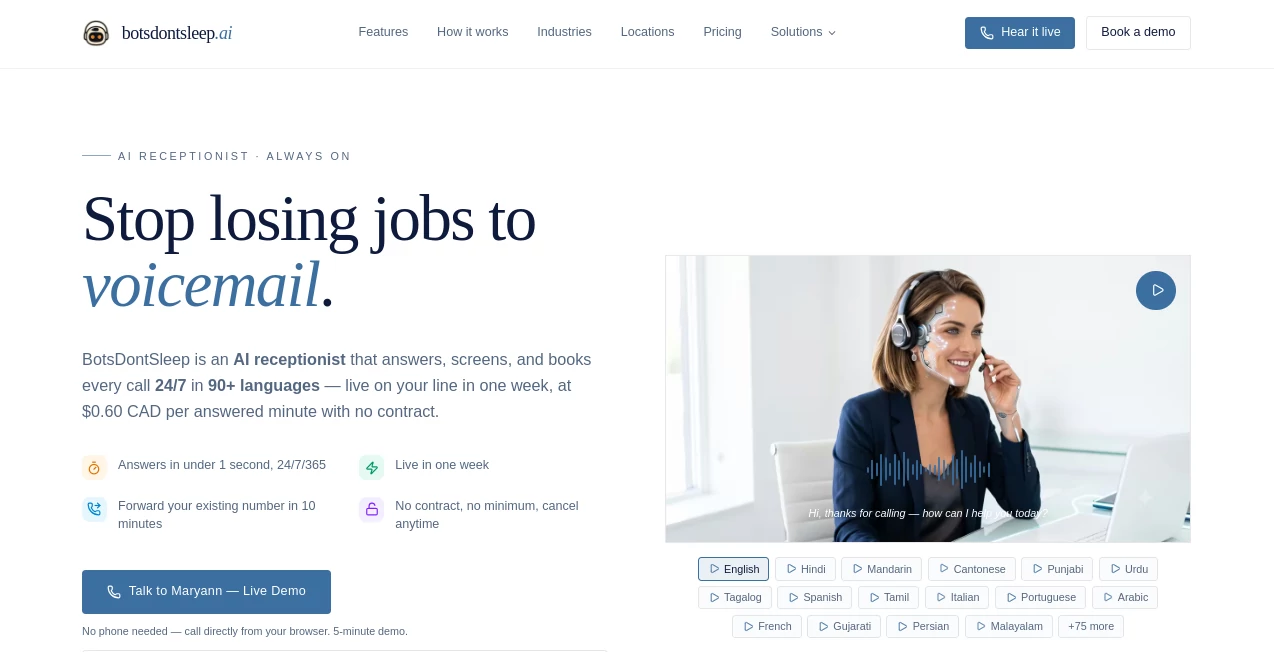
Missing a phone call can mean missing a customer. For a busy clinic, law firm, auto shop, contractor, or service business, the problem becomes even more obvious after business hours, when weekends get busy, or when the entire team is already dealing with customers. BotsDontSleep is an AI receptionist designed to keep business phone lines covered around the clock, answering incoming calls, screening callers, handling common questions, and booking appointments without requiring a full-time receptionist.
The idea is refreshingly practical. Instead of forcing callers through a long phone menu or asking them to leave a voicemail, the system holds an actual conversation. It can collect information, understand the reason for the call, check availability, and pass important situations to a member of the team. For businesses where every inbound call could become a job, appointment, or new client, that makes it a particularly useful addition to the front desk.
The service is built and tuned around each business rather than being presented as a generic script. The team maps existing call flows, job types, questions, and escalation rules before launching the receptionist. Simple single-location setups can be ready in about a day, while most businesses are live within a week.
Key Features
- 24/7 answering for incoming business calls
- Call answering in under one second
- Support for more than 90 languages
- Appointment and job booking directly into connected calendars and business systems
- Caller screening based on business-specific intake questions
- Intelligent transfers with spoken and written context
- After-hours, weekend, and holiday coverage
- Call transcripts, summaries, and outcome scoring
- Custom escalation rules for different types of callers
- Integrations with services such as Google Calendar, Outlook, Jobber, ServiceTitan, Housecall Pro, HubSpot, and Salesforce
- No setup fee, contract, monthly minimum, or per-seat charge
User Interface
The experience is intentionally centered on the phone rather than another complicated interface that employees have to learn. Customers simply call the existing business number, while the business team can review conversations, transcripts, summaries, and outcomes through a private dashboard.
The setup process is also designed to keep the business involved. The team first learns how calls are currently handled, then tunes the receptionist around the company's services and tone. Sample conversations can be reviewed before the system begins answering real customer calls. This gives owners an opportunity to correct awkward wording or adjust an escalation rule before launch.
Accuracy & Performance
Speed matters on a business phone line, and the service states that calls are answered in under one second. The receptionist is available 24/7 and can handle multiple inbound calls simultaneously, which is particularly useful during busy periods when a small team might otherwise send callers straight to voicemail.
Performance is not treated as a set-and-forget feature. Calls are transcribed and scored, allowing problematic conversations to be identified and the agent to be retuned. When the system does not have enough information to answer a question, it is designed to avoid inventing an answer and can instead take a message or escalate according to the business's rules.
Capabilities
The strongest part of the service is its ability to perform actual receptionist work rather than simply answering frequently asked questions. It can ask intake questions, identify job type and urgency, collect relevant details, check scheduling availability, and book appointments.
For example, an automotive business can have the receptionist collect a vehicle's year, make, and description of the problem before booking a drop-off. A professional services company can ask what type of service a caller needs and schedule an introductory conversation. The same approach can be adapted for medical, dental, legal, property management, home-service, and other businesses.
Multilingual conversations are another notable capability. The system supports more than 90 languages and can handle code-switching, meaning a caller can naturally move between languages during a conversation instead of being forced to select a language from a rigid menu.
Security & Privacy
Confidentiality is treated as an important part of the service. Call transcripts are encrypted at rest, access is limited to the appropriate business team, and retention periods can be controlled by the customer. The company also states that customer data is not sold and call content is not used to train models for other clients.
The system also gives businesses control over when a human should become involved. Escalation rules can determine which calls should be transferred, who should receive them, and which situations the receptionist should never handle alone. When a transfer occurs, the receiving employee can get a summary of the conversation first, reducing the need for the caller to repeat the same information.
Use Cases
Home services: Plumbers, HVAC companies, cleaners, contractors, and other service providers can capture calls while technicians are working on-site. The receptionist can collect the job type, location, urgency, and other details before booking or routing the request.
Medical and dental practices: Clinics can use an always-on receptionist to handle appointment requests, basic questions, and intake before escalating situations that require staff attention.
Legal practices: Law firms can screen incoming enquiries, collect information about the caller's needs, and route appropriate prospects to the right person.
Automotive businesses: Repair shops can collect vehicle information and problem descriptions, handle after-hours enquiries, and schedule service appointments without requiring someone to answer every call manually.
Professional services: Consulting firms, appraisal companies, and similar businesses can use structured intake questions to identify suitable enquiries and schedule consultations.
Multilingual businesses: Companies serving diverse communities can provide phone support in more than 90 languages without hiring separate reception staff for every language.
Pros and Cons
Pros
- Answers calls 24/7, including evenings, weekends, and holidays.
- Can book directly into calendars and supported business systems.
- Supports more than 90 languages and natural code-switching.
- Custom-tuned for the business rather than relying on a generic script.
- Can transfer calls to humans with useful context.
- Provides transcripts, summaries, and call outcomes.
- No setup fee, contract, monthly minimum, or per-seat pricing.
- Existing phone numbers can be forwarded or ported.
Cons
- The service is primarily designed for businesses that depend heavily on inbound phone calls.
- Businesses with unusual workflows may require additional customization.
- Usage-based pricing means monthly costs increase as answered call volume increases.
- Human escalation is still necessary for sensitive or highly specialized situations.
Pricing Plans
The pricing model is straightforward rather than being divided into several complicated subscription tiers. Setup costs $0, and answered calls are billed at $0.60 CAD per minute. There is no contract, monthly minimum, per-seat fee, or per-line fee.
Billing is based on answered call time, down to the second. That makes the model especially interesting for smaller businesses that may have inconsistent call volumes because a quiet month does not require paying for unused receptionist seats or a large fixed subscription.
Onboarding, tuning, and integrations are included. Before the system handles real calls, businesses can review test conversations and establish the rules for transfers and escalation.
How to Use the AI Receptionist
Getting started is relatively simple. First, the business discusses its current phone process, services, common questions, job types, and situations that should be transferred to a person. The implementation team then tunes the receptionist around those requirements.
Next, the business reviews sample calls and transcripts. This stage is useful for catching small details that may matter in real conversations, such as how a particular service is described or which questions should be asked before an appointment is offered.
Once everything is approved, the existing phone number can be forwarded or ported to the service. The receptionist then begins answering incoming calls, booking appointments, collecting information, and escalating calls according to the rules that were established during setup.
After launch, businesses can continue reviewing conversations and outcomes. If a particular question is not being handled correctly or a routing rule needs changing, the agent can be tuned accordingly.
Comparison with Similar Tools
Traditional voicemail is inexpensive, but it mainly records messages and leaves the follow-up to the business. A human answering service provides a more personal experience, but it can involve higher per-minute costs, staffing limitations, and more conventional message-taking workflows.
A traditional phone tree has another limitation: it gives callers predetermined options rather than allowing them to explain what they actually need. That can work for simple routing, but it becomes frustrating when a caller's request does not fit neatly into a menu.
An AI receptionist takes a different approach. It can have a conversation, collect information, answer configured questions, book appointments, and route callers based on context. For a business that receives a steady stream of calls, that combination can be more useful than simply recording messages.
The most important distinction is customization. Rather than treating every company as if it has the same call flow, the service is tuned around individual intake questions, services, calendars, tone, and escalation requirements.
Conclusion
A missed call is easy to overlook until it becomes a missed appointment, lost job, or customer who chooses a competitor. This AI receptionist addresses that very specific business problem with a practical combination of always-on call answering, appointment booking, multilingual conversations, call screening, and human escalation.
Its pay-per-minute pricing also makes the service accessible to businesses that may not want another large monthly software subscription. The ability to start without a setup fee or long-term contract removes much of the commitment normally associated with adding a new business phone system.
For companies where the phone remains an important source of new customers, the biggest attraction is simple: the phone can keep being answered even when nobody on the team has time to pick it up.
Frequently Asked Questions (FAQ)
What is an AI receptionist?
An AI receptionist is a voice-based assistant that answers incoming business calls, speaks with customers, collects information, answers configured questions, books appointments, and transfers calls to staff when necessary.
How many languages are supported?
The service supports more than 90 languages and can handle multilingual conversations where callers switch languages during the same call.
Can it book appointments?
Yes. It can read availability and book appointments into supported calendars and business management systems, including Google Calendar, Outlook, and several industry-specific platforms.
Can it transfer calls to a human?
Yes. Businesses can define transfer rules based on factors such as intent, urgency, caller type, and time of day. The system can provide a summary before the employee takes over.
Does it work after business hours?
Yes. The receptionist operates 24/7, including nights, weekends, and holidays.
Does it require a new phone number?
No. Businesses can forward their existing number or port it to the service. The existing number and caller experience can remain in place.
How much does it cost?
There is no setup fee. Answered calls are charged at $0.60 CAD per minute, with no contract, monthly minimum, per-seat fee, or per-line fee.
What happens if the AI does not know an answer?
It is designed not to invent information. When a question falls outside its configured knowledge, it can take a message or escalate the call according to the business's predefined rules.
How quickly can a business go live?
Simple single-location deployments can be ready in about 24 hours, while most businesses can go live within one week after the discovery, tuning, and review process.
Are calls and transcripts protected?
The service states that transcripts are encrypted at rest, access is scoped to the business team, and retention windows can be configured by the customer.
AI Scheduling , AI Customer Service Assistant , AI Voice Assistants .
These classifications represent its core capabilities and areas of application. For related tools, explore the linked categories above.
BotsDontSleep details
Website unavailable — View Alternatives
Pricing
- Freemium
Apps
- Web App
Categories

BotsDontSleep Alternatives Product

Omni Voice

Tinylawn

Elispeak

Klyra AI

Reloq

Supawazap

Motion

Weblo AI

Gemini Omni …