
















Built2WinWeb
What is Built2WinWeb?
Building a business website should not mean getting locked into a monthly page builder, a pile of plugins, or a template that looks like hundreds of other sites. BuiltToWinWeb takes a different approach by combining hand-coded website development with tools designed around modern search and AI-agent accessibility.
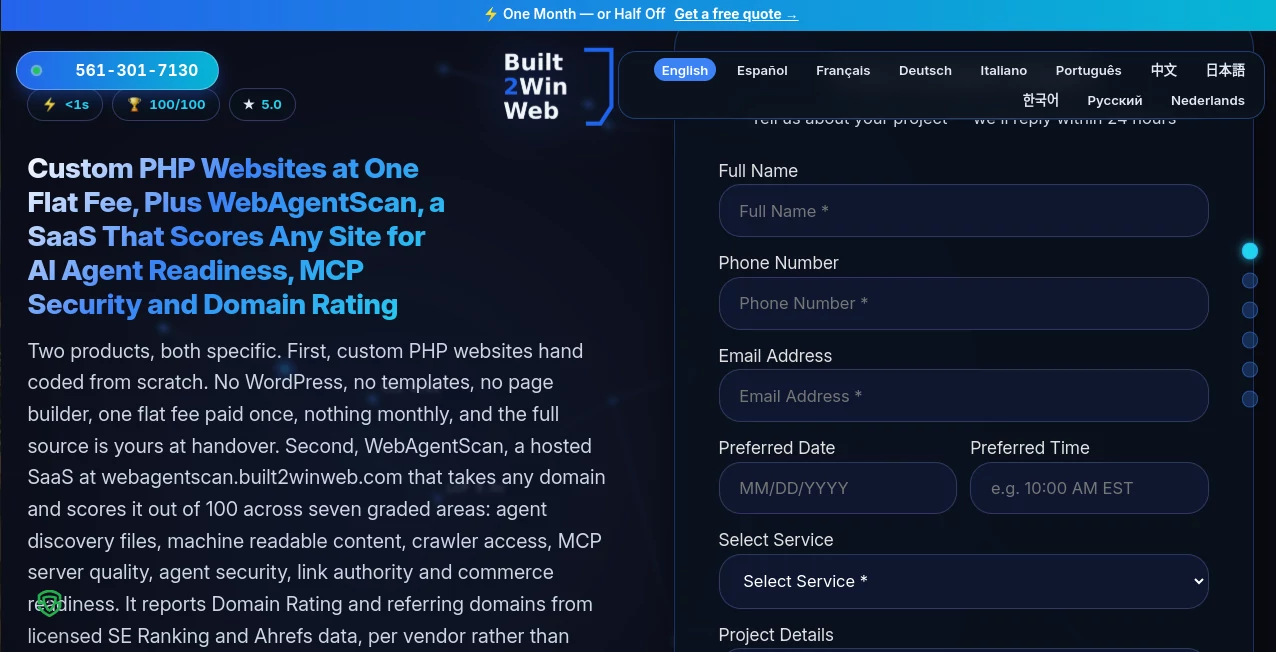
The core service focuses on custom PHP websites created from scratch, without WordPress, templates, or page-builder dependencies. The company also offers WebAgentScan, a hosted SaaS product that evaluates websites for AI agent readiness, machine-readable content, crawler access, MCP quality and security, link authority, and commerce readiness.
For businesses that care about speed, ownership, technical flexibility, and visibility in an increasingly AI-driven web, this combination makes the platform particularly interesting. Its portfolio also shows websites built for industries ranging from law firms and healthcare providers to ecommerce stores, restaurants, consultants, and professional services.
Key Features
- Custom PHP development: Websites are hand-coded rather than assembled from WordPress themes or visual page builders.
- One-time website pricing: Business websites are offered with a flat-fee model rather than an ongoing platform subscription.
- AI-agent readiness: WebAgentScan evaluates websites across several technical areas that affect how AI agents can discover, understand, and interact with online content.
- MCP security analysis: The scanner includes an assessment of MCP server quality and security alongside other website metrics.
- Machine-readable content: Website builds can include technologies such as llms.txt, agents.txt, Markdown served to agents, and a live MCP server.
- SEO-focused development: The service places considerable attention on page structure, internal linking, metadata, image alt text, topical authority, and technical performance.
- Performance optimization: The showcased portfolio reports an average PageSpeed score of 98, with individual projects reaching scores as high as 100.
- Industry-specific development: Existing projects cover business, ecommerce, restaurant, portfolio, and SaaS/application websites.
User Interface
The public-facing experience is straightforward and geared toward business owners rather than developers. Visitors can review completed projects, explore services by industry, request a custom quote, and learn how the development approach works.
WebAgentScan follows a similarly practical idea. Instead of presenting a complicated technical dashboard as the starting point, it reduces website readiness into a score out of 100 and breaks the assessment into individual areas. That makes the results easier to understand when deciding what needs improvement.
The portfolio is another strong part of the experience. Real examples show the type of website produced, the technologies involved, and the performance score achieved. For someone considering a custom build, seeing actual projects is much more useful than simply reading a list of promises.
Accuracy & Performance
Performance is clearly one of the strongest priorities behind the development approach. The site reports more than 100 custom websites and showcases projects with PageSpeed scores commonly in the high 90s. Several examples reach 99 or 100.
WebAgentScan also takes a broader approach than a simple speed test. Its scoring system examines seven areas, including agent discovery files, machine-readable content, crawler access, MCP server quality, agent security, link authority, and commerce readiness.
This distinction is useful. A fast website is valuable, but speed alone does not tell you whether an AI agent can discover the important information on a site or whether the technical infrastructure is prepared for emerging agent-based browsing.
Capabilities
The website development side is designed for businesses that need more control than a standard website builder provides. Projects can include ecommerce functionality, booking systems, intake forms, client portals, calculators, galleries, dashboards, payment integrations, and other custom features.
The portfolio demonstrates this range with examples such as law firm websites featuring intake forms and case tracking, accounting websites with client portals and appointment booking, ecommerce stores with filtering and order tracking, and healthcare websites with patient intake functionality.
On the AI-focused side, WebAgentScan gives site owners a way to inspect their domain from the perspective of modern AI agents. The service reports domain authority and referring-domain information using licensed data sources and combines those measurements with technical and security-oriented checks.
Another notable capability is the AI Indexing Pack. The service is positioned as a one-time addition for websites that want a stronger machine-readable layer, with technologies intended to make website information more accessible to AI agents.
Security & Privacy
Security becomes particularly important when websites expose machine-readable information or MCP infrastructure to automated systems. The platform addresses this by making MCP security one of the areas examined by its website scanner rather than treating AI accessibility as purely an SEO concern.
For custom website projects, the hand-coded approach also gives developers direct control over the underlying code instead of relying on a large collection of third-party plugins. That can reduce unnecessary dependencies, although the security of any individual website still depends on how its application, hosting, integrations, authentication, and updates are configured.
Businesses handling sensitive customer information should still review the specific security requirements of their project before deployment, particularly for healthcare, financial, legal, or account-based applications.
Use Cases
- Small business websites: Companies that want a professional website without committing to a recurring website-builder fee.
- Local businesses: Service providers that need technically optimized pages designed around local search visibility.
- Ecommerce businesses: Stores requiring custom checkout, filtering, subscriptions, product systems, or payment integrations.
- Professional services: Law firms, accountants, consultants, insurance agencies, medical practices, and similar businesses can benefit from industry-specific functionality.
- Website owners preparing for AI search: Businesses interested in making their content easier for AI agents and machine-readable systems to discover and understand.
- Developers and technical teams: Teams that want custom PHP development instead of depending on a visual website builder.
- AI readiness audits: Website owners who want a measurable assessment of their site's AI-agent readiness and related technical factors.
Pros and Cons
- Pros: Hand-coded websites, one-time pricing for core website builds, no mandatory monthly platform fee, strong reported performance scores, custom functionality, AI-agent readiness features, MCP security analysis, and a broad portfolio of real-world projects.
- Cons: A custom-coded website may require more technical involvement than a simple drag-and-drop builder. The service is also more appropriate for businesses that need a tailored website than for someone looking for the quickest possible template-based launch.
- Consideration: WebAgentScan and custom website development are related offerings but serve different purposes, so customers should choose based on whether they need a new website, an AI-readiness assessment, or both.
Pricing Plans
The website development pricing is built around a flat-fee model. The published pricing guide lists a business website at $1,750, a custom ecommerce store at $5,600, and SaaS or web application projects starting from $10,000. The stated model is a single payment rather than a recurring website platform charge.
WebAgentScan is offered separately as a subscription service with plans priced at $9, $29, and $100 per month. The AI Indexing Pack is listed at $599 as a one-time purchase.
This pricing structure gives businesses several ways to work with the service. A company can commission a complete custom website, use the scanner to evaluate an existing domain, or add an AI-focused indexing layer depending on its goals and technical needs.
How to Use the Platform
- Step 1: Decide whether you need a new custom website, an AI-agent readiness assessment, or an AI indexing solution.
- Step 2: For a website project, submit the project details through the quote form, including your business information, preferred schedule, service type, and project requirements.
- Step 3: Review the proposed scope and select the development package that matches your project.
- Step 4: If you already have a website, use WebAgentScan to evaluate the domain across its AI, technical, security, authority, and commerce criteria.
- Step 5: Review the score and individual assessment areas to identify potential improvements.
- Step 6: Implement the recommended technical and content improvements, or use the available development and indexing services where appropriate.
Comparison with Similar Tools
Traditional website builders such as Wix, Squarespace, Shopify, and WordPress are built around reusable platforms, themes, plugins, or managed ecosystems. That approach is convenient and can be an excellent choice for many users, particularly when speed and simplicity are the priority.
The approach here is different. Custom PHP development focuses on owning the underlying source code and avoiding the overhead associated with a large page-builder or plugin stack. This can be particularly attractive to businesses that need custom functionality, specialized integrations, or tighter control over performance.
The AI-focused offering also differs from a conventional website speed checker. Instead of looking only at performance, WebAgentScan considers whether a website is prepared for AI agents, including machine-readable information, crawler access, agent security, MCP infrastructure, authority, and commerce readiness.
For a business owner, the practical distinction is simple: traditional builders prioritize convenience, while this platform emphasizes custom development, performance, ownership, and preparation for the changing way people and AI systems discover online information.
Conclusion
BuiltToWinWeb stands out by connecting two areas that are becoming increasingly important for modern businesses: high-performance custom websites and visibility in an AI-driven web.
The hand-coded development model is a strong fit for companies that have outgrown generic templates or want more control over their website's code and functionality. The portfolio, with projects covering ecommerce, professional services, healthcare, restaurants, and other industries, demonstrates that the approach can support more than simple brochure sites.
The AI-agent side adds another layer of interest. By measuring factors such as machine-readable content, crawler access, MCP security, authority, and commerce readiness, the platform recognizes that website visibility is no longer only about traditional search engines.
For businesses planning a new website or looking to understand how prepared an existing domain is for AI-powered discovery, this is a practical option worth exploring.
Frequently Asked Questions (FAQ)
What type of websites can be built?
The development service supports business websites, ecommerce stores, restaurant websites, portfolio sites, SaaS applications, and custom web applications. The showcased projects also include features such as booking systems, client portals, intake forms, product filtering, payment integrations, and custom dashboards.
Are the websites built with WordPress?
No. The development service specifically focuses on custom PHP websites built from scratch rather than WordPress themes or page builders.
Is there a monthly fee for a custom website?
The published website pricing follows a one-time flat-fee model, meaning there is no recurring website platform fee for the build itself.
What is WebAgentScan?
WebAgentScan is a hosted website analysis service that scores a domain out of 100 across areas related to AI-agent readiness, including discovery files, machine-readable content, crawler access, MCP quality, agent security, link authority, and commerce readiness.
Can an existing website be analyzed?
Yes. The scanner is designed to accept a domain and evaluate the site's current readiness rather than requiring the website to have been built by the development service.
Does the service help websites become more accessible to AI agents?
Yes. The available AI-focused services include technologies such as llms.txt, agents.txt, Markdown served to agents, and a live MCP server. These are intended to provide machine-readable information and improve how AI agents can discover and interpret website content.
How much does a custom business website cost?
The published pricing guide lists the business website package at $1,750, while custom ecommerce is listed at $5,600 and SaaS or web application work starts at $10,000. Final costs can depend on the scope and functionality required.
Does the platform only focus on website speed?
No. Performance is an important part of the development approach, but the AI-focused scanner also evaluates factors such as machine readability, crawler access, MCP security, domain authority, referring domains, and commerce readiness.
Who is this service best suited for?
It is particularly suitable for businesses that want a custom website rather than a template-driven build, companies that need specialized web functionality, and website owners who want to evaluate or improve their readiness for AI-agent discovery.