










AI // COST logo

AI // COST

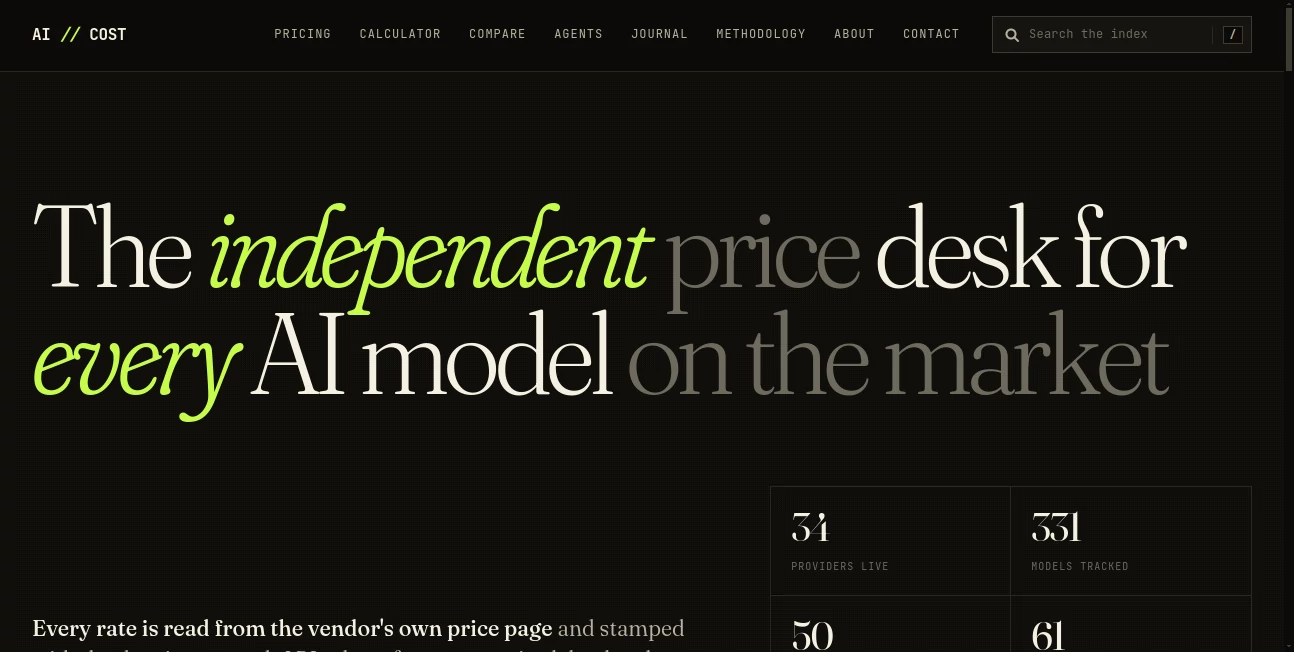
The independent price desk for every AI model on the market

Screenshot of AI // COST – An AI tool in the ,Large Language Models (LLMs) ,AI Research Tool ,AI Analytics Assistant ,Other  category, showcasing its interface and key features.

What is AI // COST?

AI model pricing changes quickly, and keeping track of what you are actually paying can become surprisingly difficult. Different providers use different token rates, caching discounts, output charges, subscription models, and pricing structures. AI//COST brings this information into one independent place, making it easier to compare models and understand what an AI workload may really cost.

The platform describes itself as an independent price desk for AI models and currently tracks hundreds of models across major providers. Its focus is not simply on listing prices. It combines pricing information with comparisons, capability research, calculators, historical changes, and practical editorial analysis.

For developers choosing an API, businesses planning an AI project, or anyone trying to compare the economics of different models, having current pricing in one searchable location can save a considerable amount of research time.

Key Features

  • Detailed pricing information for hundreds of AI models.
  • Coverage of major AI providers including OpenAI, Google, Anthropic, Mistral, DeepSeek, and other vendors.
  • Side-by-side model comparisons with pricing and use-case analysis.
  • Interactive calculators for estimating AI API costs.
  • Token counting and cost estimation across different models.
  • Subscription versus API cost comparisons.
  • Historical pricing information and records of model price changes.
  • Capability Q&A based on tested outputs and supporting evidence.
  • Research and editorial content covering AI pricing and cost optimization.
  • Pricing data verified against vendor-published sources.

User Interface

The interface is designed around discovery. Users can search for models, browse providers, open individual pricing pages, compare different options, or move directly to the calculator section. The navigation separates pricing, comparisons, agents, research, and editorial content, which makes the growing amount of information easier to explore.

The pricing section is particularly useful for users who already know which provider or model they are considering. Instead of navigating through numerous vendor documentation pages, they can start with a centralized overview and then inspect the underlying pricing details.

The presentation is relatively straightforward rather than overloaded with unnecessary visual elements. That works well for a tool where the main objective is finding accurate numbers quickly.

Accuracy & Performance

Pricing information is one of the areas where outdated AI directory data can become a real problem. A price that was correct a few weeks ago may no longer represent the current API rate. The platform addresses this by stating that pricing is manually verified against vendors' canonical pricing pages and that verification dates are attached to the data.

The methodology also distinguishes between published prices and figures that need to be inferred or calculated. This approach gives users more context when comparing effective rates rather than treating every number as if it came directly from a vendor.

The platform also keeps track of pricing changes. Recent entries show model repricing events and new model launches, giving users a useful indication of how quickly the AI pricing market can move.

Capabilities

The platform goes beyond a conventional AI model directory. Its pricing hub contains individual model information, while the comparison section focuses on head-to-head evaluations. The capability section answers practical questions about what different models can actually do.

The calculator collection adds another useful layer. Users can estimate monthly API spending, count tokens, compare subscription plans with API usage, and examine other cost scenarios. These tools are particularly valuable when a project is moving from experimentation toward a production workload.

The comparison pages can also help when the decision is not simply about choosing the cheapest model. Cost needs to be considered alongside capability, performance, context size, and the requirements of a particular workflow.

Security & Privacy

The platform is primarily a pricing and research resource rather than an AI processing service that requires users to upload sensitive business information. Its calculators are intended for cost estimation and can be used without creating an account for the basic tools.

The website also explains that its pricing research is based on publicly available vendor information and that the published figures are checked against official pricing sources. Users should still review the privacy and terms pages before submitting any information through optional services or contact forms.

Use Cases

Developers choosing an API: A developer can compare several models before integrating one into an application. Looking at input and output rates together can provide a more realistic picture than checking a single headline price.

Startups estimating AI expenses: Before launching an AI-powered product, a startup can use cost calculators to estimate monthly usage and explore how different models might affect operating expenses.

Businesses comparing providers: Companies evaluating multiple AI vendors can use the pricing hub and comparison pages as a starting point for procurement research.

AI engineers optimizing workloads: When an existing application becomes expensive, model pricing and historical changes can help engineers investigate whether switching models, adjusting usage patterns, or changing the workload architecture could reduce costs.

Researchers and AI enthusiasts: The combination of pricing data, capability tests, comparisons, and editorial material makes the platform useful for following changes across the rapidly evolving model market.

Teams planning production workloads: Cost estimation becomes especially important when moving from a small prototype to thousands or millions of API calls. The calculators provide a practical way to model that transition before committing to a particular provider.

Pros and Cons

Pros

  • Centralizes AI model pricing from many providers.
  • Pricing information is presented with verification dates.
  • Includes practical calculators rather than only static pricing tables.
  • Provides model-to-model comparisons.
  • Tracks pricing changes and new model releases.
  • Useful for both technical and business-oriented AI cost research.
  • Basic calculator functionality can be accessed without registration.
  • Editorial rankings are separated from paid placements according to the site's stated methodology.

Cons

  • The amount of information can feel extensive for someone looking for only one model price.
  • Some planned sections and calculators are still marked as coming soon.
  • Pricing information can change after a vendor updates its own rates, so users should always check the latest verification date for important purchasing decisions.
  • It is primarily a research and cost intelligence platform rather than a complete AI development environment.

Pricing Plans

The core pricing research and calculator experience is designed to be accessible without a traditional subscription requirement. The calculator section states that its tools can be used without signup or a paywall, making it possible to investigate AI costs before committing to a paid service.

The platform also offers additional services around AI cost planning and optimization. These include personalized workload planning, expert sessions, and more advanced cost-management offerings. The exact availability and pricing of these services can change as the platform develops.

For users who only need to compare model prices or perform basic calculations, the free resources are likely to be the most useful starting point. Businesses with larger AI workloads may benefit from exploring the more advanced planning and cost-management options.

How to Use It

Start by searching for the AI model or provider you are interested in. Open the relevant pricing page and review the input, output, context, caching, or other applicable rates. Pay attention to the verification date, especially when making a purchasing or architecture decision.

Next, use the comparison section if you are deciding between multiple models. Look beyond the lowest price and consider the intended workload, performance requirements, context limits, and capabilities.

For a more practical estimate, open one of the cost calculators. Enter the expected usage and compare the resulting costs across different models. For example, a developer building a customer-support application could estimate monthly token consumption before selecting the model that will power the application.

Finally, use the research and journal sections to understand pricing changes, optimization techniques, and developments that could affect the economics of an AI project.

Comparison with Similar Tools

Traditional AI directories are usually designed to help people discover applications, while AI model documentation is generally focused on explaining how to use a particular provider. This platform occupies a different position by concentrating heavily on the economics of AI models.

Compared with a simple pricing table, it offers more context through calculators, comparisons, historical pricing information, and capability research. Compared with a general AI directory, its strength is depth around model costs rather than the number of consumer-facing applications listed.

That makes it particularly useful when the question is not simply “Which AI tool should I use?” but “Which model makes financial and technical sense for this workload?”

Conclusion

Choosing an AI model is no longer only about finding the model with the best benchmark score. For production applications, pricing can have a direct effect on margins, infrastructure decisions, and the long-term viability of a product.

This platform provides a practical destination for understanding that side of the AI ecosystem. Its combination of verified pricing, model comparisons, calculators, capability research, and pricing history gives users more information than a conventional model list.

Whether you are experimenting with your first API or planning a large AI workload, having a current view of model costs can make the decision considerably easier. The platform is especially compelling for developers, startups, and businesses that want to evaluate AI options with actual numbers rather than relying on assumptions.

Frequently Asked Questions (FAQ)

What is this platform used for?

It is primarily used to research AI model pricing, compare models, estimate API costs, investigate capabilities, and follow changes in the AI pricing market.

Does it cover multiple AI providers?

Yes. The platform tracks models from numerous major providers, including companies such as OpenAI, Google, Anthropic, Mistral, DeepSeek, and others.

Can I calculate AI API costs?

Yes. The calculator section includes tools designed to estimate spending across different AI models using current pricing data.

Is registration required?

The basic calculator tools are available without signup, according to the site's current calculator documentation.

How is pricing information verified?

The platform states that pricing is checked against vendors' own canonical pricing pages and that the data includes verification dates. Some calculated or inferred figures are identified separately.

Can I compare two AI models?

Yes. The comparison section provides head-to-head evaluations that combine pricing information with benchmarks and use-case considerations.

Does the platform only show model prices?

No. It also provides calculators, capability research, comparisons, historical pricing information, and editorial articles focused on AI models and cost optimization.

Who can benefit from using it?

Developers, startups, AI product teams, researchers, businesses, and anyone comparing the cost and capabilities of different AI models can benefit from the platform.


AI // COST has been listed under multiple functional categories:

Large Language Models (LLMs) , AI Research Tool , AI Analytics Assistant , Other .

These classifications represent its core capabilities and areas of application. For related tools, explore the linked categories above.


AI // COST details

Pricing

  • Freemium

Apps

  • Web App

Categories

AI // COST | submitaitools.org