


















Bytesalt
What is Bytesalt?
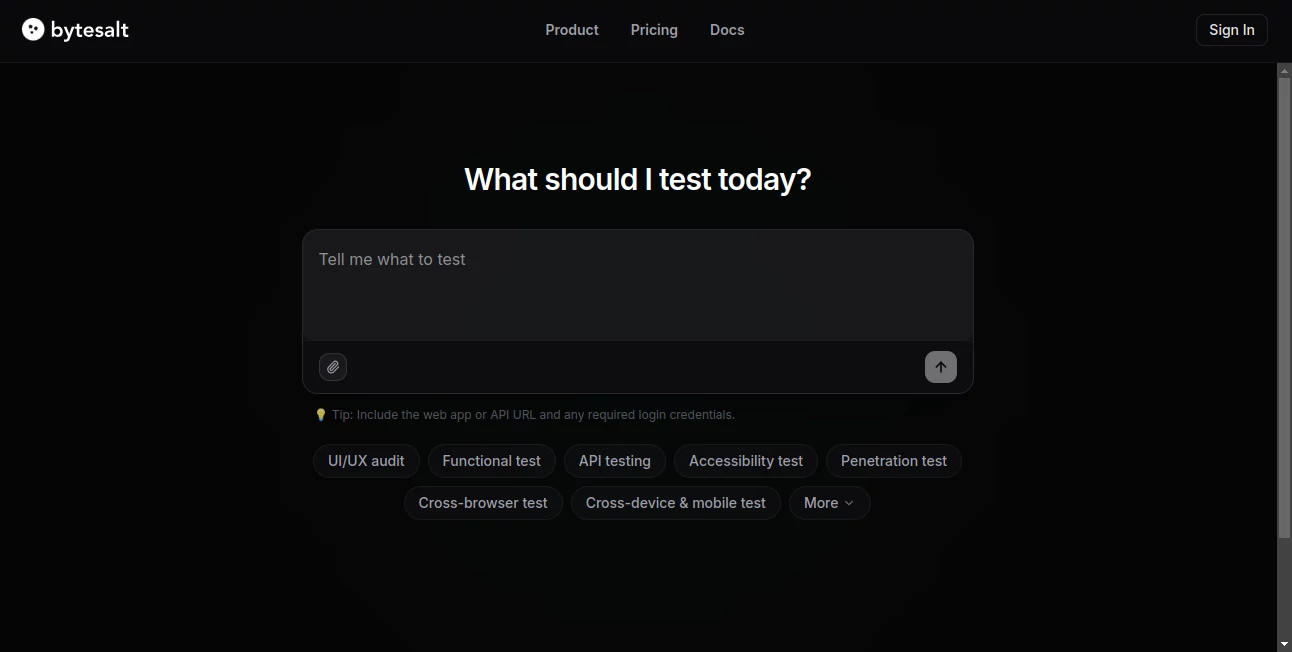
Modern software moves fast, and quality assurance has to keep pace. Traditional automated testing is excellent at verifying expected behaviors, but it often misses the unexpected issues that appear only when real users interact with an application. This platform introduces a smarter approach by combining autonomous AI agents with modern testing workflows, allowing development teams to uncover hidden bugs long before customers experience them.
Instead of spending days creating and maintaining complex test scripts, teams simply describe the feature, workflow, or API they want to validate. Parallel AI agents then explore the application like real users, examining usability, functionality, accessibility, security, and performance from multiple perspectives. The result is faster releases, stronger software quality, and dramatically reduced manual QA effort.
Whether you're developing SaaS products, enterprise applications, APIs, or eCommerce platforms, this solution adds an intelligent judgment layer that complements existing automation frameworks rather than replacing them.
Key Features
User Interface
The dashboard is designed with simplicity in mind. Creating a new testing session requires only a plain-English description of the desired workflow, eliminating the steep learning curve associated with traditional automation frameworks. Reports are organized clearly, making it easy for developers, testers, and product managers to collaborate around discovered issues.
Accuracy & Performance
Instead of following fixed scripts alone, multiple AI agents evaluate an application simultaneously from different viewpoints. This parallel execution significantly reduces testing time while increasing bug discovery across complex workflows, user journeys, browser variations, and mobile experiences.
Capabilities
- Autonomous UI and UX testing
- Regression testing for evolving applications
- Accessibility auditing following WCAG guidelines
- Security analysis for common vulnerabilities
- Cross-browser compatibility testing
- Cross-device and mobile validation
- Backend API testing
- Natural language test creation
- Parallel AI-powered execution
- Human-readable issue reports with suggested fixes
- CI/CD integration through CLI
- Support for modern web applications and distributed systems
Security & Privacy
Security remains an important part of the testing workflow. Private tunneling enables organizations to safely evaluate localhost or staging environments without exposing internal infrastructure. The platform also performs automated security analysis to identify common weaknesses and potential vulnerabilities before software reaches production.
Use Cases
- Testing newly released application features before deployment.
- Automating regression testing during continuous integration pipelines.
- Auditing accessibility compliance for enterprise applications.
- Performing UX reviews to discover friction points affecting conversions.
- Validating backend APIs with intelligent exploration.
- Running cross-browser and mobile compatibility checks.
- Supporting QA teams with AI-assisted exploratory testing.
- Helping startups release products faster without building large QA departments.
Pros and Cons
Pros
- Natural language eliminates complex test scripting.
- Parallel AI agents dramatically reduce execution time.
- Works alongside existing automation frameworks.
- Excellent coverage for UI, API, accessibility, and security testing.
- Detailed reports include causes, impact, and recommendations.
- Easy integration into modern DevOps pipelines.
- Suitable for organizations of different sizes.
Cons
- Advanced enterprise features require higher-tier plans.
- Best results are achieved when combined with existing deterministic testing.
- Organizations new to AI-powered QA may require time to adapt their workflows.
Pricing Plans
A free plan allows new users to explore the platform with limited credits and no credit card requirement. The Starter plan is designed for production environments and includes additional monthly credits, faster execution through more parallel agents, and automatic credit top-ups. Enterprise pricing is customized for organizations requiring dedicated support, advanced security, SSO, and tailored service agreements.
How to Use Bytesalt
Getting started is refreshingly straightforward.
- Create an account and access the testing dashboard.
- Enter the URL of your application or API.
- Describe the workflow or feature you want to validate using plain English.
- Launch the testing process.
- Allow multiple AI agents to explore the application simultaneously.
- Review detailed reports containing detected issues, evidence, impact analysis, and suggested fixes.
- Integrate the workflow into your CI/CD pipeline for continuous software validation.
Comparison with Similar Tools
Many QA automation platforms focus on deterministic testing, requiring engineers to build and maintain large collections of scripts. While these solutions remain valuable for validating expected scenarios, they often struggle to uncover unexpected edge cases.
This platform distinguishes itself by introducing AI-powered exploratory testing that complements existing frameworks such as Playwright, Selenium, and Cypress. Rather than replacing established workflows, it expands testing coverage with intelligent agents capable of identifying usability issues, accessibility concerns, security risks, and complex workflow failures that scripted automation may never encounter.
Its combination of natural language testing, parallel execution, and actionable reporting makes it particularly attractive for agile development teams seeking faster release cycles without sacrificing software quality.
Conclusion
Software quality increasingly depends on finding problems before users do. By combining autonomous AI agents with modern development practices, this platform offers an efficient way to strengthen QA processes without dramatically increasing engineering effort.
Its ability to perform intelligent exploratory testing, security analysis, accessibility auditing, API validation, and UX evaluation within a unified workflow makes it a valuable addition to modern software development teams. Organizations looking to accelerate releases while improving application reliability will find it to be a practical and forward-thinking testing solution.
Frequently Asked Questions (FAQ)
What makes this AI testing platform different from traditional automation?
It combines deterministic testing with AI-powered exploratory testing, allowing autonomous agents to discover issues beyond predefined test cases.
Can it work with existing testing frameworks?
Yes. It complements popular automation frameworks instead of replacing them, providing broader testing coverage.
Does it support API testing?
Yes. Both web applications and backend APIs can be evaluated using natural language testing objectives.
Is it suitable for CI/CD pipelines?
Absolutely. CLI support allows seamless integration into continuous integration and deployment workflows.
Who benefits the most from this platform?
Software developers, QA engineers, DevOps teams, startups, and enterprise engineering organizations seeking faster releases and improved software quality.
AI Testing & QA , AI Code Assistant , AI Developer Tools , AI DevOps Assistant .
These classifications represent its core capabilities and areas of application. For related tools, explore the linked categories above.

Bytesalt Alternatives Product

Project Mela
Kimi K2.5

OGimage
JSON to TOON…

Luma AI

Prelight

BootstrapKing

ClawBridge

Nestify
