
CheaterBuster
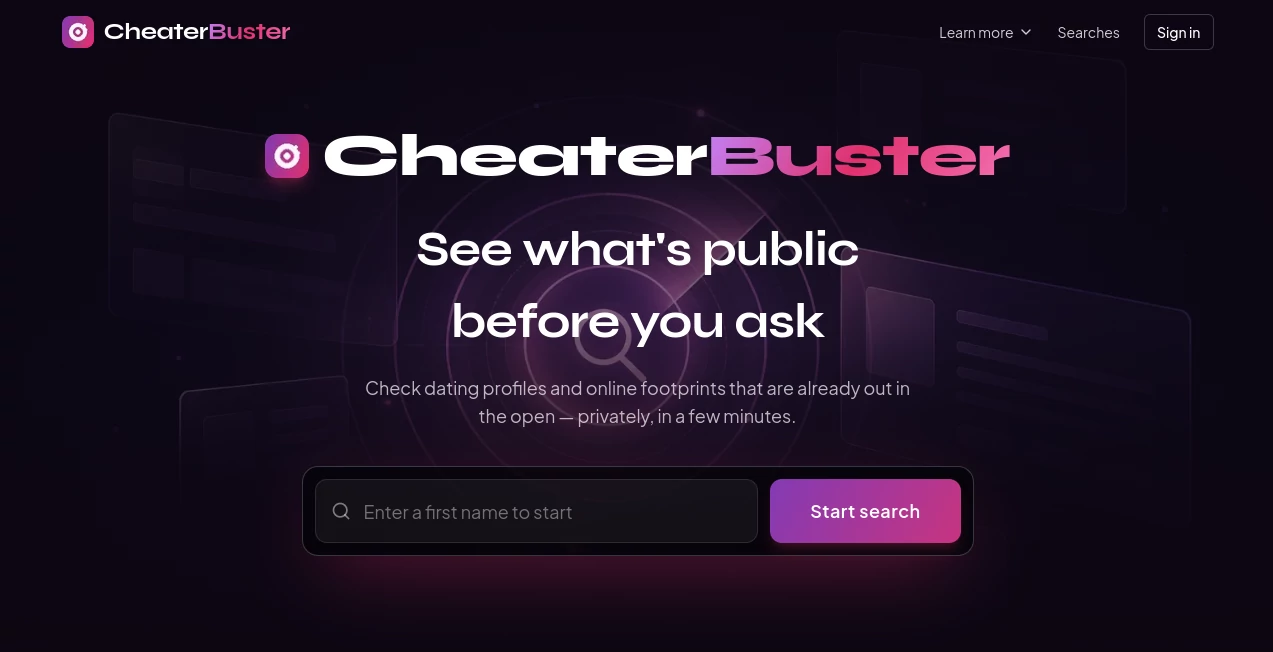
What is CheaterBuster?
When something feels unclear in a relationship, searching through dozens of dating platforms, social pages, and public websites can quickly become frustrating. CheaterBuster is designed to make that process more organized by bringing publicly available dating profiles, social footprints, and open-web mentions into one structured search.
The service is built for adults who want context rather than speculation. A typical search can use a first name, age range, location, and optional photo or known username to narrow down potential matches. Instead of simply returning a yes-or-no answer, the platform presents candidate profiles, source information, and a plain-language summary that users can review before drawing their own conclusions.
One particularly useful aspect is the emphasis on verification. A matching name or similar photograph is not automatically treated as proof that two profiles belong to the same person. This makes the experience more practical for situations where common names, old profiles, or lookalikes could otherwise create misleading results.
Key Features
- Search across publicly indexed dating profiles and online footprints.
- Search using first name, age range, and location.
- Optional face and photo matching for additional filtering.
- Support for known usernames or handles as search clues.
- Results organized into a readable report with sources.
- Plain-language risk summaries to help users understand findings.
- Ongoing monitoring for changes in eligible searches.
- Public-data-only approach without accessing private messages or passwords.
User Interface
The interface is intentionally straightforward. Rather than forcing users through a complicated investigation process, the initial flow focuses on a few pieces of information that can make a public search more precise. Entering a name is the starting point, while age, location, a photo, or a known handle can provide additional context.
The results are presented in a way that makes them easier to review. Sources, possible matches, and relevant signals are grouped together instead of leaving users to piece information together from separate browser tabs. For someone who has never used a public-profile search service before, that simplicity is a genuine advantage.
Accuracy & Performance
Search quality depends heavily on the information supplied. A common first name on its own can produce a much wider candidate pool than a name combined with an approximate age and city. Adding a clear photograph or distinctive username can further narrow the possibilities.
The underlying process works by comparing overlapping public signals and filtering weaker matches. This is important because public searches naturally contain false positives. Two people can have the same name, similar ages, or even surprisingly similar photographs.
The service therefore treats a match as a possible public footprint rather than definitive proof of identity or behavior. That distinction is one of the more responsible aspects of the overall experience.
Capabilities
The platform goes beyond a simple dating-profile lookup. It can examine publicly indexed dating-related pages, social footprints, open forum and blog mentions, and reverse-image matches on public pages. Search inputs can include a person's name, age range, location, optional photo, and known handles.
The search process can be thought of as four stages: collecting the available clues, querying public indexes, scoring and filtering potential matches, and assembling the results into a report. Stronger combinations of information generally make the final results easier to evaluate.
Another useful capability is monitoring. Instead of treating a search as a one-time event, eligible searches can be monitored for newly observed changes, giving users a way to revisit the situation over time.
Security & Privacy
Privacy is an important part of the service's positioning. Searches focus on information that is already publicly accessible rather than private accounts or restricted communications. The platform states that it does not open private messages, hack passwords, access non-public GPS or phone records, or retrieve information hidden behind inaccessible login areas.
The person being searched is not notified when a search is performed. At the same time, users should remember that public information can still be sensitive. Searches should be limited to adults and used responsibly, without harassment, stalking, threats, or attempts to expose someone's private information.
Most importantly, a search result should be treated as a starting point for verification. An old profile, a stolen photograph, or a person with the same name can all create misleading results.
Use Cases
One of the clearest use cases is checking whether a public dating profile may exist when someone wants to better understand an online presence. Instead of manually searching individual services, users can start with a focused set of identifying details and review the resulting public signals in one place.
It can also be useful for investigating potentially reused photographs. A clear image combined with location or identity clues can help separate an actual profile from unrelated people who happen to share a name.
Another practical scenario is ongoing monitoring. If a user has already found a relevant public footprint, recurring updates can make it easier to notice changes without repeating the entire investigation manually.
For example, someone searching for a person named Alex in a large city may initially receive many possible matches. Adding an approximate age, a known username, and a suitable photograph can significantly reduce the number of plausible candidates. The important step is still manual verification before treating any result as meaningful.
Pros and Cons
- Pros: Focused public-profile searching, multiple search signals, optional photo matching, organized reports, source information, privacy-conscious design, and ongoing monitoring options.
- Pros: The service clearly distinguishes a possible public match from proof of cheating or dishonest behavior.
- Pros: Users do not need to manually search multiple public sources one by one.
- Cons: Results depend on what is publicly indexed and available to the search system.
- Cons: Common names and weak identifying information can increase the chance of false positives.
- Cons: An empty result does not prove that a person has no dating profile or online activity.
- Cons: Searches are intended for adults and should be used with appropriate privacy and legal considerations.
Pricing Plans
The service operates as a paid search platform rather than offering unlimited free investigations. Pricing and available subscription options can depend on the current offering and checkout configuration, so users should review the plan presented before completing a purchase.
The value proposition is mainly based on saving time. Instead of manually checking multiple public sources and attempting to connect potentially related profiles, users pay for a structured search process that brings relevant public signals together and presents them in a more convenient format.
How to Use [Tool Name]
Using the platform is relatively simple. Start by entering the person's first name. Add an approximate age and likely location when available, since these details can substantially improve the quality of the search. A suitable photo or known username can also be added when the search supports those inputs.
Once the search is submitted, the system examines relevant public sources and filters potential matches based on overlapping information. The resulting report can include candidate profiles, source links, and contextual information about the match.
Do not stop at the first result. Check whether multiple independent details agree, such as the person's appearance, location, age, username, or other publicly visible information. If the evidence does not line up, keep the result unresolved rather than assuming it is the same person.
Comparison with Similar Tools
Traditional search engines are useful for finding public webpages, but they usually require users to manually combine names, locations, usernames, photographs, and dating-related searches. Reverse-image services are particularly useful for finding reused photographs, but they are not designed specifically around dating-profile discovery.
Dedicated people-search services may cover broader public-record information, while dating-focused search platforms concentrate more heavily on dating profiles and related online signals. The main advantage here is the combination of several public-search clues within one workflow.
The biggest difference is therefore not simply the number of sources searched. It is the way the information is organized. A structured report can save considerable time for users who would otherwise have to open numerous pages and decide for themselves whether separate results might belong to the same individual.
Conclusion
For anyone trying to understand a person's public dating footprint, the platform offers a more focused alternative to hours of scattered manual searching. Its combination of name, age, location, optional photo matching, public-source discovery, and structured reporting makes the process considerably easier to navigate.
Its strongest quality is perhaps the emphasis on context. A search result is not presented as an automatic verdict, and that is important when dealing with information that can easily be misunderstood. Users still need to verify identities, consider whether profiles are old or inactive, and think carefully about what a particular result actually means.
Used responsibly, it can turn a vague online search into a more organized process: provide useful clues, examine public evidence, review the sources, and make the final judgment yourself.
Frequently Asked Questions (FAQ)
What information can I use for a search?
A typical search can use a first name, approximate age, and location. Depending on the available search options, users can also provide a photo or known username to improve matching.
Does the service access private messages?
No. The service is designed around publicly available information and does not access private messages, passwords, non-public GPS records, or other private account information.
Will the person know that I searched for them?
The service states that it does not notify the person being searched when a public-data search is performed.
Does a matching profile prove that someone is cheating?
No. A match only indicates that a potentially relevant public footprint was found. It does not by itself prove cheating, intent, current activity, or even that the profile belongs to the person being searched.
Can the search produce false positives?
Yes. Common names, similar-looking people, old profiles, stolen photographs, and incomplete public information can all lead to incorrect matches. Users should verify multiple independent details before reaching a conclusion.
What happens if no profile is found?
An empty result simply means that the system did not find a sufficiently confident public footprint within the sources it could access. It does not prove that the person has never used a dating service or has no online presence.
Can searches be monitored over time?
Eligible searches can include ongoing monitoring, allowing the system to check for newly observed changes and provide updated information through the user's account.
Who should use the service?
The service is intended for searches involving adults aged 18 and over. It should be used responsibly and never for harassment, stalking, threats, or attempts to expose private information.
AI Life Assistant , AI Research Tool , AI Dating Assistant , AI Search Engine .
These classifications represent its core capabilities and areas of application. For related tools, explore the linked categories above.

CheaterBuster Alternatives Product

ChatFlowchart

Flyback.ai

Sourcetable

Reverse Imag…

igrecent

Semantic SEO…

lovetype16

Prelight

Harvey